
Introduction
Sometimes, business owners decide to close a company because it never started properly or because operations stopped long ago. In such cases, the strike off process gives them a practical legal route to shut the company down.
In simple words, strike off means removing the company’s name from the official records. Once the authority completes the process, the company stands closed. However, owners must follow the legal procedure carefully. Otherwise, the authority may delay, question, or reject the application.
Therefore, before starting the process, business owners should understand the eligibility conditions, required documents, and legal steps involved.
What Does Strike Off Mean?
Strike off is the legal process through which a company removes its name from the Register of Companies. After approval and publication of the final notice, the company stands dissolved.
However, strike off does not erase past responsibilities. If the company has unpaid dues, legal issues, or non-compliance, the persons responsible may still have to answer for them. So, while strike off offers a lawful closure route, it does not allow anyone to escape earlier liabilities.
Which Companies Can Apply for Strike Off?
A company can usually apply for strike off in the following situations:
1. The company did not start business
If the company failed to commence business within the prescribed period, it may qualify for strike off.
2. The company has become inactive
If the company has not carried on business or operations for a long time and does not plan to continue, it may use this route.
3. The promoters want voluntary closure
If the promoters no longer wish to continue the company and the company has no active business, they may apply for strike off after meeting the required conditions.
In short, strike off mainly suits a company that has stopped functioning and has no genuine plan to continue in the future.
When Can a Company Not Apply?
A company cannot use the strike-off route in every case. The law restricts this option in certain situations.
For example, the company should not have recently made major changes such as changing its name, shifting its registered office from one state to another, or disposing of property outside the closure process. Likewise, if the company is facing certain legal proceedings, winding-up action, or similar complications, it may not qualify for strike off.
Therefore, the company should first check its eligibility before preparing the application.
Key Conditions Before Filing the Application
Before filing for strike off, the company should put its records and affairs in proper order.
Complete pending ROC filings
The company should file overdue annual returns and financial statements up to the relevant financial year in which it stopped business. Pending filings often create the biggest obstacle in the strike-off process.
Clear liabilities
The company should settle creditors, statutory dues, and other obligations. If liabilities still exist, the authority may refuse the closure request.
Stop business activities
The company should not carry on active business at the time of filing. Strike off is meant for closure, not for an ongoing business.
Obtain proper approvals
The Board of Directors and the shareholders must approve the closure in the prescribed manner before filing the application.
Which Form Is Used for Strike Off?
For voluntary closure, the company generally files Form STK-2. This form is the main application used to remove the company’s name from the register.
The prescribed government fee for filing STK-2 is ₹10,000. Therefore, the company should keep the supporting documents ready before filing the form.
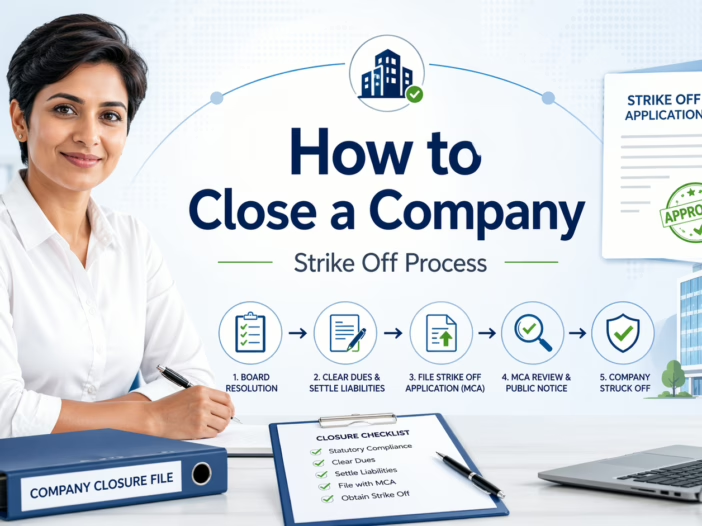
Step-by-Step Strike Off Process
Step 1: Hold a Board Meeting
First, the directors should hold a Board Meeting. During this meeting, they should decide to apply for strike off and authorise one director to sign and file the necessary forms and documents.
This step matters because only a properly authorised person can file the application.
Step 2: Clear Pending Compliance
Next, the company should review all pending ROC filings, tax matters, and internal records. If annual returns or financial statements remain pending, the company should complete them first.
At the same time, the company should stop all business activity and align its records with the closure position.
Step 3: Settle Liabilities
After that, the company should pay off creditors, statutory dues, employee dues, and other outstanding amounts. If immediate payment is not possible in full, the company should at least make proper provision for discharge.
This step is important because the strike-off route is meant for a company that has already settled its affairs responsibly.
Step 4: Obtain Shareholders’ Approval
Then, the company should take approval from its members. Normally, it does this by passing a special resolution or obtaining the required consent based on paid-up share capital.
Without shareholder approval, the closure process remains incomplete.
Step 5: Prepare the Required Documents
Once approvals are in place, the company should prepare the required documents. These generally include:
Indemnity Bond
Each director gives an indemnity in the prescribed format.
Affidavit
Each director also gives a declaration in the prescribed form.
Statement of Accounts
The company must prepare a statement of accounts showing its financial position. Usually, this statement should not be older than 30 days from the date of filing, and a Chartered Accountant should certify it.
Copy of Board and Shareholders’ Approval
The company should also attach proper authorisation records and approval documents.
If the company falls under a regulated sector, it may also need a no-objection document from the concerned authority.
Step 6: File Form STK-2
After preparing all documents, the company files Form STK-2 online along with the prescribed attachments and fee.
Usually, a practising professional such as a Chartered Accountant, Company Secretary, or Cost Accountant certifies the form, wherever required.
Step 7: Scrutiny by the Authority
After filing, the authority examines the application. At present, the centralised mechanism known as C-PACE handles voluntary closure applications to make the exit process faster and more streamlined.
During scrutiny, the authority may also check whether tax authorities or other departments have any objections.
Step 8: Public Notice and Final Closure
If the authority finds the application proper, it issues a public notice. If no valid objection is received and the authority remains satisfied, it strikes the company’s name off the register.
After publication of the final notice, the company stands dissolved. In simple terms, the company becomes legally closed.
How Long Does the Strike Off Process Take?
There is no single fixed timeline for every case. The process depends on document quality, pending filings, objections, and resubmissions, if any.
However, centralised handling through C-PACE has made the process faster than before. So, if the company maintains clean records and submits proper documentation, the closure usually moves more smoothly.
Important Points to Remember
Strike off is not for active companies
If the company is still carrying on business, this route may not be suitable.
Pending filings can delay the case
Many applications get delayed because the company has not updated annual returns and financial statements.
Old liabilities do not vanish automatically
Even after dissolution, responsible persons may still have to answer for past liabilities.
Proper documentation is essential
Missing affidavits, incorrect accounts, or weak paperwork can slow down or block the process.
Common Mistakes to Avoid
Business owners often make these mistakes during strike off:
- filing the application without clearing pending ROC filings
- applying while liabilities still exist
- using an outdated statement of accounts
- ignoring shareholder approval requirements
- assuming the company can close without proper internal resolutions
- treating strike off as a shortcut instead of a legal process
Therefore, owners should prepare the case carefully before filing.
Can a Struck-Off Company Be Restored?
Yes, in certain situations, the law allows restoration of a struck-off company. This usually happens when an aggrieved party, creditor, member, or authority approaches the Tribunal and shows valid grounds for restoration.
So, even after strike off, the matter may reopen if proper legal reasons exist.
Conclusion
Strike off is one of the most practical ways to close an inactive company in India. Although it is simpler than a full winding-up process, it still requires careful compliance.
To complete the process properly, the company should stop business, clear pending filings, settle liabilities, take approvals, prepare the required documents, and then file Form STK-2. After that, it must follow the legal process until the authority issues the final closure notice.
In short, if a company has become inactive and the owners want a lawful exit, strike off can be the right solution. However, they should handle the process carefully from the beginning so they can avoid delays and close the company in a clean and professional manner.
FAQs
1. What is strike off of a company?
Strike off means legally removing the company’s name from the Register of Companies so that the company can be closed.
2. Which form is used for company strike off?
For voluntary closure, the company generally files Form STK-2.
3. What is the government fee for STK-2?
The filing fee is ₹10,000.
4. Is shareholder approval required for strike off?
Yes. The company must obtain the required member approval before filing the application.
5. Can I apply for strike off if annual filings are pending?
Usually, the company should complete overdue annual filings first. Pending filings often delay or prevent the application.
6. Can a company with liabilities apply for strike off?
The company should settle liabilities or make proper provision for their discharge before closure.
7. How long does strike off take?
There is no fixed timeline for every case, but the process is now faster under C-PACE than it was earlier.
8. Can a struck-off company be revived?
Yes. In certain cases, the law allows restoration through the legal process.