
Introduction
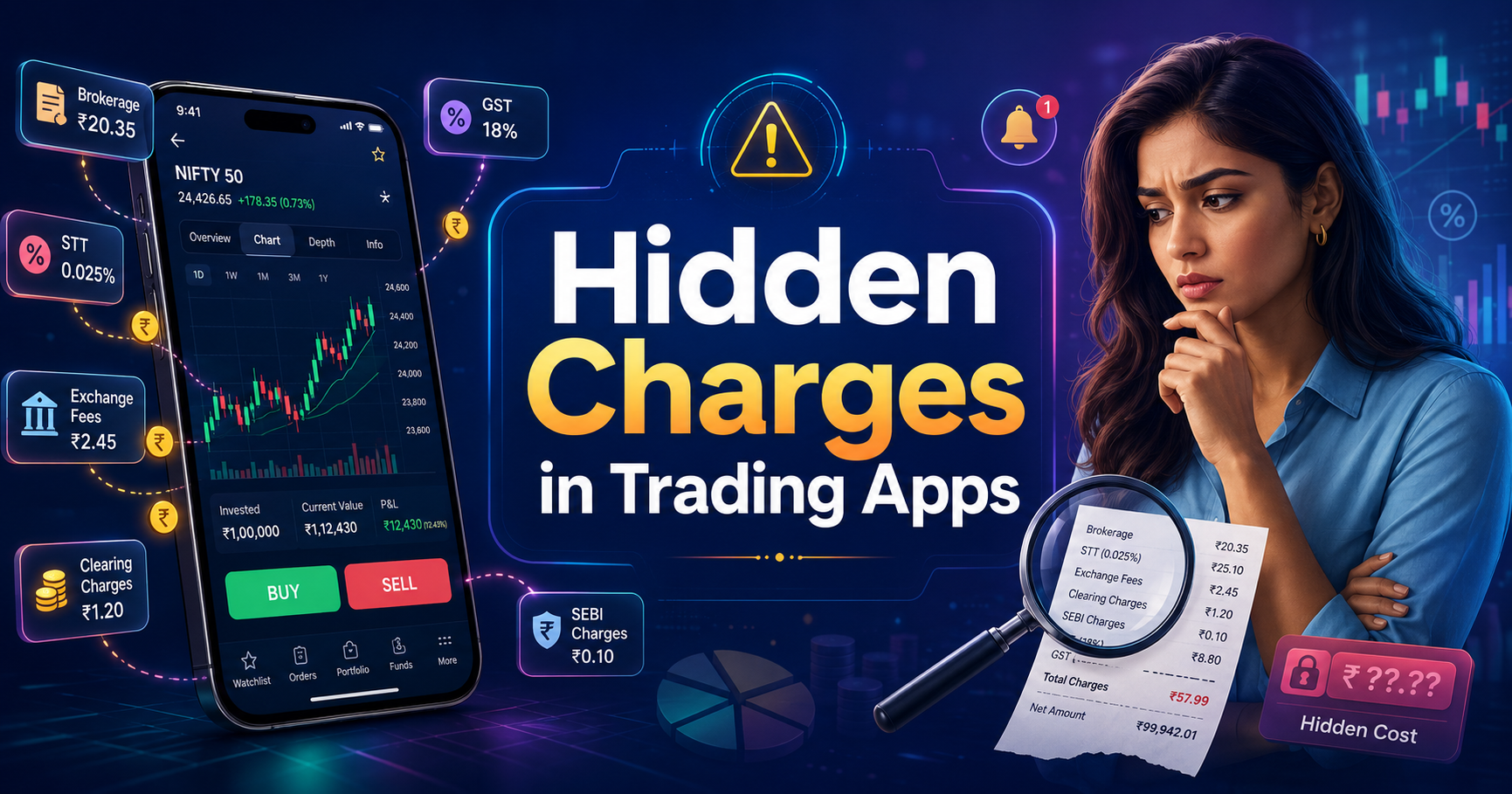
Trading apps have made investing easier than ever. Today, people can open an account, add money, and buy or sell investments in just a few taps. Because of that, many apps promote low-cost trading and sometimes even say that trading is free. However, the real cost is often higher than it looks at first. A platform may charge little or no brokerage, yet your trade can still include taxes, exchange-related fees, depository charges, auto square-off charges, currency conversion costs, or wider buy-sell spreads.
As a result, many investors focus only on the visible brokerage and ignore the total cost of trading. That can be a mistake. Even small charges can reduce your return over time. Therefore, before using any trading app, it is important to understand where these hidden costs may appear and how they affect your profit.
Why hidden charges matter
At first, a small fee may not look important. However, when you trade often, these costs can add up quickly. As a result, they may reduce your profit and sometimes even turn a good trade into a poor one. That is why smart investors do not look only at brokerage. Instead, they check the full cost of the trade.
Why zero brokerage does not mean free trading
Many investors think zero brokerage means zero cost. In reality, that is usually not true. It often means only one fee has been reduced or removed. Other charges may still apply in the background. So, even if the app does not charge a direct commission, you may still pay taxes, transaction charges, service-related taxes, depository fees, or product-specific charges.
Therefore, it is always better to ask one simple question: what is my total cost for entering and exiting this trade?
1. Regulatory and statutory charges
In many countries, some trading costs are compulsory. These charges do not go away even if an app offers free trading. They may include transaction taxes, regulatory levies, exchange charges, and stamp-type duties, depending on the market.
Because of this, free trading is often not truly free. These charges may not look large at first, but they still form an important part of the overall cost.
2. Service taxes on trading-related fees
Another cost many users miss is tax on the services connected to trading. This is not always charged on the full value of the trade itself, but it may apply to brokerage, transaction-related services, or other operational charges collected by the platform.
As a result, even when the basic trading fee looks low, the final bill can still be higher than expected. So, whenever you review a contract note or trade statement, check whether service tax has been applied on the charges listed there.
3. Depository or custody-related charges
If you hold investments in electronic form, you may also face depository or custody-related charges. These often appear when you sell holdings from your account, not when you buy them. Because of that, many first-time investors do not notice them until later.
This type of charge is common in markets where a depository system is used to hold securities in electronic form. Therefore, if you are a long-term investor who buys and later sells shares from holdings, this is one of the most important hidden costs to watch.
4. Platform and maintenance fees
Many apps no longer depend only on old-style brokerage income. Instead, they use subscription models, maintenance fees, research packages, advanced chart plans, or premium account services. At first, these charges may look small. However, over time, they can become meaningful, especially for small investors or occasional traders.
So, before using any app, check whether it charges monthly or annual fees even when you trade very little.
5. Auto square-off and assisted-trade charges
Some platforms charge extra when they close an open intraday position automatically. This usually happens when the user does not exit before the cut-off time. Likewise, some brokers charge more if an order is placed by phone or with dealer assistance instead of through the app.
These costs are easy to miss because they do not affect every trade. Even so, they can matter a lot for active traders. Therefore, anyone doing intraday trading should read these rules carefully before placing orders.
6. Pledge and margin-related charges
Many investors use their holdings as collateral for margin or choose margin-based products to increase buying power. However, leverage is not free. Platforms may charge pledge fees, unpledge fees, financing charges, or interest-like costs depending on the product.
Because of this, a leveraged trade can cost much more than a normal cash trade. So, before using margin, always check both the risk and the extra charges.
7. Payment and fund transfer charges
Adding money to a trading account is not always free. Some apps allow free transfers through one payment method but charge for another. For example, fees may apply on card-based loading, certain gateway methods, or faster withdrawals. These charges may look minor one by one, but they can build up over time.
Therefore, if you move money in and out of your trading account often, review the funding and withdrawal section very carefully.
8. Currency conversion costs
This charge matters a lot in global investing. If you buy foreign stocks, international funds, or any overseas asset, the app may convert your money using an exchange rate that includes a markup. Sometimes the visible fee looks low, but the hidden cost sits inside the conversion rate itself.
As a result, international investors should compare both the fee and the exchange rate, not just the headline claim.
9. Spread: the invisible trading cost
One of the biggest hidden charges is the spread, which is the gap between the buy price and the sell price. This cost may not appear as a separate line item, yet it directly affects your return. If the spread is wide, you may buy at a higher price and sell at a lower price than expected.
This becomes even more important in less liquid assets, small-cap securities, options, and certain fractional or global products. So, even if the app says brokerage is zero, the trade may still be expensive in practice.
10. Changing rules and cost structures
Trading costs do not stay the same forever. Regulators often push for more transparency, better investor disclosure, and stronger compliance. At the same time, brokers may change their pricing models, revise service charges, or introduce new operational fees.
Therefore, investors should not assume that the fee structure they saw once will remain the same forever. Instead, it is wise to review pricing pages, statements, and contract notes regularly.
How hidden charges reduce your profit
Suppose you make a small gain on a trade. That sounds good at first. However, once you subtract transaction taxes, service charges, platform fees, spread cost, and exit-related charges, the actual profit may be much smaller. In some cases, a trade that looked profitable on the screen may not feel profitable after all costs are included.
That is why it is always better to calculate net return, not just gross gain.
How to spot hidden charges before you start
Read the full pricing schedule
Do not depend only on the app advertisement. Instead, read the detailed fee structure from start to finish.
Check contract notes and statements
This is where many hidden charges first become visible. So, make it a habit to review them after trades.
Compare total trading cost
A platform with low brokerage can still be expensive if other costs are high. Therefore, compare the complete cost, not just one line item.
Understand how the app makes money
If a platform offers very cheap trading, ask how it earns revenue. That answer often tells you where the hidden charges may be.
Watch sell-side and leverage-related charges carefully
Many important costs appear only when you sell holdings or use margin-based products. So, do not focus only on the buying stage.
Conclusion
Trading apps have made investing faster and more accessible, which is a positive change. However, lower visible brokerage does not always mean lower real cost. Hidden charges can still come through taxes, transaction-related levies, depository fees, spreads, maintenance charges, payment costs, and leverage-based fees.
Therefore, the right question is not whether the app says trading is free. The right question is whether you understand the full cost of the trade before you place it. Once you understand that, you can make better decisions and protect more of your returns.
FAQs
1. What are hidden charges in trading apps?
Hidden charges are costs that are not always obvious in the app’s main advertisement. These may include taxes, exchange levies, depository charges, spreads, maintenance fees, funding charges, and other service-related costs.
2. Does zero brokerage mean free trading?
No. It usually means only one fee has been removed or reduced. Other charges may still apply.
3. What is the spread in simple words?
Spread is the difference between the buying price and the selling price of an asset. It is an indirect cost of trading.
4. Why do investors often miss these charges?
Because many of them appear only in the detailed statement, contract note, or pricing page, not on the first screen.
5. Are depository charges common?
Yes, in markets that use electronic holding systems, these charges can apply, especially when selling holdings.
6. Can small fees really affect profit?
Yes. Small fees add up over time, especially for frequent traders.
7. Do global trading apps also have hidden charges?
Yes. In global investing, currency conversion costs and wider spreads are common hidden costs.
8. Is margin trading more expensive?
Usually, yes. Margin products may involve pledge fees, financing costs, and other operational charges.
9. Do trading app charges stay the same forever?
No. Fee structures, tax rules, and operational charges can change over time. That is why regular review is important.
10. What is the best way to avoid hidden charges?
Read the full pricing schedule, review trade statements, compare total cost, and understand exactly how the platform earns money.
I can also make this more blog-ready with a stronger intro and ending for your website.