Introduction
The E-Way Bill system plays a vital role in ensuring GST compliance for businesses that transport goods. It enables authorities to track movement efficiently and reduces tax evasion. Moreover, businesses must generate this electronic document when the value of goods exceeds the prescribed limit. Over time, the system has become more structured and technology-driven.
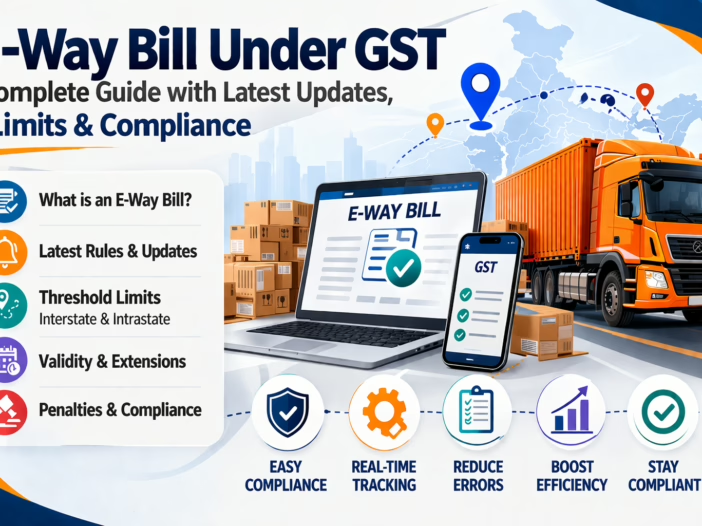
What is an E-Way Bill?
An E-Way Bill is an electronic document generated on the GST portal to record the movement of goods.
It consists of two parts:
Part A – Goods Details
This part captures:
- HSN (Harmonized System of Nomenclature)
- Value of goods
- GSTIN of supplier and recipient
Part B – Transport Details
This part includes:
- Vehicle number
- Transporter ID
Once generated, the system provides a unique E-Way Bill Number (EBN), which authorities can verify during transit.
Latest Updates & Compliance Changes
The government has introduced several important changes to make the system more secure and efficient.
1. Mandatory Multi-Factor Authentication (MFA)
From April 1, 2025, all taxpayers must log in using:
- Username
- Password
- OTP (One-Time Password)
As a result, security has significantly improved.
2. 180-Day Document Limit
Now, you cannot generate an E-Way Bill if:
- The invoice, debit note, or credit note is older than 180 days
This rule prevents misuse of old invoices.
3. Cap on Extensions
Although you can extend an E-Way Bill in case of emergencies (like vehicle breakdown), there is now a limit:
- Maximum extension allowed: 360 days from original generation
4. Case-Insensitive Invoice Matching (IRN Integration)
For businesses using e-invoicing:
- The system treats invoice numbers as case-insensitive
For example:
- “INV01” = “inv01”
This avoids duplicate E-Way Bill generation.
5. Blocking for Non-Filers
If a taxpayer fails to file:
- GSTR-3B or
- CMP-08 (Composition Scheme)
for two consecutive periods, then:
- E-Way Bill generation will be blocked automatically
Therefore, timely return filing is now critical.
Threshold Limits: Interstate vs Intrastate
E-Way Bill applicability depends on the value of goods and type of movement.
Interstate Movement (Across States)
- Mandatory if value exceeds ₹50,000
- Uniform across India
Intrastate Movement (Within State)
Different states have different limits:
- Maharashtra, Delhi, Tamil Nadu, Bihar → ₹1,00,000
- Gujarat → ₹50,000 (with some exemptions)
- West Bengal → ₹50,000 (recently reduced)
- Rajasthan →
- ₹2,00,000 (within city)
- ₹1,00,000 (between cities)
Hence, businesses must always check state-specific rules before transportation.
Validity of E-Way Bill
The validity depends on the type of cargo and distance:
Regular Cargo
- 1 day for every 200 km
Over Dimensional Cargo (ODC)
- 1 day for every 20 km
Extension Rule
If goods cannot reach on time due to:
- Accident
- Vehicle breakdown
- Natural issues
Then:
- You must extend validity within 8 hours before or after expiry
Penalties for Non-Compliance
Non-compliance can lead to serious financial and operational issues.
1. Standard Penalty
- ₹10,000 or
- Tax amount (whichever is higher)
2. Detention and Seizure
If goods are transported without a valid E-Way Bill:
- Owner comes forward → 100% of tax as penalty
- Owner does not come forward → 200% of tax
3. Minor Errors
Small mistakes (like a typo in vehicle number) may attract:
- Reduced penalty of ₹1,000
However, documents must otherwise be correct.
Pro Tips for Businesses
To avoid penalties and ensure smooth compliance, follow these practical tips:
1. Start a Fresh Invoice Series
Always begin a new invoice series for FY 2026–27 to avoid reconciliation issues.
2. Use E-Invoice Integration
If your turnover exceeds ₹5 crore:
- Generate E-Way Bills through the e-invoicing system
- This ensures data consistency
3. Track Validity in Real Time
Use GST Suvidha Provider (GSP) tools to:
- Monitor active E-Way Bills
- Check remaining validity
4. Stay Compliant with GST Returns
Since E-Way Bill generation can be blocked:
- File GSTR-3B and other returns on time
Conclusion
The E-Way Bill system has evolved into a strict and technology-oriented compliance mechanism under GST. Therefore, businesses must follow updated rules such as MFA, document limits, and return-based restrictions. Although the provisions may appear complex, proper understanding ensures smooth operations. Furthermore, timely compliance helps businesses avoid penalties and operational disruptions. In conclusion, staying updated and proactive remains the key to efficient GST compliance.