
Introduction
GST compliance involves much more than filing returns on time. Businesses must also verify whether their sales, purchases, tax payments, and records match correctly. That is why a GST audit checklist plays such an important role.
A proper GST review helps businesses detect mistakes early, avoid notices, and maintain accurate records. In addition, it makes annual return filing easier and reduces last-minute pressure. Whether you run a small business, a trading concern, a service company, or an e-commerce venture, this checklist can help you stay compliant and organized.
What Is a GST Audit Checklist?
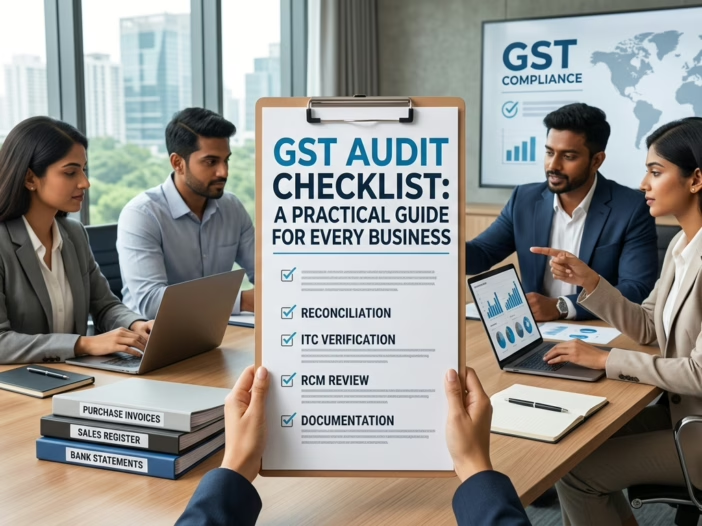
A GST audit checklist is a practical list of points that a business should review to confirm that its GST records are accurate. It covers invoices, Input Tax Credit, reverse charge, return filing, tax payments, and supporting documents.
In simple terms, this checklist helps you review your GST compliance before a problem arises. Instead of waiting for a departmental notice, you can identify and correct errors at the right time.
Why Is a GST Audit Checklist Important?
A GST audit checklist is important because even a small mistake can create serious issues later. For instance, a mismatch in sales figures, an incorrect ITC claim, a missing invoice, or the wrong tax rate can lead to interest, penalties, or departmental queries.
Moreover, GST compliance has become more system-driven. Therefore, businesses must regularly match books of accounts with return data and portal records. When you review records on time, you reduce errors and improve compliance.
1. Review Sales Records Carefully
Match sales with GST returns
First, compare your sales register with the details reported in GST returns. Check whether the taxable value, tax amount, and invoice details are correct.
You should verify:
- B2B sales
- B2C sales
- Export sales
- SEZ supplies
- Exempt supplies
- Debit notes and credit notes
This step matters because mismatches between books and returns often create reconciliation problems.
Check invoice numbering
Next, review your invoice numbering system. Every invoice should carry a unique number and follow a proper sequence. If you do not manage invoice numbering properly, tracking records becomes difficult.
Verify tax rates and classification
Further, confirm that you have applied the correct GST rate to every product or service. At the same time, review the HSN or SAC classification. Wrong classification can result in short payment or excess payment of tax.
2. Verify Input Tax Credit Properly
Match purchases with GSTR-2B
After reviewing sales, move to purchases. Compare your purchase register with GSTR-2B and identify missing invoices, duplicate entries, or incorrect credit claims.
This review helps you detect:
- Invoices not uploaded by suppliers
- Excess ITC claimed
- Ineligible ITC
- Duplicate ITC
- Pending supplier corrections
Identify blocked credits
In addition, make sure you have not claimed ITC on blocked items where the law does not allow credit. Many businesses make mistakes here because some expenses appear business-related but still remain ineligible under GST.
Review unclaimed ITC
Also, check whether any eligible ITC is still unclaimed. When you identify such credits on time, you can take corrective action more easily. Therefore, regular ITC review remains a smart practice.
3. Check Reverse Charge Liability
Now, review all expenses where reverse charge may apply. Businesses often miss reverse charge transactions because these expenses do not always appear like regular purchase invoices.
You should examine expenses such as:
- Legal fees
- Transport charges, where applicable
- Security services in certain cases
- Import of services
- Other notified supplies
At the same time, verify whether you have paid tax correctly and claimed ITC properly wherever the law permits.
4. Reconcile Returns with Books
Match GSTR-1 with GSTR-3B
Another important step is to compare outward supplies reported in GSTR-1 with the tax liability disclosed in GSTR-3B. If the two returns do not match, identify the reason immediately.
For example, mismatches may arise because of:
- Missed invoice reporting
- Incorrect amendments
- Credit note adjustment issues
- Tax paid under the wrong head
- Delay in reporting
Check monthly and annual consistency
Likewise, compare monthly return figures with yearly turnover and tax records. This process helps you prepare for annual return filing and reduces confusion at year-end.
5. Review E-Invoicing and E-Way Bill Compliance
If e-invoicing applies to your business, verify whether you generated all applicable invoices correctly through the prescribed system. Also, ensure that invoice details match your books and GST returns.
Similarly, if e-way bill provisions apply, compare e-way bill data with your sales and dispatch records. This review becomes especially important for trading and manufacturing businesses.
6. Maintain Proper Documents and Records
A strong GST review is incomplete without proper documentation. Therefore, keep all supporting records organized and accessible.
These documents generally include:
- Sales invoices
- Purchase invoices
- Debit notes and credit notes
- E-invoice records
- E-way bills
- Tax payment challans
- Vendor confirmations, where required
- Reconciliation workings
- LUT, where applicable
- Reverse charge workings
When records stay clear and updated, businesses can handle audits, notices, and reconciliations more confidently.
7. Monitor Vendor Compliance
GST compliance does not depend only on your own actions. It also depends on your vendors. Therefore, review whether suppliers are filing returns on time and uploading invoices correctly.
If vendors fail to comply, your ITC may suffer. So, regular vendor follow-up becomes necessary, especially for high-value transactions.
8. Prepare Early for Annual Return Filing
Another key part of the checklist is annual return readiness. Instead of waiting until the final stage, start reconciling your records in advance. Review turnover, tax paid, ITC claimed, amendments made during the year, and differences between books and returns.
Early preparation gives you enough time to correct errors and collect missing data. As a result, annual return filing becomes smoother and less stressful.
9. Update GST Registration Details
Many businesses ignore registration details, but these details also form part of sound GST compliance. Therefore, review your GST registration profile from time to time and keep it updated.
Check the following details:
- Business address
- Email and mobile number
- Authorized signatory
- Bank details
- Nature of business
Accurate registration details help you avoid unnecessary compliance issues.
10. Follow a Regular Review System
The best way to manage GST is to review compliance regularly instead of waiting until year-end. A monthly or quarterly review helps you detect errors early and keep records under control.
A simple review system may include:
- Sales reconciliation
- Purchase and ITC matching
- Reverse charge review
- Invoice verification
- Vendor follow-up
- Return matching
- Document filing
This habit saves time, improves accuracy, and reduces compliance risks.
Common Mistakes Businesses Should Avoid
Even when businesses file returns on time, they often make practical mistakes. Therefore, they should remain alert to the following issues.
Ignoring mismatches
Many businesses do not compare books with GST returns regularly. As a result, mistakes remain unnoticed for a long time.
Claiming incorrect ITC
Sometimes businesses claim ITC on ineligible expenses or without proper invoice matching. This mistake can create major compliance problems later.
Missing reverse charge entries
This issue is very common, especially when the accounts team books expenses without proper GST review.
Using the wrong HSN or tax rate
Even a single classification mistake can affect the tax liability and create reporting errors.
Delaying reconciliation
When businesses postpone reconciliation until year-end, correction becomes more difficult and time-consuming.
Conclusion
A GST audit checklist is not useful only for professionals or large companies. In fact, every business can benefit from it. When you review sales, purchases, ITC, reverse charge, invoices, returns, and documents regularly, you reduce errors and maintain stronger compliance.
Moreover, regular checking helps you face annual return filing and departmental scrutiny with greater confidence. In short, a GST audit checklist acts as a safety system for your business. It keeps records organized, helps you correct mistakes on time, and supports smooth GST compliance throughout the year.