
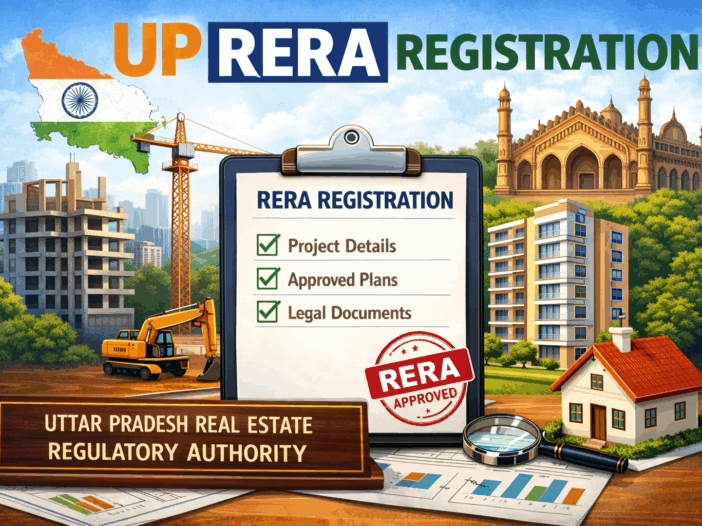
The real estate sector in India has long been a significant contributor to the country’s economy, but it has also been criticized for its lack of transparency and accountability. To address these challenges and safeguard the interests of homebuyers, the Real Estate (Regulation and Development) Act, 2016 (RERA) was enacted. Every state and union territory in India has established its own Real Estate Regulatory Authority to regulate the real estate sector.
In Uttar Pradesh, the authority is known as the Uttar Pradesh Real Estate Regulatory Authority (UP RERA). UP RERA came into force on 1st May 2017, and UP RERA ensures transparency in real estate transactions, regulates promoters, builders, and real estate agents, and protects homebuyers’ interests.
Learn about UP RERA registration for promoters, builders & agents in Uttar Pradesh. Step-by-step process, documents, fees & validity explained.
What is Uttar Pradesh Real Estate Regulatory Authority?
The Uttar Pradesh Real Estate Regulatory Authority (UP RERA) is the regulatory body constituted under the Real Estate (Regulation and Development) Act, 2016. Its primary responsibilities include:
- Regulating and promoting the real estate sector in Uttar Pradesh.
- Ensuring transparency and efficiency in project execution.
- Protecting the interests of homebuyers.
- Ensuring that promoters, developers, and real estate agents follow fair practices.
- Providing a platform for quick resolution of disputes between buyers and developers.
If you are a promoter, builder, or real estate agent, you must register under Uttar Pradesh Real State Regulatory Authority before conducting any real estate business in the state.
Who Needs to Register with Uttar Pradesh Real State Regulatory Authority?
1. Promoters/Builders
- Any promoter or builder who develops a project on land exceeding 500 square meters or with more than 8 apartments/units must register the project with UP RERA.
- Registration is mandatory before advertising, marketing, or selling the property.
2. Real Estate Agents
- Any person or entity facilitating the sale or purchase of plots, apartments, or buildings must register as a real estate agent with UP RERA.
- Agents cannot sell or market projects that are not registered under RERA.
👉 Note: Failure to register can lead to heavy penalties, fines, and even imprisonment in case of serious violations.
UP RERA Promoter Registration (Process, Documents & Fees)
Who is a Promoter?
- A landowner (if the project is being launched on their land).
- Development Authority / Housing Board.
- Co-operative society launching a project.
- A builder/developer is also considered a promoter.
RERA Registration Process for Promoters
Here is the step-by-step process for UP RERA promoters registration:
Step 1: Visit the Official Portal
- Go to the UP RERA website: https://www.up-rera.in.
- Select “Promoter Registration” from the menu.
Step 2: Create an Account
- Sign up by entering details like name, email, and mobile number.
- Verify through OTP/email confirmation.
Step 3: Fill in Project Details
- Enter project name, type (residential/commercial/mixed), location, land size, carpet area, number of units, completion timeline, etc.
Step 4: Upload Documents
- Upload scanned copies of all required documents (list provided below).
Step 5: Pay Registration Fee
- The system calculates the registration fee based on project type and land area.
- Pay online using net banking, UPI, or credit/debit card.
Step 6: Application Review & Approval
- After submission, UP RERA scrutinizes the application.
- If everything is correct, a unique project registration number is issued within 30 days.
Documents Required for Promoter Registration
Promoters need to submit the following documents for UP RERA registration:
- PAN Card of the promoter/firm/company.
- Aadhaar Card of the promoter/authorized signatory.
- Certificate of Incorporation (in case of company).
- MOA & AOA (for companies).
- Partnership Deed (for partnerships).
- Title Deed of the land showing legal ownership.
- Joint Development Agreement (if applicable).
- Encumbrance Certificate (to prove land is free from legal dues).
- Project Layout Plan & Sanctioned Building Plan.
- Commencement Certificate from the competent authority.
- Affidavit & Declaration stating project details and compliance.
- Past Project Details launched in the last five years.
- Audited Financial Statements for the past three years.
- Bank Account Details (70% of buyer funds must be deposited in a dedicated project account).
- Photographs of promoter/authorized signatory.
Registration Fee for Promoters
The fee depends on the type of project:
- Group Housing Project: ₹10 per sq. meter.
- Mixed Development Project: ₹10 per sq. meter.
- Commercial Project: ₹20 per sq. meter.
- Plotted Development Project: ₹5 per sq. meter.
👉 Maximum Limit: The fee is capped as per UP RERA rules (subject to revision). GST may be applicable.
Builder Registration Process (Developer / Construction Company as Builder)
Who is a Builder?
- The person/company that actually constructs and markets/sells apartments, plots, or commercial spaces.
- Often the builder and promoter are the same, but in a joint development project:
- Landowner = Promoter
- Construction company = Builder (but legally both are considered promoters).
RERA Registration Process for Builders
Here is the step-by-step process for UP RERA builder registration:
Step 1: Visit the Official Portal
- Go to the UP RERA website: https://www.up-rera.in.
- Select “Promoter Registration” from the menu.
Step 2: Create an Account
- Sign up by entering details like name, email, and mobile number.
- Verify through OTP/email confirmation.
Step 3: Fill in Project Details
- Enter project name, type (residential/commercial/mixed), location, land size, carpet area, number of units, completion timeline, etc.
Step 4: Upload Documents
- Upload scanned copies of all required documents (list provided below).
Step 5: Pay Registration Fee
- The system calculates the registration fee based on project type and land area.
- Pay online using net banking, UPI, or credit/debit card.
Step 6: Application Review & Approval
- After submission, UP RERA scrutinizes the application.
- If everything is correct, a unique project registration number is issued within 30 days.
Documents Required for Builders Registration
Builders and promoters need to submit the following documents for UP RERA registration:
- PAN Card of the promoter/firm/company.
- Aadhaar Card of the promoter/authorized signatory.
- Certificate of Incorporation (in case of company).
- MOA & AOA (for companies).
- Partnership Deed (for partnerships).
- Title Deed of the land showing legal ownership.
- Joint Development Agreement (if applicable).
- Encumbrance Certificate (to prove land is free from legal dues).
- Project Layout Plan & Sanctioned Building Plan.
- Commencement Certificate from the competent authority.
- Affidavit & Declaration stating project details and compliance.
- Past Project Details launched in the last five years.
- Audited Financial Statements for the past three years.
- Bank Account Details (70% of buyer funds must be deposited in a dedicated project account).
- Photographs of promoter/authorized signatory.
Registration Fee for Builders
The fee depends on the type of project:
- Group Housing Project: ₹10 per sq. meter.
- Mixed Development Project: ₹10 per sq. meter.
- Commercial Project: ₹20 per sq. meter.
- Plotted Development Project: ₹5 per sq. meter.
👉 Maximum Limit: The fee is capped as per UP RERA rules (subject to revision). GST may be applicable.
Real Estate Agents
Who Needs to Register as an Agent in UP RERA?
As per the rules of UP RERA (Uttar Pradesh Real Estate Regulatory Authority):
- A Real Estate Agent means any individual, firm, company, or LLP who:
- Acts as an intermediary in the sale, purchase, or booking of property.
- Facilitates transactions between builder and buyer.
- Markets or sells units (flats, plots, shops, etc.) in RERA-registered projects.
👉 All such agents must get registered with UP RERA.
Without registration, no one can advertise, market, or sell units in RERA-registered projects.
Registration is required for:
- Individual agents
- Partnership firms
- Private Limited companies
- LLPs / Proprietorships
UP RERA Registration Process for Real Estate Agents
Here is how real estate agents can register under UP RERA:
Step 1: Visit the UP RERA Website
- Select “Agent Registration” from the homepage.
Step 2: Sign Up & Fill Form
- Enter details like name, firm name, business structure (individual/firm/company).
Step 3: Upload Documents
- Attach required documents (see list below).
Step 4: Pay Registration Fee
- Pay online as per prescribed fees.
Step 5: Approval & Certificate
- Upon successful verification, UP RERA issues a Registration Certificate with a unique ID number.
Documents Required for Real Estate Agent Registration
- PAN Card (individual/firm/company).
- Aadhaar Card of applicant/partners/directors.
- Incorporation Certificate (for companies).
- MOA & AOA (for companies).
- Partnership Deed (for partnerships).
- Business Address Proof (electricity bill/rent agreement/property tax receipt).
- Passport-size Photographs of applicant/partners/directors.
- Details of Previous RERA Registrations (if any).
- Fee payable:
- Individual – ₹10,000
- Other than individual (firm/company) – ₹50,000
- A registration certificate is issued (valid for 5 years).
Training Process for Agents
UP RERA has made it mandatory for registered agents to undergo a structured training program so that they fully understand the law and compliance requirements.
- Duration: 50 hours training program (usually a mix of online + offline).
- Conducted by: RERA-approved training institutions (like CREDAI, NAREDCO, REA associations, universities, or other empanelled institutions).
- Course contents include:
- RERA Act, 2016 and UP RERA Rules
- Builder–buyer agreements
- Ethical practices in selling
- Consumer rights & grievance redressal
- Documentation & compliance requirements
- Assessment: A test is conducted at the end of the training.
- Certification: On passing, the agent receives a Certificate of Competency, which is linked with their RERA registration.
- Every real estate agent must register with UP RERA before engaging in property transactions.
- After registration, they must complete mandatory training & certification to operate legally and ethically under the RERA framework.
Validity of UP RERA Registration
- For Builders/Promoters: Valid until project completion (as declared). If delayed, an extension must be applied for.
- For Agents: Valid for 5 years, after which renewal is mandatory.
Penalties for Non-Compliance
- Builders/Promoters: Fine up to 10% of the project cost and imprisonment for continuous violations.
- Agents: Fine of ₹10,000 per day during default or up to 5% of the transaction value.
FAQs on UP RERA Registration
- Is UP RERA registration mandatory for all projects?
Yes. Any project exceeding 500 sq. meters or 8 apartments must be registered before sale or advertisement.
- Can a builder advertise without RERA registration?
No. Advertising or marketing without registration is illegal and punishable.
- How long does it take for registration approval?
Generally, within 30 days, if all documents and fees are correct.
- Can a real estate agent operate without RERA registration?
No. It is mandatory to register; otherwise, penalties will apply.
- Is the registration fee refundable?
No. Once paid, the fee is generally non-refundable.
- Can a promoter register multiple projects under one application?
No. Each project requires a separate registration.
- What happens if a project is delayed?
The promoter must apply for an extension of registration with valid reasons.
- How can buyers verify RERA registration?
By visiting https://www.up-rera.in and checking the project/agent details.
- What is the penalty for agents without renewal?
Operating with an expired registration can lead to fines and cancellation of license.
- Does UP RERA help in dispute resolution?
Yes. UP RERA provides an online complaint mechanism for buyers, builders, and agents.
Conclusion
The Uttar Pradesh Real Estate Regulatory Authority (UP RERA) has revolutionized the real estate sector in the state by ensuring transparency, accountability, and protection of homebuyers’ rights. For builders, promoters, and real estate agents, registration under UP RERA is not just a legal formality but a necessity to build credibility and trust in the market.
By following the step-by-step registration process, submitting the required documents, and paying the prescribed fees, stakeholders can operate legally and contribute to a healthier, more transparent real estate ecosystem in Uttar Pradesh.
For buyers, UP RERA has become a trustworthy platform to verify projects and agents before investing, thereby reducing fraud and ensuring timely delivery of properties.
In 2025 and beyond, compliance with UP RERA will remain one of the strongest pillars for sustainable growth in Uttar Pradesh’s real estate industry