
Introduction
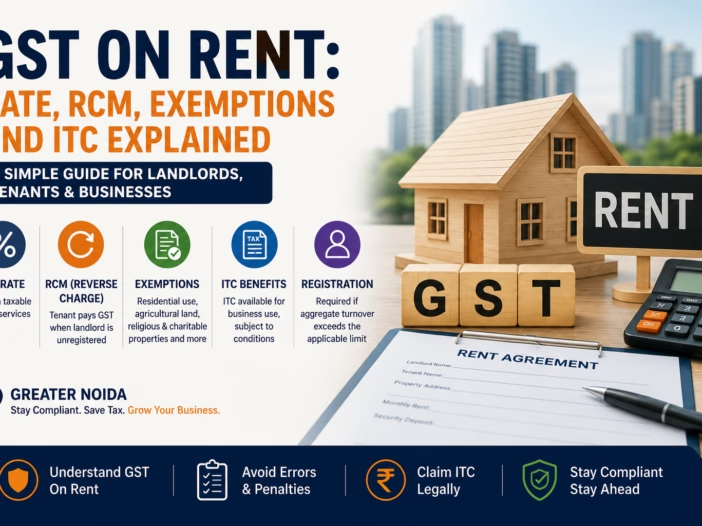
GST on rent often creates confusion for landlords, tenants and businesses. The rules do not apply in the same way to every rental transaction. Instead, the tax treatment depends on the type of property, the GST status of the landlord and tenant, and the actual use of the premises.
For example, an individual may rent a house for personal residence, while a company may rent the same type of property for employee accommodation or office use. Although the property may look similar, GST may apply differently in both cases.
Moreover, businesses in Greater Noida often take offices, shops, warehouses, clinics and co-working spaces on rent. Therefore, they must clearly understand whether the landlord should charge GST or whether the tenant must pay GST under the Reverse Charge Mechanism.
This article explains GST on residential and commercial rent, applicable rates, RCM rules, exemptions and input tax credit in simple language.
GST Treats Renting as a Supply of Service
Under GST law, renting an immovable property is treated as a supply of service.
Therefore, when a landlord rents out a property for business or commercial use, GST may apply. However, GST law also provides exemptions for certain residential, agricultural, religious and charitable property rentals.
In other words, GST does not apply merely because a landlord receives rent. Instead, the nature of the property and its actual use decide the tax treatment.
GST Rate on Rent
GST generally applies at 18% on taxable rental services.
For a rental transaction within the same state, the tax is divided as follows:
- CGST at 9%
- SGST at 9%
On the other hand, an inter-state rental transaction may attract IGST at 18%.
In most cases, the place of supply follows the location of the property.
For example, if a property is situated in Greater Noida and the landlord is registered in Uttar Pradesh, the transaction will generally attract CGST and Uttar Pradesh SGST.
The commonly used Service Accounting Codes are:
- SAC 997211 for residential property rental services
- SAC 997212 for commercial and non-residential property rental services
GST on Commercial Property Rent
Commercial property includes:
- Shops
- Offices
- Warehouses
- Clinics
- Factories
- Showrooms
- Co-working spaces
- Business premises
GST usually applies at 18% on commercial property rent.
However, the person responsible for paying GST depends on whether the landlord holds a GST registration.
When the Landlord Is GST-Registered
When a GST-registered landlord rents a commercial property, the landlord normally follows the Forward Charge Mechanism.
Under this mechanism, the landlord must:
- Issue a GST invoice
- Charge GST at 18%
- Collect GST from the tenant
- Report the transaction in GST returns
- Deposit the tax with the government
For example, suppose a registered landlord rents an office in Greater Noida for ₹50,000 per month.
The invoice may show:
Rent: ₹50,000
CGST at 9%: ₹4,500
SGST at 9%: ₹4,500
Total invoice value: ₹59,000
Accordingly, the tenant pays ₹59,000 to the landlord. Thereafter, the landlord deposits the GST with the government.
When the Landlord Is Unregistered
The Reverse Charge Mechanism may apply when an unregistered landlord rents a commercial property to a regular GST-registered tenant.
In this situation:
- The landlord does not charge GST
- The tenant calculates GST at 18%
- The tenant pays GST directly to the government
- The tenant pays only the agreed rent to the landlord
- The tenant pays the RCM liability through the electronic cash ledger
For example, suppose an unregistered landlord rents a shop in Greater Noida to a GST-registered company for ₹40,000 per month.
The company will pay:
Rent to landlord: ₹40,000
GST under RCM: ₹7,200
Total cash outflow: ₹47,200
Thus, the company pays ₹40,000 to the landlord and deposits ₹7,200 directly with the government.
However, composition taxpayers generally do not fall under this commercial rent RCM rule. Therefore, the tenant should first check whether it holds a regular or composition GST registration.
Self-Invoice Under RCM
When a registered tenant receives a taxable rental service from an unregistered landlord, the tenant may need to prepare a self-invoice.
In addition, the tenant should maintain the following records:
- Rent agreement
- Landlord declaration
- Rent payment proof
- Self-invoice
- RCM payment details
- Property-use proof
- GST registration documents
These documents help the business support its tax position during a GST audit, assessment or departmental verification.
GST on Residential Property Rent
GST on residential rent mainly depends on:
- The tenant’s GST status
- The purpose of renting
- The actual use of the property
Therefore, a residential property does not always remain exempt merely because the building is a house or flat.
Instead, the actual use of the property plays an important role.
House Rented to an Unregistered Individual
GST generally does not apply when an unregistered individual rents a house for personal residence.
For example, suppose a salaried person rents a flat in Greater Noida for family use.
In this case:
- The tenant is not registered under GST
- The tenant uses the flat as a residence
- No GST applies
Moreover, even if the landlord holds GST registration for another business, the landlord should not charge GST on an exempt residential rental transaction.
Residential Property Rented to a GST-Registered Business
When a GST-registered company, LLP, partnership firm or other business rents a residential dwelling, the tenant may need to pay GST at 18% under RCM.
This situation may arise when the business uses the property for:
- Employee accommodation
- Director accommodation
- Staff housing
- Guest house
- Other business purposes
In such cases, the landlord does not usually collect GST. Instead, the registered tenant pays GST directly to the government.
Therefore, businesses should examine the tenant’s GST status and the purpose of the property before deciding the tax treatment.
Residential House Rented by a Proprietor for Personal Use
A sole proprietor may hold GST registration for business purposes and still rent a house for personal residence.
The residential rent may remain exempt when:
- The individual rents the house in a personal capacity
- The individual uses the house for family residence
- The individual pays the rent personally
- The business does not claim the rent as an expense
Thus, GST registration of the proprietor alone does not make personal house rent taxable.
However, the proprietor should clearly mention personal residential use in the rent agreement and accounting records.
Residential Flat Used as an Office or Clinic
GST may apply when the tenant uses a residential flat as:
- Office
- Clinic
- Consultancy centre
- Coaching centre
- Co-working space
- Business premises
In such cases, the actual business use may remove the residential exemption.
If the landlord is registered, the landlord may charge GST under the Forward Charge Mechanism.
On the other hand, if the landlord is unregistered and the tenant is a regular GST-registered person, the tenant may pay GST under RCM.
Therefore, businesses should not rely only on the property description in the sale deed. They should also consider how they actually use the premises.
Input Tax Credit on Rent
A regular GST-registered business can claim Input Tax Credit on rent when it uses the premises for taxable business activities.
However, the business must satisfy the following conditions:
- It uses the property for business
- It receives the rental service
- It holds the required tax documents
- It pays the applicable GST
- It makes taxable or zero-rated supplies
- No blocked-credit rule applies
In simple terms, the business must show a clear connection between the rented premises and its taxable activities.
ITC on Commercial Rent
A business can generally claim ITC on GST paid for:
- Office rent
- Shop rent
- Warehouse rent
- Factory rent
- Showroom rent
- Commercial premises rent
The business may claim ITC whether:
- The landlord charges GST under Forward Charge, or
- The tenant pays GST under RCM
However, the tenant must first pay the RCM liability in cash.
The tenant cannot use its existing ITC balance to pay GST under RCM.
After paying the tax, the tenant may claim eligible ITC in the GST return, provided it satisfies all applicable conditions.
ITC on Residential Property Used by a Business
Businesses should examine ITC on residential accommodation carefully.
A business may claim ITC when it genuinely uses the property as an office or business premises and maintains proper evidence.
However, the department may question ITC when the company uses the property for:
- Director accommodation
- Employee housing
- Guest house
- Personal consumption
- Non-business use
Therefore, payment of GST under RCM does not automatically allow ITC.
The business should review:
- Rent agreement
- Actual property use
- Accounting treatment
- Business purpose
- Employee recovery
- Documentary evidence
As a result, proper documentation becomes essential before claiming credit.
RCM Liability Must Be Paid in Cash
A taxpayer must pay GST under RCM through the electronic cash ledger.
The taxpayer cannot use the available Input Tax Credit balance to pay RCM tax.
However, after making the cash payment, the taxpayer may claim ITC if the law permits the credit.
Therefore, RCM first creates a cash payment obligation. Thereafter, the taxpayer may claim the eligible amount as credit.
GST Registration Requirement for Landlords
A landlord who provides taxable rental services may need GST registration when aggregate turnover crosses the applicable threshold.
The general threshold for service providers is:
- ₹20 lakh in most states
- ₹10 lakh in specified special category states
The landlord must calculate aggregate turnover on a PAN basis.
Aggregate turnover may include:
- Commercial rent
- Residential rent
- Professional receipts
- Business income
- Exempt supplies
- Other taxable supplies
Therefore, the landlord should not consider only commercial rent while checking the GST registration limit.
Moreover, exempt supplies may also form part of aggregate turnover.
However, where the tenant pays the entire GST under RCM, the landlord should separately examine whether registration is still required.
GST on Security Deposit
GST does not normally apply to a refundable security deposit.
The deposit remains outside GST when:
- The landlord holds it only as security
- The landlord must refund it
- The landlord does not adjust it against rent
- The landlord does not use it as consideration
However, GST may apply when the landlord adjusts the deposit against:
- Unpaid rent
- Repair charges
- Damage recovery
- Maintenance dues
- Other taxable amounts
Therefore, the tax treatment depends on the final adjustment of the deposit.
GST on Maintenance and Other Charges
Landlords often recover additional charges along with rent, such as:
- Maintenance charges
- Common-area charges
- Parking charges
- Electricity charges
- Water charges
- Generator charges
- Facility management charges
GST may apply when these charges form part of the rental service.
However, if the landlord merely recovers the exact electricity or water amount as a pure agent, the tax treatment may differ.
Therefore, the rent agreement and invoice should clearly separate:
- Rent
- Maintenance charges
- Utility reimbursements
- Security deposit
- Other taxable services
Clear documentation helps both the landlord and tenant avoid disputes.
Exemption for Agricultural Land
GST generally does not apply to the renting or leasing of land for qualifying agricultural activities.
The exemption may cover land used for:
- Cultivation
- Harvesting
- Agricultural operations
- Rearing of animals connected with agriculture
- Farm-related activities
However, GST may apply when the tenant uses agricultural land for:
- Warehouse
- Factory
- Commercial event
- Industrial activity
- Non-agricultural business
Thus, the actual use of the land decides the tax treatment.
Exemption for Religious and Charitable Properties
Certain properties connected with religious places may qualify for GST exemption, subject to prescribed conditions and monetary limits.
The commonly prescribed limits include:
- Room rent below ₹1,000 per day
- Rent of halls or open areas below ₹10,000 per day
- Rent of shops or business premises below ₹10,000 per month
However, the exemption does not apply automatically to every charitable trust.
The entity must check:
- Nature of the property
- Public use
- Registration status
- Type of activity
- Rental amount
- Prescribed conditions
Therefore, each case requires a separate review.
Practical Checklist for Businesses
Before signing or renewing a rent agreement in Greater Noida, a business should take the following steps:
- Identify whether the property is residential or commercial.
- Confirm the actual use of the property.
- Check the landlord’s GST registration status.
- Verify the landlord’s GSTIN.
- Check whether GST applies under Forward Charge or RCM.
- Confirm whether the tenant follows the regular or composition scheme.
- Add a clear GST clause in the rent agreement.
- Prepare a self-invoice where RCM applies.
- Pay RCM tax through the electronic cash ledger.
- Claim ITC only after checking eligibility.
By following this checklist, businesses can reduce the risk of incorrect GST treatment.
Common Mistakes to Avoid
Businesses often make the following mistakes:
- Assuming that no GST applies when the landlord is unregistered
- Paying RCM liability through ITC
- Claiming ITC on personal accommodation
- Treating every residential flat as exempt
- Ignoring exempt rent while calculating aggregate turnover
- Failing to prepare a self-invoice
- Not checking the composition scheme status
- Using the property for business while the agreement mentions residential use
- Claiming ITC without proper documents
Therefore, businesses should review both the rent agreement and the actual use of the premises before finalising the GST treatment.
Conclusion
GST on rent depends on the type of property, the GST status of the landlord and tenant, and the actual use of the premises.
A registered landlord normally charges GST at 18% on commercial rent under the Forward Charge Mechanism.
However, when an unregistered landlord rents commercial property to a regular GST-registered tenant, the tenant may need to pay GST under RCM.
Residential rent generally remains exempt when an unregistered individual uses the house for personal residence.
On the other hand, GST may apply when a registered business rents a residential property for employee accommodation, guest-house use or business purposes.
Therefore, businesses in Greater Noida should verify the landlord’s GST status, clearly mention the property use in the rent agreement and check ITC eligibility before claiming credit.
Proper documentation, timely payment and correct GST treatment can help landlords and tenants avoid interest, penalties and future disputes.
Frequently Asked Questions
1. What is the GST rate on commercial rent?
The general GST rate on taxable commercial rent is 18%.
2. Is GST applicable on house rent?
GST does not generally apply when an unregistered individual rents a residential property for personal residence.
3. Who pays GST when the commercial landlord is unregistered?
A regular GST-registered tenant may need to pay GST under the Reverse Charge Mechanism.
4. Does GST depend on monthly rent of ₹50,000?
No. GST does not provide a general exemption based on monthly rent of ₹50,000.
The ₹50,000 limit may apply to TDS on rent under Income Tax law in certain cases.
5. Can a tenant claim ITC on office rent?
Yes. A regular GST-registered tenant can generally claim ITC when it uses the office for taxable business activities and meets all conditions.
6. Can a taxpayer pay RCM through ITC?
No. The taxpayer must pay RCM liability through the electronic cash ledger.
7. Does GST apply to a refundable security deposit?
No. GST does not normally apply to a refundable security deposit unless the landlord adjusts it against rent or another taxable amount.
8. Is residential rent paid by a company taxable?
A GST-registered company may need to pay GST at 18% under RCM when it rents a residential dwelling.
9. Is rent paid by a proprietor for family residence taxable?
The rent may remain exempt when the proprietor rents the house personally, uses it as a family residence and does not claim it as a business expense.
10. Does GST apply to agricultural land rent?
GST generally does not apply when the tenant uses the land for qualifying agricultural activities.
11. Is TDS on rent different from GST on rent?
Yes. TDS on rent falls under Income Tax law, while GST on rent falls under GST law.
Both provisions may apply separately to the same transaction.
12. Can an unregistered landlord collect GST?
No. An unregistered landlord cannot normally collect GST.
However, the registered tenant may need to pay GST directly to the government under RCM.