
Introduction
Taxpayers sometimes forget to report interest income, capital gains, dividends, freelance receipts or other taxable income in their Income Tax Return. In other cases, they may miss both the original and belated return filing deadlines.
Fortunately, the Income Tax Act allows eligible taxpayers to correct such omissions by filing an Updated Income Tax Return, commonly known as ITR-U.
Section 139(8A) governs the filing of an updated return. A taxpayer may file ITR-U even when they did not file an original, belated or revised return for the relevant assessment year.
However, taxpayers mainly use ITR-U to disclose additional income and pay the related tax. They cannot generally use it to claim a refund, reduce their existing tax liability or report a total loss.
Therefore, taxpayers and businesses in Greater Noida should regularly review their Annual Information Statement, Form 26AS and financial records. By identifying omitted income early, they can correct genuine mistakes before the Income Tax Department starts any proceedings.
What Is an Updated Income Tax Return or ITR-U?
An Updated Income Tax Return allows a taxpayer to correct certain omissions or errors after the normal return-filing period has ended.
A taxpayer may use ITR-U to:
- file an income tax return after missing the original and belated return deadlines;
- disclose income omitted from an earlier return;
- correct an incorrect head of income;
- apply the correct tax rate;
- reduce an incorrectly claimed carried-forward loss;
- reduce unabsorbed depreciation;
- reduce MAT or AMT credit; and
- pay the additional tax arising from the correction.
While filing ITR-U, the taxpayer must also complete the applicable regular ITR form, such as ITR-1, ITR-2, ITR-3 or another relevant form.
Therefore, ITR-U does not replace the regular income tax return. Instead, it forms part of the applicable return and includes additional schedules relating to the updated return.
Who Can File ITR-U?
Individuals, Hindu Undivided Families, firms, LLPs, companies, associations of persons and other eligible taxpayers may file ITR-U, subject to the prescribed conditions.
1. You missed filing the original and belated return
You may file ITR-U when you did not file:
- the original return under Section 139(1); or
- the belated return under Section 139(4).
For example, a salaried employee in Greater Noida may miss the filing deadline despite having taxable salary, interest or capital gain income.
In such a case, the taxpayer may consider filing ITR-U after checking eligibility and calculating the applicable tax liability.
2. You omitted taxable income
You may file an updated return when you forgot to disclose taxable income in your earlier return.
Such income may include:
- savings account interest;
- fixed-deposit interest;
- dividend income;
- capital gains from shares or mutual funds;
- gains from the sale of property;
- rental income;
- freelance or professional receipts;
- business income; or
- income appearing in AIS or Form 26AS but not reported in the return.
For instance, if a taxpayer forgets to report fixed-deposit interest that appears in AIS, the taxpayer may use ITR-U to disclose that income and pay the applicable tax.
3. You selected the wrong head of income
A taxpayer may incorrectly report professional receipts as income from other sources. Similarly, a taxpayer may report capital gains under an incorrect category.
In such cases, the taxpayer may use ITR-U to correct the classification, provided the correction increases the income or tax payable.
4. You applied an incorrect tax rate
You may file ITR-U when you applied a lower or incorrect tax rate in the earlier return.
For example, a taxpayer may treat taxable income as exempt or apply the normal slab rate to income that attracts a special tax rate.
In that situation, the taxpayer may file an updated return and pay the resulting tax difference.
5. You need to reduce carried-forward losses or tax credits
A taxpayer may file ITR-U to reduce:
- carried-forward business loss;
- carried-forward capital loss;
- unabsorbed depreciation;
- MAT credit; or
- AMT credit.
However, the updated return cannot show the final total income as a loss.
Moreover, if the updated return reduces a loss, depreciation or tax credit carried forward to a later year, the taxpayer may also need to revise the tax position of the affected subsequent years.
When Can You Not File ITR-U?
Although ITR-U gives taxpayers an additional opportunity to correct omissions, the law restricts its use in several situations.
1. ITR-U results in a refund
You cannot file an updated return when it:
- creates a new refund; or
- increases the refund claimed in an earlier return.
Therefore, you cannot use ITR-U merely to claim an omitted deduction, exemption or TDS credit when the claim results in a refund or increases an existing refund.
2. ITR-U reduces the tax liability
You cannot file ITR-U when the updated return reduces the tax liability calculated in the original, belated or revised return.
For example, suppose a taxpayer claimed fewer deductions in the original return and now wants to claim additional deductions to reduce the tax payable.
In that case, the taxpayer cannot generally use ITR-U.
3. ITR-U creates or increases a loss
An updated return cannot report the taxpayer’s total income as a loss.
However, the return may include a loss under one head of income if the taxpayer’s final total income remains positive.
4. You have already filed ITR-U for that assessment year
A taxpayer can file only one updated return for a particular assessment year.
In addition, the taxpayer cannot revise an ITR-U after filing it.
Therefore, the taxpayer should verify every figure, income source, deduction, tax payment and challan detail before submitting the updated return.
5. Search, requisition or survey proceedings apply
A taxpayer may become ineligible to file ITR-U when the Income Tax Department has initiated certain proceedings.
These proceedings may include:
- a search under Section 132;
- requisition of books, documents or assets under Section 132A;
- a survey under Section 133A, subject to prescribed exceptions; or
- proceedings based on seized assets or documents connected with the taxpayer.
The restriction may apply to the relevant assessment year and certain preceding assessment years.
Therefore, taxpayers should carefully review their case before filing ITR-U when the Department has initiated any search, survey or seizure-related action.
6. Assessment or reassessment proceedings are pending or completed
A taxpayer generally cannot file ITR-U when assessment, reassessment, recomputation or revision proceedings are pending or have already been completed for the relevant assessment year.
However, the law may allow filing in certain cases involving a notice under Section 148, subject to specific conditions and time limits.
Since such cases involve complex legal provisions, taxpayers should seek professional advice before proceeding.
7. The Department has received specified information
A taxpayer may not be eligible to file ITR-U when the Assessing Officer has communicated information received under specified laws.
Such information may relate to:
- black money;
- benami property;
- money laundering;
- smuggling;
- foreign exchange violations; or
- international tax information-sharing agreements.
Similarly, restrictions may apply when the Department has started prosecution proceedings or issued a prescribed notice under Section 148A.
Time Limit for Filing ITR-U
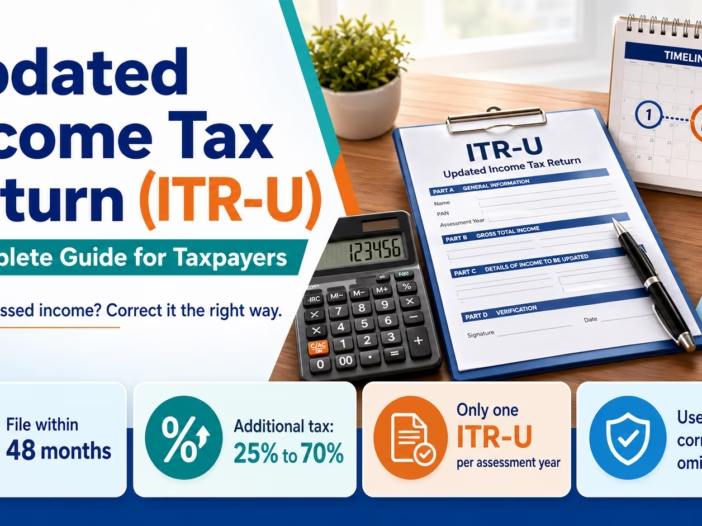
A taxpayer may file an updated return within 48 months from the end of the relevant assessment year.
This four-year filing window gives taxpayers more time to disclose previously omitted income voluntarily.
However, taxpayers should not delay the filing unnecessarily because the additional tax percentage increases with time.
Therefore, filing ITR-U at the earliest available opportunity can reduce the overall financial burden.
Additional Tax Payable on ITR-U
A taxpayer must pay the normal tax, applicable interest, late-filing fee and additional income tax before filing ITR-U.
| Time of filing from the end of the relevant assessment year | Additional income tax |
|---|---|
| Up to 12 months | 25% of tax and applicable interest |
| After 12 months but up to 24 months | 50% of tax and applicable interest |
| After 24 months but up to 36 months | 60% of tax and applicable interest |
| After 36 months but up to 48 months | 70% of tax and applicable interest |
The additional tax percentage applies to the relevant tax and interest payable. The tax calculation may also include surcharge and cess, wherever applicable.
Important clarification
The additional tax of 25%, 50%, 60% or 70% does not replace the normal income tax.
Instead, the taxpayer may have to pay:
- normal income tax on the additional income;
- applicable surcharge;
- health and education cess;
- interest under Sections 234A, 234B and 234C, wherever applicable;
- late-filing fee under Section 234F, wherever applicable; and
- additional income tax at the applicable percentage.
As a result, taxpayers who file ITR-U earlier usually pay a lower overall amount.
Documents to Check Before Filing ITR-U
Before preparing an updated return, the taxpayer should reconcile all relevant income and tax records.
The taxpayer should check:
- Annual Information Statement;
- Taxpayer Information Summary;
- Form 26AS;
- Form 16;
- Form 16A;
- bank statements;
- fixed-deposit interest certificates;
- capital gain statements;
- mutual fund statements;
- demat account statements;
- property purchase and sale documents;
- GST returns, wherever applicable;
- books of account;
- invoices and expense records; and
- details of advance tax, self-assessment tax, TDS and TCS.
This reconciliation helps the taxpayer identify every omitted transaction and calculate the correct additional tax liability.
Moreover, a proper review reduces the risk of filing an incorrect ITR-U, which the taxpayer cannot revise later.
Step-by-Step Process to File ITR-U
Step 1: Reconcile AIS, Form 26AS and financial records
First, compare the income disclosed in the earlier return with AIS, Form 26AS, bank statements and other financial records.
Next, identify every omitted transaction and classify it under the correct head of income.
For example, report bank interest under income from other sources. Similarly, report gains from the sale of shares or property under capital gains.
Step 2: Select the correct assessment year and ITR form
Log in to the official Income Tax e-Filing Portal and select the relevant assessment year.
After that, select the ITR form applicable to your taxpayer category and sources of income.
For example:
- use ITR-1 only when you satisfy all ITR-1 eligibility conditions;
- use ITR-2 when an eligible individual or HUF does not have business or professional income;
- use ITR-3 when an individual or HUF has business or professional income; and
- use the relevant ITR form for firms, LLPs, companies, trusts or other taxpayers.
The portal may provide online, offline or utility-based filing options, depending on the assessment year and the applicable ITR form.
Step 3: Complete the entire return and ITR-U schedules
The taxpayer must complete the full applicable ITR form and not merely report the omitted income.
In addition, the taxpayer must complete:
- Part A Gen_139(8A);
- Part B ATI;
- details of the earlier return, wherever applicable;
- the reason for filing the updated return;
- head-wise details of additional income;
- the applicable filing period;
- the complete tax computation; and
- details of tax payments.
The taxpayer should also disclose whether the updated return reduces any carried-forward loss, unabsorbed depreciation, MAT credit or AMT credit.
Step 4: Calculate and pay the complete tax liability
The taxpayer should calculate:
- normal tax on the additional income;
- surcharge and cess, wherever applicable;
- interest;
- late-filing fee, wherever applicable; and
- additional income tax at 25%, 50%, 60% or 70%.
Next, the taxpayer should pay the complete amount through the e-Pay Tax facility on the Income Tax Portal.
The taxpayer must then enter the challan details correctly in the return.
If the taxpayer fails to pay the complete amount or enters incorrect payment details, the Department may treat the return as defective.
Step 5: Upload and verify the return
After completing and validating the return, the taxpayer should generate and upload the required JSON file where the offline filing mode applies.
Finally, the taxpayer must verify the return through the permitted method.
Depending on the taxpayer category, the verification method may include:
- Aadhaar OTP;
- net banking;
- Electronic Verification Code;
- Digital Signature Certificate; or
- another method available on the portal.
Companies, political parties and specified taxpayers subject to tax audit may need to verify the return through a Digital Signature Certificate.
Official Website for Filing ITR-U
Taxpayers should file ITR-U only through the official Income Tax Department e-Filing Portal:
https://www.incometax.gov.in/iec/foportal/
Taxpayers should avoid sharing passwords, Aadhaar OTPs, bank OTPs or other confidential information with unauthorised persons.
Practical Example of ITR-U
Suppose a taxpayer in Greater Noida filed an income tax return but forgot to report fixed-deposit interest of ₹2,00,000.
Later, the taxpayer reviews AIS and identifies the omission.
Since reporting the interest increases the taxpayer’s total income and tax liability, the taxpayer may file ITR-U, provided no restriction applies.
The taxpayer should:
- add the interest income under income from other sources;
- recompute the total income;
- calculate the normal tax;
- calculate the applicable interest;
- calculate the additional income tax based on the filing period;
- pay the complete liability; and
- file and verify the updated return.
However, suppose the taxpayer only wants to claim additional TDS and receive a higher refund.
In that case, the taxpayer cannot use ITR-U because an updated return cannot create or increase a refund.
Common Mistakes to Avoid While Filing ITR-U
Taxpayers should avoid the following mistakes:
- selecting the wrong assessment year;
- selecting an incorrect ITR form;
- reporting only the omitted income instead of completing the full return;
- ignoring income appearing in AIS or Form 26AS;
- applying the additional tax percentage only to the normal tax;
- forgetting to include applicable interest;
- claiming a refund through ITR-U;
- reporting the final total income as a loss;
- failing to pay the complete tax before filing;
- entering incorrect challan details; and
- filing the return without checking whether assessment or other proceedings have started.
Since the taxpayer cannot revise an ITR-U, they should carefully review the computation and supporting documents before submission.
Conclusion
ITR-U gives taxpayers an important opportunity to correct omissions and voluntarily disclose taxable income after the normal return-filing period has ended.
A taxpayer may use ITR-U when they missed filing the return, omitted interest or capital gains, selected an incorrect head of income or claimed excessive carried-forward losses.
However, taxpayers cannot use ITR-U to reduce tax liability, create or increase a refund or report the final total income as a loss.
Moreover, the additional tax increases from 25% to 70% as the filing delay increases. Therefore, taxpayers should reconcile their financial records and file the updated return as early as possible.
Taxpayers and businesses seeking assistance with ITR-U filing in Greater Noida may consult R Negi & Company, Chartered Accountants, for eligibility verification, tax calculation and return filing.
Frequently Asked Questions on ITR-U
1. What is the full form of ITR-U?
ITR-U means Updated Income Tax Return. Taxpayers file it under Section 139(8A) to report omitted income or correct eligible errors after the normal return-filing period has ended.
2. Can I file ITR-U if I did not file any earlier return?
Yes. An eligible taxpayer may file ITR-U even when they did not file an original or belated return for the relevant assessment year.
3. Can I file ITR-U to claim a refund?
No. You cannot file ITR-U when it creates a refund or increases the refund claimed in an earlier return.
4. Can I use ITR-U to reduce my tax liability?
No. An updated return cannot reduce the tax liability calculated in an earlier return.
5. Can I report capital gains through ITR-U?
Yes. You may report omitted capital gains through ITR-U when the disclosure increases taxable income or tax liability and no restriction applies.
You must also select the correct ITR form and complete the applicable capital gain schedules.
6. Can I file ITR-U for omitted bank interest?
Yes. You may report omitted savings account or fixed-deposit interest through ITR-U, subject to eligibility and payment of the applicable tax, interest and additional income tax.
7. Can I file ITR-U more than once for the same assessment year?
No. You can file only one updated return for a particular assessment year.
In addition, you cannot revise the ITR-U after filing it.
8. What is the maximum time limit for filing ITR-U?
You may file ITR-U within 48 months from the end of the relevant assessment year.
9. What additional tax applies to ITR-U?
The additional income tax may apply at 25%, 50%, 60% or 70% of the relevant tax and interest, depending on when you file the updated return.
10. Can ITR-U show a loss?
The updated return cannot show the final total income as a loss.
However, it may include a loss under one head of income when the taxpayer’s overall total income remains positive.
11. Can I file ITR-U when an assessment is pending?
Generally, no. A taxpayer cannot ordinarily file ITR-U when assessment, reassessment, recomputation or revision proceedings are pending or completed for the relevant assessment year.
However, specific statutory exceptions may apply in certain cases involving Section 148.
12. Is professional assistance necessary for filing ITR-U?
The law does not always require professional assistance. However, taxpayers should consider taking professional advice when the return involves:
- capital gains;
- business or professional income;
- foreign income or assets;
- carried-forward losses;
- unabsorbed depreciation;
- MAT or AMT credit;
- multiple assessment years; or
- pending income tax proceedings.
Professional review can reduce errors because the taxpayer cannot revise an ITR-U after filing it.