
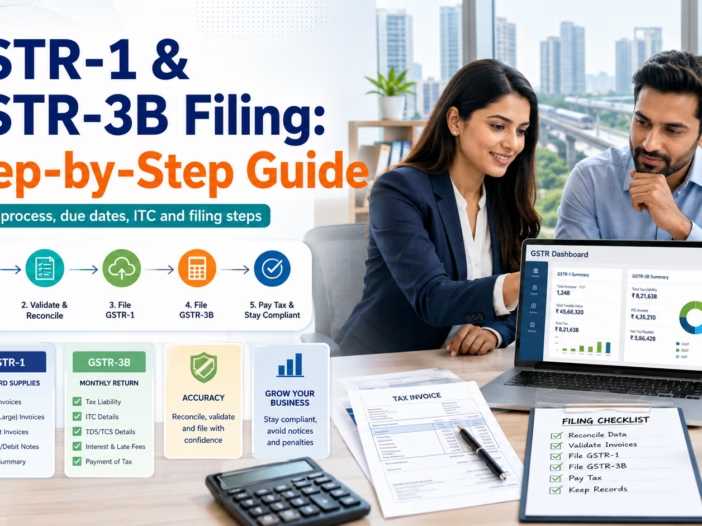
GST return filing is an important compliance requirement for every regular GST-registered business. Among the various GST returns, GSTR-1 and GSTR-3B are the two returns that most regular taxpayers need to deal with every month or quarter.
In simple terms, GSTR-1 contains details of your outward supplies or sales. GSTR-3B, on the other hand, summarises your GST liability, eligible Input Tax Credit (ITC), reversals, and final tax payment.
Therefore, businesses should prepare both returns together and reconcile the figures before filing. This is especially important for businesses in Greater Noida and across India because incorrect reporting may result in ITC mismatches, interest, late fees, or GST notices.
Where Should You File GSTR-1 and GSTR-3B?
Taxpayers should file their GST returns only through the Government of India’s official GST Portal.
You can access the portal here: Official GST Portal – www.gst.gov.in
After logging in, generally navigate to:
Services → Returns → Returns Dashboard
From the Returns Dashboard, select the relevant financial year and return filing period. You can then prepare and file GSTR-1 and GSTR-3B.
The GST Portal’s official GSTR-1 guidance also confirms the return dashboard process.
What Is GSTR-1?
GSTR-1 is a statement of outward supplies.
In simple words, it contains details of the sales made by a GST-registered taxpayer during a particular month or quarter.
GSTR-1 may contain details relating to:
- B2B sales made to GST-registered customers
- B2C sales made to unregistered customers
- Export supplies
- Supplies to SEZ units or developers
- Credit notes and debit notes
- Nil-rated supplies
- Exempt supplies
- Non-GST outward supplies
- HSN or SAC-wise summary
- Documents issued during the return period
- Supplies made through e-commerce operators, where applicable
Therefore, GSTR-1 plays an important role not only for the seller but also for the buyer. Correct B2B invoice reporting helps the recipient identify the invoice through the GST system for ITC purposes.
What Is GSTR-3B?
GSTR-3B is a summary GST return.
Unlike GSTR-1, taxpayers generally do not report every sales invoice separately in GSTR-3B. Instead, they report consolidated figures.
GSTR-3B broadly contains:
- Taxable outward supplies
- Zero-rated supplies
- Nil-rated and exempt supplies
- Reverse charge liability
- Eligible Input Tax Credit
- ITC reversals
- Ineligible ITC
- GST payable
- GST paid through the Electronic Credit Ledger
- GST paid through the Electronic Cash Ledger
- Interest and late fee, wherever applicable
Therefore, taxpayers use GSTR-3B to discharge their final GST liability for the relevant tax period.
Difference Between GSTR-1 and GSTR-3B
| Particulars | GSTR-1 | GSTR-3B |
|---|---|---|
| Main purpose | Reporting outward supplies | Reporting summary liability and paying GST |
| Sales details | Detailed reporting | Consolidated reporting |
| Invoice-wise B2B details | Yes | Generally no |
| ITC claim | No | Yes |
| GST payment | No | Yes |
| GSTR-2B relevance | Indirect | Directly relevant for ITC |
| Same-period correction | GSTR-1A may be used before GSTR-3B | No normal revision after filing |
Therefore, taxpayers should reconcile GSTR-1 and GSTR-3B instead of preparing them independently.
Normal Due Dates for GSTR-1 and GSTR-3B
The filing due date depends on whether the taxpayer files monthly returns or has opted for the Quarterly Return Monthly Payment Scheme (QRMP).
Monthly Return Filers
| Return | Normal Due Date |
|---|---|
| GSTR-1 | 11th of the following month |
| GSTR-3B | 20th of the following month |
For example, the normal due date for July GSTR-1 is 11 August, while the normal due date for July GSTR-3B is 20 August, unless the government extends the due date.
QRMP Taxpayers
Eligible taxpayers with aggregate annual turnover up to ₹5 crore may opt for the QRMP Scheme, subject to prescribed conditions.
Under QRMP:
- GSTR-1 is generally filed quarterly.
- GSTR-3B is generally filed quarterly.
- Tax is paid monthly through the prescribed mechanism.
- IFF may be used during the first two months of the quarter.
The normal quarterly GSTR-1 due date is the 13th of the month following the quarter.
The normal quarterly GSTR-3B due date is the 22nd or 24th of the month following the quarter, depending on the State or Union Territory.
For a taxpayer whose principal place of business is in Uttar Pradesh, including Greater Noida, the normal QRMP GSTR-3B due date is the 24th of the month following the quarter.
Government extensions or notifications may change a due date for a particular period. Therefore, taxpayers should always check the official GST Portal before filing.
Step 1: Prepare Your Sales Records
Before you start filing GSTR-1, prepare your sales records for the relevant month or quarter.
Keep the following information ready:
- Sales register
- Tax invoices
- Debit notes
- Credit notes
- Export invoices
- E-invoice details, wherever applicable
- E-way bill details, wherever applicable
- Customer GSTIN
- Invoice date
- Invoice number
- Place of Supply
- HSN or SAC
- Taxable value
- GST rate
- IGST
- CGST
- SGST
- Cess, wherever applicable
- Exempt and nil-rated sales
Next, compare your sales register with your accounting software.
For example, if your books show taxable sales of ₹25 lakh but the data prepared for GSTR-1 shows ₹24 lakh, identify the ₹1 lakh difference before filing the return.
This simple reconciliation can prevent future GST mismatches.
Step 2: Log In to the Official GST Portal
Visit the official GST Portal and log in using your GST credentials.
After logging in, navigate to:
Services → Returns → Returns Dashboard
Then:
- Select the relevant Financial Year.
- Select the return filing period.
- Click Search.
- Locate GSTR-1.
- Choose the applicable preparation or filing option.
Taxpayers can prepare GSTR-1 online or use other permitted utilities depending on their requirements.
Step 3: Report B2B Sales
B2B means Business to Business.
These are sales made to customers who are registered under GST.
For B2B transactions, carefully verify:
- Customer GSTIN
- Invoice number
- Invoice date
- Taxable value
- Invoice value
- GST rate
- Place of Supply
- IGST or CGST and SGST treatment
- Reverse charge status, wherever applicable
An incorrect GSTIN can cause problems for your customer because the invoice may not appear correctly for ITC reconciliation.
Therefore, verify the customer’s GSTIN before filing GSTR-1.
Step 4: Report B2C Sales
B2C means Business to Consumer.
These supplies are generally made to persons who are not registered under GST.
B2C transactions are broadly divided into B2C Large and B2C Others for GSTR-1 reporting.
B2C Large
Taxpayers should remember an important change in the B2C Large threshold.
For current return periods, an inter-State taxable supply made to an unregistered person where the invoice value exceeds ₹1 lakh falls under B2C Large.
Therefore, taxpayers should not use the earlier ₹2.5 lakh limit for current return periods.
B2C Others
This category generally covers:
- Intra-State supplies made to unregistered persons
- Inter-State supplies to unregistered persons where the invoice value does not exceed ₹1 lakh
These transactions are generally reported in consolidated form according to the applicable GSTR-1 table.
Step 5: Report Credit Notes and Debit Notes
If your business issues credit notes or debit notes, report them correctly in GSTR-1.
A credit note may arise when:
- A customer returns goods
- You reduce the value of a supply
- You charged excess GST
- You charged excess taxable value
- A permissible post-sale adjustment takes place
Similarly, you may issue a debit note when you originally charged less value or tax than required.
Since these documents may also affect the recipient’s ITC, report them carefully.
Step 6: Report Export and SEZ Supplies
Exporters must report export invoices in the relevant section of GSTR-1.
Similarly, supplies made to SEZ units or SEZ developers should be reported separately.
Depending on the transaction, exports or SEZ supplies may be:
- With payment of IGST
- Without payment of IGST under LUT or bond
Therefore, exporters should reconcile GSTR-1 with export invoices, shipping details, LUT records, and other supporting documents.
Incorrect reporting may also delay GST refund claims.
Step 7: Report Nil-Rated, Exempt and Non-GST Supplies
Many taxpayers assume that sales without GST do not need to be reported.
However, applicable nil-rated, exempt and non-GST outward supplies should also be reported in the appropriate section of GSTR-1.
Therefore, businesses having both taxable and exempt supplies should maintain separate records.
Step 8: Complete the HSN or SAC Summary
GSTR-1 requires taxpayers to report an HSN or SAC-wise summary of outward supplies.
Businesses selling goods should maintain correct HSN codes, while service providers should maintain correct SAC codes.
The number of HSN digits required depends on the applicable turnover criteria and GST rules.
The GST Portal has strengthened HSN validations and the current GSTR-1 system separately considers B2B and B2C information in Table 12. The portal may also display validation messages where Table 12 figures do not match the relevant outward-supply tables.
Therefore, taxpayers should reconcile the HSN summary with their sales register before filing.
Step 9: Report Documents Issued
GSTR-1 also requires information relating to documents issued during the tax period.
Depending on the nature of the business, these may include:
- Tax invoices
- Debit notes
- Credit notes
- Receipt vouchers
- Refund vouchers
- Delivery challans
- Other prescribed documents
The current GST Portal validation also makes Table 13 mandatory in specified cases where data has been reported in applicable GSTR-1 tables.
Therefore, businesses should maintain a proper document and invoice series throughout the year.
Step 10: Generate and Review the GSTR-1 Summary
After entering all applicable details, generate the GSTR-1 summary.
Then compare it with your books.
Check:
- Total sales
- Taxable turnover
- B2B sales
- B2C sales
- Export sales
- Exempt supplies
- Credit notes
- Debit notes
- IGST
- CGST
- SGST
- HSN or SAC summary
If you make changes after generating the summary, regenerate it and review the figures again.
Do not file GSTR-1 merely because the portal has accepted the data. You should first confirm that the figures agree with your records.
Step 11: File GSTR-1
Once you verify all the information, proceed with GSTR-1 filing.
You can file the return using the authentication method available and applicable to you, such as DSC or EVC.
After successful filing, download and preserve the filed return and acknowledgement.
Step 12: Use GSTR-1A if You Find an Error
Suppose you file GSTR-1 and later discover that you missed an invoice or reported certain information incorrectly.
In eligible cases, GSTR-1A allows you to make additions or amendments for the same tax period before filing the corresponding GSTR-3B.
This facility can help taxpayers correct certain GSTR-1 errors without waiting for a later month’s GSTR-1.
However, GSTR-1A is available only within the permitted filing window before the corresponding GSTR-3B is filed.
Therefore, after filing GSTR-1, review it once more before moving to GSTR-3B.
Step 13: Review the Invoice Management System
The Invoice Management System, commonly known as IMS, has become an important part of purchase-side GST reconciliation.
Supplier records reported through GSTR-1, GSTR-1A, IFF and other applicable statements may flow into the recipient’s IMS.
Depending on the type of record, the recipient may be able to:
- Accept the record
- Reject the record
- Keep the record pending, where permitted
- Take no action
IMS has also received additional functionality over time, including changes introduced for tax periods from October 2025 onwards. Therefore, taxpayers should review the action available for each type of document instead of following an old one-rule-fits-all approach.
Step 14: Download and Reconcile GSTR-2B
GSTR-2B is an auto-drafted ITC statement.
It contains information received from different GST sources, including supplier filings.
However, taxpayers should never assume that every amount appearing in GSTR-2B is automatically eligible for ITC.
Compare GSTR-2B with your purchase register and check:
- Supplier GSTIN
- Invoice number
- Invoice date
- Taxable value
- GST amount
- Whether goods or services were received
- Whether the purchase relates to business
- Whether ITC is blocked
- Whether reversal provisions apply
- Whether the statutory time limit has expired
The GST Portal itself states that GSTR-3B may auto-populate information from GSTR-2B, but taxpayers must still self-assess ITC eligibility under other legal provisions.
Step 15: Recompute GSTR-2B Where Required
The IMS framework allows taxpayers to take certain actions even after the draft GSTR-2B is generated.
Where a later IMS action affects GSTR-2B, the taxpayer may need to recompute GSTR-2B before filing GSTR-3B.
The revised IMS guidance explains that filed supplier records are considered for ITC computation and that actions taken after draft GSTR-2B generation may require recomputation before GSTR-3B filing.
Therefore, complete your IMS review before finalising the ITC claim.
Step 16: Open GSTR-3B
Once you complete the purchase and ITC reconciliation, return to the official GST Portal.
Navigate to:
Services → Returns → Returns Dashboard
Select the relevant financial year and return period.
Then open GSTR-3B and proceed with preparation.
The GST system may auto-populate several figures from GSTR-1, GSTR-1A and GSTR-2B.
However, you should always verify the auto-populated values.
Step 17: Check Outward Supplies and Tax Liability
Review the outward-supply section of GSTR-3B.
Depending on the business, it may contain:
- Taxable outward supplies
- Zero-rated outward supplies
- Nil-rated or exempt supplies
- Non-GST outward supplies
- Reverse charge liability
- Other applicable categories
Most importantly, reconcile the GSTR-3B tax liability with GSTR-1 and GSTR-1A.
For example, if GSTR-1 shows taxable sales of ₹20 lakh but GSTR-3B shows ₹18 lakh, identify the ₹2 lakh difference before filing.
Step 18: Check Inter-State Supplies
GSTR-3B also requires State-wise details of certain inter-State supplies.
These may include applicable supplies made to:
- Unregistered persons
- Composition taxpayers
- UIN holders
Therefore, select the correct Place of Supply while preparing your sales data.
Step 19: Verify Eligible Input Tax Credit
Next, review the ITC section of GSTR-3B.
The system may auto-populate applicable figures from GSTR-2B.
However, taxpayers must still verify eligibility.
Common ITC categories may include:
- Import of goods
- Import of services
- Reverse charge supplies
- ISD credit
- Other eligible ITC
Only claim ITC that satisfies the applicable GST conditions.
Step 20: Check ITC Reversals
Some ITC may need to be reversed even if the invoice appears in GSTR-2B.
Examples may include:
- Blocked credit under Section 17(5)
- Rule 42 reversal
- Rule 43 reversal
- Credit relating to exempt supplies
- Credit relating to non-business use
- Temporary reversals
- Other reversals required under GST law
Therefore, GSTR-2B should form the starting point for ITC reconciliation, not the final answer.
Step 21: Calculate the Net GST Payable
After verifying output tax and eligible ITC, calculate the tax that remains payable.
In simple terms:
Output GST liability – Eligible ITC = Balance GST payable through cash
However, taxpayers must follow the prescribed CGST, SGST and IGST credit utilisation rules.
The GST Portal assists with the utilisation of the Electronic Credit Ledger while offsetting liability.
Step 22: Create a GST Challan if Required
If the Electronic Cash Ledger does not contain sufficient balance, create a GST challan.
Use one of the payment modes available on the GST Portal and deposit the required amount.
After payment, verify that the amount appears under the correct tax heads in your Electronic Cash Ledger.
Step 23: Preview GSTR-3B Before Filing
Never file GSTR-3B without reviewing the final figures.
Check:
- Taxable turnover
- Output IGST
- Output CGST
- Output SGST
- Reverse charge liability
- Eligible ITC
- ITC reversal
- Net cash liability
- Interest
- Late fee
- Electronic Credit Ledger utilisation
- Electronic Cash Ledger utilisation
Auto-populated GSTR-3B information remains subject to taxpayer verification and self-assessment.
Therefore, download or review the system-generated summary before proceeding.
Step 24: File GSTR-3B
Once you verify the return:
- Proceed to payment.
- Offset the applicable liability.
- Confirm the declaration.
- Select the authorised signatory.
- File GSTR-3B through the applicable DSC or EVC facility.
After successful filing, download and preserve the return and acknowledgement.
Can GSTR-3B Be Revised After Filing?
GSTR-3B does not have a normal revision facility after filing.
Therefore, taxpayers should carefully review all figures before submitting the return.
If you discover an error later, the method of correction will depend on the nature of the error and the provisions applicable to that transaction.
What Happens if GSTR-1 and GSTR-3B Do Not Match?
Taxpayers should reconcile their outward liability reported in GSTR-1 with the liability reported in GSTR-3B.
An unexplained mismatch can lead to GST compliance issues.
Therefore, check:
- Taxable turnover
- IGST
- CGST
- SGST
- Credit notes
- Debit notes
- Export turnover
- Amendments made through GSTR-1A
- Other adjustments
If a difference exists, identify and document the reason before filing the return.
Late Fee for Delayed Filing
Late filing of GSTR-1 or GSTR-3B may attract a late fee.
Broadly, the general daily rate is:
| Type of Return | General Late Fee |
|---|---|
| Return having transactions | ₹50 per day |
| Nil return | ₹20 per day |
The amount is divided between CGST and SGST.
However, maximum late-fee limits, concessions, waivers and special notifications may apply.
Therefore, taxpayers should verify the actual late fee through the official GST Portal and relevant government notifications.
Interest on Delayed GST Payment
Interest may also apply when a taxpayer pays GST after the applicable due date.
The general interest rate for delayed tax payment is 18% per annum in applicable cases under Section 50 of the CGST Act.
However, the actual interest calculation depends on the type of liability, period of delay and applicable provisions.
Therefore, taxpayers should distinguish between late fee and interest.
Late fee applies because of delayed return filing, while interest generally relates to delayed payment of tax.
Common Mistakes While Filing GSTR-1
Taxpayers should avoid the following mistakes:
- Entering an incorrect customer GSTIN
- Selecting the wrong Place of Supply
- Missing sales invoices
- Missing credit or debit notes
- Applying an incorrect GST rate
- Using an incorrect HSN or SAC
- Using the old ₹2.5 lakh B2C Large threshold for current periods
- Ignoring exempt and nil-rated supplies
- Filing without reconciling e-invoice data
- Filing without checking the sales register
- Ignoring GSTR-1A when an eligible same-period correction is required
- Incorrectly completing the HSN summary or document details
Common Mistakes While Filing GSTR-3B
Similarly, taxpayers should avoid:
- Claiming the entire GSTR-2B amount without checking ITC eligibility
- Claiming blocked ITC
- Ignoring IMS
- Missing required ITC reversals
- Reporting GSTR-3B turnover differently from GSTR-1 without reconciliation
- Missing reverse charge liability
- Paying GST under the wrong tax head
- Ignoring interest or late fee
- Filing without checking the system-generated summary
- Filing GSTR-3B before completing necessary GSTR-1A corrections
Simple GSTR-1 and GSTR-3B Filing Workflow
A business in Greater Noida can follow this practical process:
Prepare sales register
↓
Reconcile sales and tax liability
↓
File GSTR-1
↓
Review filed GSTR-1
↓
Use GSTR-1A if an eligible correction is required
↓
Review IMS
↓
Download or recompute GSTR-2B
↓
Match GSTR-2B with purchase register
↓
Identify eligible and ineligible ITC
↓
Prepare GSTR-3B
↓
Reconcile GSTR-1 with GSTR-3B
↓
Calculate GST payable
↓
Create challan, if required
↓
Pay GST
↓
Preview GSTR-3B
↓
File GSTR-3B
↓
Download and preserve filed returns
Following the same process every month or quarter can significantly reduce GST errors.
Example of GSTR-1 and GSTR-3B Filing
Suppose a business in Greater Noida has the following figures:
Taxable sales: ₹10,00,000
Output GST: ₹1,80,000
Eligible ITC after reconciliation: ₹1,20,000
First, the taxpayer reports the applicable sales details in GSTR-1.
Next, the taxpayer reviews IMS and reconciles GSTR-2B with the purchase register.
After checking ITC eligibility, suppose the taxpayer confirms eligible ITC of ₹1,20,000.
The basic calculation will be:
Output GST liability: ₹1,80,000
Less eligible ITC: ₹1,20,000
Balance GST payable: ₹60,000
The taxpayer can then pay the remaining amount according to the applicable CGST, SGST and IGST utilisation rules and file GSTR-3B.
Why Regular GST Reconciliation Is Important
Taxpayers should not wait until the end of the financial year to reconcile GST.
Monthly or quarterly reconciliation helps identify:
- Missing sales invoices
- Missing purchase invoices
- Duplicate invoices
- Incorrect GSTINs
- Wrong GST rates
- Excess ITC
- Short ITC
- Supplier reporting errors
- Credit-note mismatches
- IMS issues
- GSTR-1 and GSTR-3B differences
As a result, businesses can correct errors earlier and reduce the chances of notices, interest and unexpected GST liabilities.
Conclusion
GSTR-1 and GSTR-3B are closely connected GST compliances.
GSTR-1 reports detailed outward supplies, while GSTR-3B reports the summary GST liability, eligible Input Tax Credit and final tax payment.
Therefore, taxpayers should first prepare and reconcile their sales records, file GSTR-1, make eligible same-period corrections through GSTR-1A where required, review IMS, reconcile GSTR-2B with the purchase register, and finally prepare and file GSTR-3B.
Businesses in Greater Noida and across India should maintain proper sales, purchase, invoice and ITC records throughout the year. Regular reconciliation can help prevent incorrect ITC claims, return mismatches, interest, late fees and GST notices.
For security and authenticity, taxpayers should always use the Government’s Official GST Portal for GST registration, return filing and other GST services rather than relying on unofficial links for statutory filing.
Frequently Asked Questions
1. What is GSTR-1?
GSTR-1 is a statement of outward supplies in which a GST-registered taxpayer reports sales and other applicable outward-supply details.
2. What is GSTR-3B?
GSTR-3B is a summary return used to report GST liability, claim eligible Input Tax Credit and pay the remaining GST liability.
3. Where can I file GSTR-1 and GSTR-3B online?
Taxpayers can file GSTR-1 and GSTR-3B through the Government of India’s Official GST Portal.
After logging in, go to Services → Returns → Returns Dashboard.
4. What is the due date for monthly GSTR-1?
The normal due date for monthly GSTR-1 is the 11th of the following month, subject to any extension announced by the government.
5. What is the due date for monthly GSTR-3B?
The normal due date for a regular monthly GSTR-3B filer is generally the 20th of the following month.
6. What is the QRMP GSTR-3B due date for Greater Noida?
For a taxpayer whose principal place of business is in Uttar Pradesh, including Greater Noida, the normal quarterly GSTR-3B due date under QRMP is the 24th of the month following the quarter.
7. Who can opt for the QRMP Scheme?
Eligible taxpayers with aggregate annual turnover up to ₹5 crore may opt for QRMP, subject to the conditions prescribed under GST law.
8. Is IFF mandatory for QRMP taxpayers?
No. IFF is an optional facility for eligible QRMP taxpayers.
9. What is the current B2C Large threshold in GSTR-1?
For current return periods, an inter-State taxable supply to an unregistered person with an invoice value exceeding ₹1 lakh generally falls under the B2C Large category.
10. Can I correct GSTR-1 after filing?
GSTR-1A allows eligible additions and amendments for the same return period after filing GSTR-1 but before filing the corresponding GSTR-3B.
11. Can I use GSTR-1A after filing GSTR-3B?
No. GSTR-1A for the same period cannot normally be used after the corresponding GSTR-3B has been filed.
12. What is GSTR-2B?
GSTR-2B is an auto-drafted ITC statement that contains information from supplier filings and other prescribed sources.
13. Can I claim the entire ITC shown in GSTR-2B?
No. You should claim only the ITC that is eligible under GST law after checking the relevant conditions and reversals.
14. What is IMS under GST?
IMS stands for Invoice Management System. It allows recipients to review supplier records and take the applicable action before finalising their ITC position.
15. Can GSTR-2B change after IMS action?
Where an action taken through IMS affects ITC after draft GSTR-2B generation, the taxpayer may need to recompute GSTR-2B before filing GSTR-3B.
16. Can GSTR-3B be revised after filing?
There is no normal facility to revise an already filed GSTR-3B. Therefore, taxpayers should verify it carefully before filing.
17. What happens if GSTR-1 and GSTR-3B do not match?
An unexplained difference may result in GST compliance issues or mismatch proceedings. Therefore, taxpayers should reconcile the returns before filing GSTR-3B.
18. Is late fee applicable to a Nil GST return?
Yes. Delayed Nil returns may also attract late fees, subject to applicable limits, waivers and government notifications.
19. Is interest payable for delayed GST payment?
Interest may apply on delayed GST payment under Section 50 of the CGST Act. The applicable calculation depends on the facts and relevant provisions.
20. Should I reconcile GSTR-2B every month?
Yes. Regular reconciliation helps identify missing invoices, supplier errors, duplicate invoices and ineligible ITC before GSTR-3B filing.
21. Why is GST reconciliation important for businesses in Greater Noida?
Regular reconciliation helps businesses claim correct ITC, report accurate tax liability, identify supplier errors and reduce the risk of GST notices, interest and late fees.
22. Can a Chartered Accountant assist with GSTR-1 and GSTR-3B filing?
Yes. A Chartered Accountant can assist with GSTR-1 preparation, GSTR-2B reconciliation, IMS review, ITC verification, GSTR-3B preparation, tax payment, mismatch reconciliation and GST notice compliance.