
Introduction
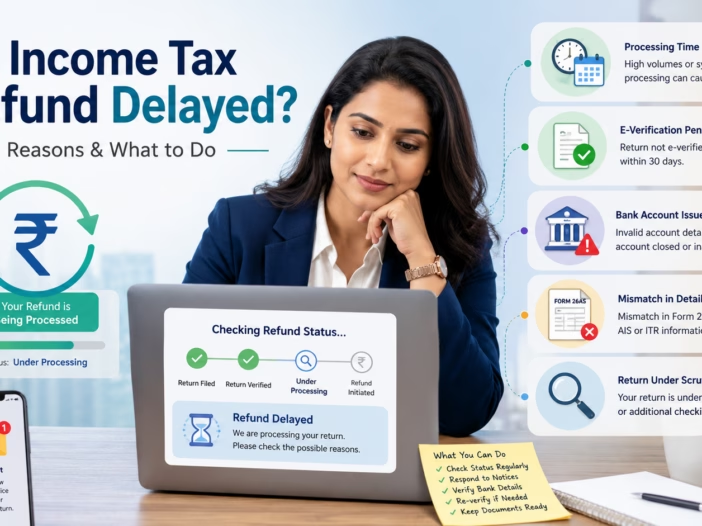
Waiting for an Income Tax Refund can be frustrating, especially when you filed your Income Tax Return on time and expected the money to reach your bank account quickly. In many cases, taxpayers file their ITR correctly but still find that the refund remains under processing, gets adjusted against an old demand, or fails because of a bank account issue.
According to the Income Tax Department, refund processing starts after the taxpayer successfully e-verifies the return. Generally, the refund may take around 4 to 5 weeks to reach the taxpayer’s bank account. However, the actual time can vary depending on return processing, verification requirements, tax credit mismatches, bank validation, outstanding demands, or other compliance issues.
Therefore, if your Income Tax Refund is delayed, you should first identify the exact reason instead of simply waiting. This article explains the major reasons for refund delays and the practical steps you can take to resolve them.
How Does an Income Tax Refund Arise?
An Income Tax Refund generally arises when the total tax already paid on your behalf is higher than your final tax liability.
For example, a refund may arise because of:
- Excess TDS deducted from salary, professional receipts, interest, rent, or other income
- Excess advance tax paid
- Excess self-assessment tax paid
- Higher TDS appearing in Form 26AS than your actual tax liability
- Eligible deductions or exemptions reducing your final tax liability
After you file and verify your ITR, the Centralised Processing Centre processes your return and determines whether any refund is payable.
How Long Does an Income Tax Refund Normally Take?
The Income Tax Department states that a refund usually takes around 4 to 5 weeks after the return has been e-verified.
However, this is only the usual processing period and not a guarantee that every refund will arrive within the same time. If your refund does not arrive within this period, you should check the refund status, your registered email, pending actions, and any communication issued by the Income Tax Department.
For taxpayers in Greater Noida or anywhere else in India, the same online process applies.
Main Reasons Why Your Income Tax Refund May Be Delayed
1. Your ITR Has Not Been E-Verified
Filing an ITR alone does not complete the return filing process. You must also verify the return.
Generally, you must complete e-verification or submit ITR-V within 30 days from the date of filing the return. If you fail to verify it within the prescribed period, the return may be treated as invalid, subject to the applicable rules and condonation process.
Therefore, always check whether your return shows “Successfully e-Verified.”
You can usually e-verify through Aadhaar OTP, net banking, bank account EVC, demat account EVC, DSC, or other permitted methods.
2. AIS, TIS or Form 26AS Does Not Match Your ITR
Another common reason for a delayed refund is a mismatch between the information reported in your ITR and information available with the Income Tax Department.
For example, suppose you claim TDS of ₹50,000 in your ITR, but only ₹40,000 appears in Form 26AS. The system may not allow the entire tax credit claimed by you.
Similarly, differences may arise because of:
- Interest income not reported in the ITR
- Dividend income not reported
- Incorrect TDS amount
- Wrong TAN of the deductor
- Missing tax payment challan
- Capital gain transactions not reported correctly
- Property transactions appearing in AIS
- Mutual fund or share transactions not considered
- High-value transactions reported by banks or other institutions
The Income Tax portal provides a Tax Credit Mismatch facility that allows taxpayers to check differences between tax credits claimed in the return and tax credits available in Form 26AS.
Therefore, always compare your ITR with AIS, TIS and Form 26AS before filing.
3. Your Refund Claim Is Selected for Confirmation
In certain cases, the Income Tax Department may identify a refund claim under its risk-management process.
The Department may ask you to confirm whether the deductions, exemptions, income details and refund claimed in your return are correct.
In such cases, simply waiting may not solve the problem. You may need to log in to the e-Filing portal and check Pending Actions or Worklist for a “Response for Refund Confirmation.”
The Department also advises taxpayers to review their AIS before confirming the refund claim.
If the refund claim is correct, you can confirm it. However, if you find an error in your ITR, you should take the appropriate corrective action within the permitted time.
4. Bank Account Is Not Validated
The Income Tax Department can issue the refund only to an eligible validated bank account nominated for receiving the refund.
For successful bank validation, you should generally have an active bank account linked with your PAN.
Refund problems may occur if:
- The bank account is closed
- The account number is incorrect
- IFSC has changed
- PAN details do not match bank records
- Bank account validation has failed
- The account has not been nominated for refund
Therefore, check your bank account details on the e-Filing portal before assuming that CPC has delayed your refund.
5. Refund Was Issued but Failed
Sometimes CPC processes the return and issues the refund, but the bank rejects the payment.
In this situation, your status may show something similar to “Refund Failed.”
Once you correct and validate your bank details, you can submit a Refund Reissue Request.
The current portal path is:
Services → Refund Reissue → Create Refund Reissue Request
After selecting the relevant refund, choose a validated bank account and complete verification.
6. An Old Income Tax Demand Is Pending
A taxpayer may have an old outstanding demand relating to an earlier assessment year.
For example, suppose your current refund is ₹25,000 but an old outstanding demand of ₹15,000 exists. The Income Tax Department may adjust the refund against that demand after following the applicable process.
Therefore, you should regularly check:
Pending Actions → Response to Outstanding Demand
If you do not respond to an outstanding demand, the Department may confirm the demand and adjust it against an available refund.
If you believe the demand is incorrect, submit your response instead of ignoring it.
7. PAN Is Inoperative Due to PAN-Aadhaar Issue
PAN-Aadhaar problems can also delay a refund.
The Income Tax Department has issued communications stating that where PAN becomes inoperative because of non-linking with Aadhaar, a determined refund and applicable interest may remain on hold under Section 139AA(2) read with the relevant rules.
Therefore, if your ITR is already processed but the refund remains on hold, check your PAN-Aadhaar status.
8. CPC Has Made an Adjustment While Processing Your Return
Sometimes the refund claimed in your ITR differs from the refund calculated by CPC.
For example, you may claim ₹60,000 as a refund, while CPC calculates only ₹35,000.
In this situation, download your Intimation under Section 143(1) and compare the figures reported in your return with the figures calculated by the Department.
Common reasons include incorrect deductions, TDS mismatches, incorrect tax calculations or income differences.
9. A Defective Return or Other Compliance Issue Is Pending
Your return may also require further action because of a defective return notice, compliance communication, e-Campaign or another pending proceeding.
Therefore, check your registered email and the Pending Actions section of the e-Filing portal regularly.
Ignoring a notice can delay the final processing of your return.
What to Do If Your Income Tax Refund Is Delayed
Step 1: Check Your ITR and Refund Status
Log in to the Income Tax e-Filing portal.
Go to:
e-File → Income Tax Returns → View Filed Returns
The Income Tax Department officially provides this facility for checking the processing and refund status of filed returns.
Check the exact status shown against your return.
| Refund/ITR Status | What It Means | What You Should Do |
|---|---|---|
| Pending for e-Verification | Return verification is incomplete | Complete e-verification immediately |
| Successfully e-Verified | Verification completed but processing may be pending | Wait for CPC processing and monitor status |
| Processing | CPC is processing the return | Normally no immediate action is required unless a communication appears |
| Processed with Refund Due | CPC has determined a refund | Check refund issue status and bank account |
| Processed with No Refund | CPC calculated no refund | Download Section 143(1) intimation and compare calculations |
| Refund Failed | Bank could not credit the refund | Validate bank account and submit Refund Reissue Request |
| Refund Adjusted Against Demand | Refund has been adjusted against an outstanding demand | Review and respond to the outstanding demand |
| Refund on Hold | Further compliance may be required | Check Pending Actions, Worklist, PAN-Aadhaar status and emails |
Step 2: Confirm That Your ITR Is Verified
Check whether the return has been successfully verified.
If verification is still pending, complete it immediately.
Remember, CPC normally starts refund processing only after successful verification of the return.
Step 3: Compare ITR With AIS, TIS and Form 26AS
Next, compare the income and taxes reported in your ITR with the information available in:
- Annual Information Statement
- Taxpayer Information Summary
- Form 26AS
- Form 16
- Form 16A
- Tax payment challans
Pay special attention to TDS and high-value financial transactions.
If your refund depends heavily on TDS credit, even a small mismatch can affect the refund calculation.
Step 4: Download the Section 143(1) Intimation
Once CPC processes your return, download the Intimation under Section 143(1).
You can generally find it under:
e-File → Income Tax Returns → View Filed Returns → Download Intimation Order
Compare your filed figures with CPC’s calculation.
If CPC has reduced your refund, the intimation normally helps you identify the reason.
Step 5: Check Pending Actions and Refund Confirmation
If everything appears correct but the refund remains on hold, check:
Pending Actions → Worklist
Also review e-Proceedings, Compliance Portal communications and outstanding demands.
If you find a Refund Confirmation request, review your ITR and AIS carefully before submitting your response.
Step 6: File Rectification If CPC Made an Apparent Error
If your return has already been processed and CPC has made a mistake that is apparent from the record, you may file an online rectification request.
The portal path is:
Services → Rectification
The Income Tax Department specifically advises that rectification should be used for mistakes apparent from the record. It should not be used to correct your own filing errors where a revised return is the proper remedy.
Step 7: File a Revised Return If Your ITR Contains an Error
If you discover that you omitted income, claimed an incorrect deduction or entered incorrect information in your original return, you may file a Revised Return within the applicable statutory time limit.
For AY 2026–27, which relates to income earned during FY 2025–26, proceedings continue to be governed by the Income-tax Act, 1961 despite the transition to the Income-tax Act, 2025. Accordingly, a revision for AY 2026–27 continues under Section 139(5) of the 1961 Act.
Therefore, taxpayers should be careful not to mix the provisions applicable to AY 2026–27 with those applicable to later tax years under the new Act.
Step 8: Submit a Refund Reissue Request
If CPC issued your refund but the bank rejected it, first validate the correct bank account.
Then go to:
Services → Refund Reissue → Create Refund Reissue Request
Select the relevant refund, choose your validated bank account and complete verification.
Step 9: Submit a Grievance If the Refund Remains Unresolved
If your ITR has been properly verified and processed, your bank account is valid, no demand is pending and no compliance action is required, but the refund still remains unresolved, you can submit a grievance through the Income Tax e-Filing portal.
However, you should first complete all available actions shown under your account instead of raising a grievance immediately after filing.
Important Tips to Avoid Income Tax Refund Delays
Before filing your next Income Tax Return, follow these precautions:
- Check AIS, TIS and Form 26AS before filing.
- Verify all TDS entries carefully.
- Report bank interest and other income correctly.
- Use a correct and active bank account.
- Validate and nominate the bank account for refund.
- Complete e-verification immediately after filing.
- Keep your PAN and Aadhaar compliance updated where applicable.
- Check old outstanding demands before filing.
- Monitor your registered email after filing.
- Respond promptly to Income Tax notices and refund-confirmation requests.
These small checks can prevent unnecessary refund delays.
Conclusion
An Income Tax Refund delay does not always mean that something is wrong with your return. Sometimes CPC simply needs additional processing time. However, if the normal processing period has passed, you should actively check your refund status instead of waiting indefinitely.
Start by confirming your e-verification status. Then check AIS, TIS, Form 26AS, your bank account, Section 143(1) intimation, outstanding demands and Pending Actions. If CPC has made an apparent error, consider rectification. If your own return contains an error and revision is legally available, file the appropriate revised return. Similarly, if the refund has failed because of bank details, submit a Refund Reissue Request.
Taxpayers in Greater Noida can complete most of these steps online. However, where the refund involves a large amount, incorrect demand, TDS mismatch, capital gains, business income or multiple tax notices, taking professional advice can help prevent further mistakes.
Frequently Asked Questions
1. How long does an Income Tax Refund normally take?
According to the Income Tax Department, refunds usually take around 4 to 5 weeks after successful e-verification. However, the actual processing time can vary depending on the return and any verification or compliance issues.
2. How can I check my Income Tax Refund status?
Log in to the Income Tax e-Filing portal and go to:
e-File → Income Tax Returns → View Filed Returns
Select the relevant Assessment Year to check the processing and refund status.
3. My ITR is processed, but I have not received the refund. What should I do?
First check whether the refund has been issued. Then check whether your bank account is validated and nominated for refund. If the status shows “Refund Failed,” submit a Refund Reissue Request.
4. Can the Income Tax Department adjust my refund against an old tax demand?
Yes. An outstanding demand can affect your current refund. You should check Pending Actions → Response to Outstanding Demand and respond if you disagree with the demand.
5. What should I do if my bank account has changed?
Add your current bank account to the Income Tax portal, complete validation and nominate an eligible validated account for refund. If an earlier refund has already failed, submit a Refund Reissue Request.
6. Can an AIS or Form 26AS mismatch delay my refund?
Yes. Differences in reported income, TDS, TCS or tax payments can affect processing and the refund calculated by CPC. Therefore, compare your ITR with AIS, TIS and Form 26AS carefully.
7. What happens if I did not e-verify my ITR?
An ITR must be verified within the prescribed period to complete the filing process. The general time limit for e-verification or submission of ITR-V is 30 days from filing.
8. What does “Refund Failed” mean?
It generally means CPC attempted to issue the refund, but the payment could not be credited to your bank account. Correct and validate the bank account details and then submit a Refund Reissue Request.
9. Can PAN-Aadhaar non-linking affect an Income Tax Refund?
Where PAN becomes inoperative because of applicable PAN-Aadhaar linking requirements, the Department may hold the determined refund and applicable interest until the issue is resolved.
10. Should I file a revised return just because my refund is delayed?
No. Do not file a revised return only because the refund is taking time. First identify the reason for the delay. File a revised return only when you actually find an error or omission in your filed ITR and revision is legally available.
11. When should I file a rectification request?
You can consider rectification when CPC has already processed your return and there is a mistake apparent from the record, such as certain tax-credit or processing errors. Rectification is not a substitute for correcting an incorrect return filed by the taxpayer.
12. What should I do if there is no problem but my refund is still pending?
Check your registered email, refund status, Worklist, Pending Actions, outstanding demands and bank validation first. If everything is complete and the refund continues to remain unresolved beyond the normal processing period, you can raise a grievance through the Income Tax e-Filing portal.