
Introduction
Employee Stock Option Plans, commonly known as ESOPs, have become an important part of employee compensation in India. Startups and established companies use ESOPs to reward employees, retain talent and create a sense of ownership.
ESOPs can help employees build substantial wealth when the company’s share value increases. However, many employees confuse the estimated value of their ESOPs with actual cash in hand. As a result, they may face a tax liability even before selling the shares.
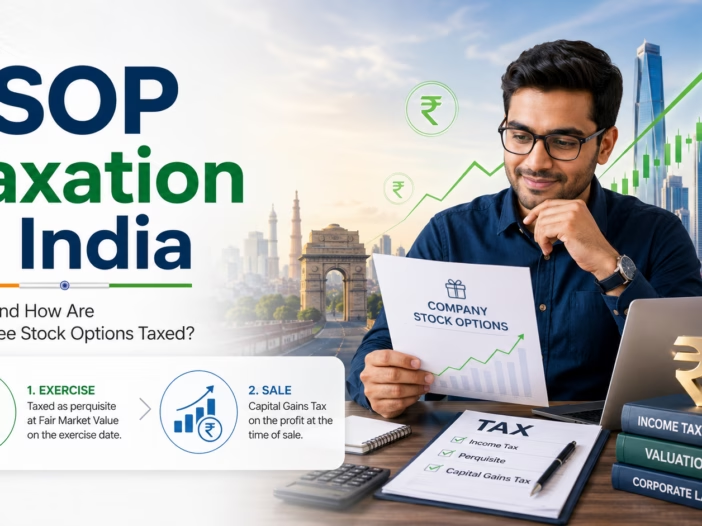
In India, the tax system generally taxes ESOPs at two stages:
- When the employee exercises the options, the benefit becomes taxable as salary income.
- When the employee sells the shares, the profit becomes taxable as capital gains.
Therefore, employees in Greater Noida and across India should understand the tax impact before exercising or selling ESOP shares.
What Is an ESOP?
An Employee Stock Option Plan gives an employee the right to purchase shares of the employer company at a predetermined price after fulfilling certain conditions.
The company does not issue shares immediately at the time of grant. Instead, it gives the employee an option to buy shares after the options vest.
The predetermined price is called the exercise price or strike price.
For example, a company may allow an employee to purchase its shares at ₹100 per share even when the fair market value stands at ₹500 per share. In this case, the difference of ₹400 per share represents a financial benefit for the employee.
Important Stages in the ESOP Lifecycle
An ESOP normally passes through four stages: grant, vesting, exercise and sale.
Grant
At the grant stage, the company offers a specified number of stock options to the employee.
The grant letter usually mentions:
- Number of options;
- Exercise price;
- Vesting conditions;
- Vesting schedule; and
- Exercise period.
No tax normally arises when the company grants the options.
Vesting
Vesting gives the employee the right to exercise the options after completing the required service period or performance conditions.
For example, a company may grant 1,000 ESOPs that vest equally over four years.
Merely vesting the options does not normally create a tax liability.
Exercise
The employee exercises vested options by paying the exercise price to the company.
After receiving the payment, the company allots or transfers the shares to the employee.
At this stage, the difference between the fair market value and the exercise price becomes taxable as a salary perquisite.
Sale
Once the employee receives the shares, those shares become capital assets.
Later, when the employee sells them, the resulting profit or loss becomes taxable under the head “Capital Gains.”
The ESOP lifecycle can be understood as follows:
Grant → Vesting → Exercise and allotment → Sale
No tax → No tax → Salary perquisite tax → Capital gains tax
How Are ESOPs Taxed in India?
The Income Tax Act generally taxes ESOPs at two separate stages.
First, it taxes the benefit received by the employee as salary income.
Later, it taxes the profit earned from selling the shares as capital gains.
This two-stage system covers:
- The discount received when the employee buys shares below their fair market value; and
- The increase in share value after the employee acquires the shares.
Stage 1: Tax on ESOPs at the Time of Exercise
When an employee exercises ESOPs, the employee purchases the shares at the exercise price.
If the fair market value exceeds the exercise price, the employee receives a benefit from the employer. The Income Tax Department treats this benefit as a taxable salary perquisite.
Technically, the taxable event generally arises when the company allots or transfers the shares after the employee exercises the options.
Formula for Calculating the ESOP Perquisite
The employer calculates the taxable perquisite as follows:
Perquisite value = (Fair market value on the exercise date − Exercise price) × Number of shares
Example
Suppose an employee exercises 1,000 ESOPs with the following details:
- Exercise price: ₹100 per share
- Fair market value on the exercise date: ₹500 per share
- Number of shares: 1,000
The taxable perquisite will be:
(₹500 − ₹100) × 1,000 = ₹4,00,000
The employer will add ₹4,00,000 to the employee’s taxable salary.
The employee will then pay tax according to the applicable income-tax slab rate. Surcharge and health and education cess may also apply.
TDS on ESOP Perquisite
The employer generally deducts tax at source on the ESOP perquisite as part of salary TDS.
Usually, the employer reports the perquisite value in:
- Form 16;
- Form 12BA; and
- Salary records.
To recover the tax, the employer may deduct TDS from the employee’s salary or ask the employee to deposit the required amount before allotting the shares.
This situation can create a serious cash-flow issue because the employee may need to pay:
- The exercise price for the shares; and
- The tax on the perquisite value.
At the same time, the employee may not receive any cash because the shares remain unsold.
For this reason, employees should calculate the exercise cost and tax liability before exercising a large number of ESOPs.
How Is the Fair Market Value of ESOP Shares Determined?
The valuation method depends on whether the shares are listed or unlisted.
Fair Market Value of Listed Shares
For shares listed on a recognised stock exchange, the fair market value generally depends on the average of the opening and closing prices on the exercise date.
If the shares trade on more than one recognised stock exchange, the calculation generally considers the exchange with the highest trading volume.
In case no trading takes place on the exercise date, the valuation may use the nearest preceding trading date on which the shares were traded.
Therefore, employees should not use any random price available during the day.
Fair Market Value of Unlisted Shares
For unlisted shares, a Category-I Merchant Banker registered with SEBI generally determines the fair market value.
The valuation must follow the conditions prescribed under the Income Tax Rules.
Employees should obtain a copy of the valuation report or perquisite calculation from the employer and keep it for future reference.
Stage 2: Tax When ESOP Shares Are Sold
After the company allots the shares, the employee becomes their legal owner.
These shares qualify as capital assets. Therefore, any profit or loss from their sale falls under the head “Capital Gains.”
Formula for Calculating Capital Gains
The employee calculates capital gains as follows:
Capital gain = Sale value − Cost of acquisition − Eligible transfer expenses
For ESOP shares, the fair market value already considered while calculating the salary perquisite generally becomes the cost of acquisition.
Accordingly:
Capital gain = (Sale price − Fair market value considered at exercise) × Number of shares
The original exercise price does not become the cost of acquisition for capital-gains purposes because the employer has already included the discount as a salary perquisite.
This method prevents double taxation of the same amount.
Example of Two-Stage ESOP Taxation
Suppose an employee holds 1,000 ESOPs with the following details:
- Exercise price: ₹100 per share
- Fair market value on the exercise date: ₹500 per share
- Sale price: ₹900 per share
- Number of shares: 1,000
Tax at the Exercise Stage
The employer calculates the salary perquisite as follows:
(₹500 − ₹100) × 1,000 = ₹4,00,000
Accordingly, the employer adds ₹4,00,000 to the employee’s salary income.
If the employee falls under the 30% tax slab, the basic tax on the perquisite will be ₹1,20,000. Applicable surcharge and cess will apply separately.
Tax at the Sale Stage
The employee calculates the capital gain as follows:
(₹900 − ₹500) × 1,000 = ₹4,00,000
The applicable tax rate will depend on:
- Whether the shares are listed or unlisted;
- How long the employee held them;
- Whether securities transaction tax conditions apply;
- The employee’s residential status; and
- Other relevant facts.
How Is the Holding Period Calculated?
The holding period generally starts from the date on which the company allots or transfers the shares to the employee.
It does not normally start from:
- The grant date;
- The vesting date; or
- The employee’s joining date.
Hence, the allotment or transfer date plays an important role in deciding whether the capital gain is short-term or long-term.
Tax on Listed ESOP Shares
Listed equity shares generally qualify as long-term capital assets when the employee holds them for more than 12 months.
A holding period of 12 months or less normally results in short-term capital gains.
Short-Term Capital Gains on Listed Shares
Eligible short-term capital gains covered under Section 111A are generally taxed at 20%, subject to applicable conditions such as payment of securities transaction tax.
Surcharge and health and education cess apply separately.
Long-Term Capital Gains on Listed Shares
Eligible long-term capital gains covered under Section 112A are generally taxed at 12.5%.
However, tax applies only to the total eligible long-term capital gains exceeding ₹1.25 lakh during the financial year.
The ₹1.25 lakh exemption applies to the total gains covered under Section 112A and not separately to each sale or each company.
Tax on Unlisted ESOP Shares
Unlisted shares generally qualify as long-term capital assets when the employee holds them for more than 24 months.
A holding period of 24 months or less normally results in short-term capital gains.
Short-Term Capital Gains on Unlisted Shares
Short-term capital gains from unlisted shares generally form part of the employee’s total income.
The applicable income-tax slab rate then applies to those gains.
Long-Term Capital Gains on Unlisted Shares
Long-term capital gains from unlisted shares are generally taxed at 12.5% without indexation.
The ₹1.25 lakh exemption available under Section 112A does not ordinarily apply to unlisted shares.
Applicable surcharge and health and education cess may increase the final tax liability.
Summary of Tax Rates
| Type of shares | Nature of gain | General holding period | General tax treatment |
|---|---|---|---|
| Listed equity shares | Short-term capital gain | 12 months or less | 20% under Section 111A, subject to conditions |
| Listed equity shares | Long-term capital gain | More than 12 months | 12.5% on eligible gains exceeding ₹1.25 lakh under Section 112A |
| Unlisted shares | Short-term capital gain | 24 months or less | Taxed according to the applicable slab rate |
| Unlisted shares | Long-term capital gain | More than 24 months | Generally taxed at 12.5% without indexation |
The final tax treatment may differ for non-residents, foreign shares, off-market transactions or transactions that do not satisfy the required conditions.
Example: Listed and Unlisted Shares
Assume that an employee earns a capital gain of ₹4,00,000 after selling ESOP shares.
Listed Shares Held for 18 Months
Since the employee held the listed shares for more than 12 months, they qualify as long-term capital assets.
If the gain qualifies under Section 112A and the employee has not used the ₹1.25 lakh threshold against other eligible gains, the taxable amount will generally be:
₹4,00,000 − ₹1,25,000 = ₹2,75,000
Tax at 12.5% will be:
₹2,75,000 × 12.5% = ₹34,375
Applicable surcharge and cess will apply separately.
Where the employee has already used the ₹1.25 lakh exemption against other eligible gains, the entire ₹4,00,000 may become taxable at 12.5%.
Unlisted Shares Held for 18 Months
Unlisted shares generally require a holding period of more than 24 months to qualify as long-term capital assets.
Since the employee held the shares for only 18 months, the gain will normally remain short-term.
The employee will add ₹4,00,000 to total income and pay tax according to the applicable slab rate.
Special ESOP Tax Deferral for Employees of Eligible Startups
Employees of certain eligible startups may receive relief from immediate tax payment on the ESOP perquisite.
This relief does not remove the tax liability. Instead, it postpones the deduction and payment of tax.
The provision generally applies only when the employer qualifies as an eligible startup under the prescribed income-tax provisions.
DPIIT recognition alone may not always be sufficient. The startup must also satisfy the relevant conditions under the Income Tax Act.
Under the special rule, the employer defers the deduction or payment of tax until a prescribed event occurs.
The tax generally becomes payable within 14 days from the earliest of the following events:
- Forty-eight months from the end of the relevant assessment year in which the company allotted or transferred the shares;
- The date on which the employee leaves the eligible startup; or
- The date on which the employee sells the shares.
Important Point for Startup Employees
The relief only defers tax. It does not provide a permanent exemption.
For example, an employee may exercise ESOPs in an unlisted startup and later resign before selling the shares. In that case, the deferred tax may become payable even though the employee has not received any money from the shares.
Therefore, startup employees should carefully assess the tax impact before exercising ESOPs or leaving the company.
What Happens If the Share Value Falls After Exercise?
An employee may pay salary tax based on the fair market value at the time of exercise, but the share value may later decline.
Consider the following example:
- Exercise price: ₹100
- Fair market value at exercise: ₹500
- Taxable perquisite: ₹400 per share
- Sale price: ₹300
The employee will still pay salary tax on the perquisite of ₹400 per share.
For capital-gains purposes, the fair market value of ₹500 generally becomes the cost of acquisition.
If the employee sells the share for ₹300, the transaction creates a capital loss of ₹200 per share.
The employee cannot normally reverse the salary tax merely because the share value falls later.
However, the employee may set off or carry forward the capital loss according to the applicable provisions, provided the Income Tax Return is filed within the prescribed time.
This risk makes exercise planning especially important in the case of unlisted startup shares.
Tax Treatment of Foreign Company ESOPs
Many Indian employees receive ESOPs from foreign parent companies.
Depending on the employee’s residential status and other relevant facts, India may tax both the perquisite and the capital gain.
Foreign ESOPs may also involve additional reporting requirements, such as:
- Reporting foreign shares in the foreign-assets schedule;
- Reporting foreign income;
- Disclosing foreign brokerage or custodial accounts;
- Claiming foreign tax credit, where applicable;
- Filing the correct Income Tax Return form; and
- Following the relevant foreign-exchange rules.
A resident and ordinarily resident employee may need to disclose foreign shares even when no sale has taken place.
Incorrect or incomplete foreign-asset reporting can lead to serious consequences. Therefore, employees holding foreign company ESOPs should obtain professional advice before filing their tax returns.
Which ITR Form Applies to ESOP Income?
An employee with only salary income and ESOP perquisite income may use the applicable salary return form, subject to all other conditions.
Once the employee sells ESOP shares and earns capital gains, ITR-2 will generally apply if the employee does not have business or professional income.
ITR-1 generally cannot be used when the taxpayer has capital gains beyond its permitted scope or holds reportable foreign assets.
Employees should also reconcile the ESOP details with:
- Form 16;
- Form 12BA;
- Form 26AS;
- Annual Information Statement; and
- The employer’s ESOP statement.
Documents Employees Should Keep
Proper records help employees calculate tax accurately and respond to future income-tax inquiries.
Employees should preserve:
- ESOP grant letter;
- Vesting schedule;
- Exercise application;
- Proof of payment of the exercise price;
- Share allotment confirmation;
- Demat statement;
- Fair market value certificate;
- Merchant banker valuation report for unlisted shares;
- Form 16 and Form 12BA;
- Employer’s perquisite calculation;
- Sale contract note;
- Brokerage and transfer-expense details;
- Foreign tax payment proof, where applicable; and
- Bank statements relating to the exercise and sale.
Common Mistakes Employees Make
Treating the Grant of ESOPs as Taxable Income
The grant of options does not normally create an immediate tax liability.
Tax generally arises when the company allots or transfers the shares after exercise and again when the employee sells them.
Using the Exercise Price as the Cost of Acquisition
For capital-gains purposes, the fair market value already used for calculating the salary perquisite generally becomes the cost of acquisition.
Ignoring TDS at the Exercise Stage
Some employees calculate only the exercise price and overlook the TDS liability.
This mistake can create a major cash shortage.
Calculating the Holding Period from the Grant Date
The holding period generally begins from the date of allotment or transfer of shares.
It does not normally begin from the grant or vesting date.
Assuming Startup Deferral Means Tax Exemption
The startup relief only postpones tax payment.
It does not waive the tax.
Failing to Report Foreign ESOPs
Foreign shares and accounts may require separate disclosure in the Income Tax Return, even where no sale has taken place.
Ignoring Capital Losses
If the sale price falls below the fair market value considered at exercise, the employee may incur a capital loss.
The employee should report the loss correctly and file the return within the prescribed time to preserve eligible carry-forward benefits.
How Can Employees Plan ESOP Taxes Better?
Before exercising ESOPs, employees should estimate:
- Total exercise cost;
- Fair market value;
- Salary perquisite;
- TDS liability;
- Sale restrictions;
- Lock-in period;
- Availability of buyers;
- Expected capital-gains tax; and
- Risk of a fall in share value.
Where the ESOP scheme permits, the employee may consider exercising the options in phases instead of exercising all vested options at once.
At the same time, the employee should consider the option expiry date, company valuation, liquidity prospects and personal financial position.
Employees in Greater Noida may consult a Chartered Accountant before exercising ESOPs, especially when the shares are unlisted, foreign or high in value.
Conclusion
ESOPs can create significant wealth, but they can also create tax obligations at different stages.
The first tax generally arises when the employee exercises the options and receives shares at a value higher than the exercise price. The employer treats the difference as a salary perquisite and deducts TDS.
The second tax arises when the employee sells the shares. The difference between the sale price and the fair market value already considered at exercise becomes a capital gain or loss.
Employees should not exercise ESOPs merely because the company’s valuation appears attractive.
A proper decision should consider:
- Exercise price;
- Perquisite tax;
- Liquidity;
- Holding period;
- Lock-in conditions;
- Expected sale value; and
- Capital-gains tax.
Careful planning and proper documentation can help employees manage cash flow, calculate tax correctly and avoid future tax notices.
Frequently Asked Questions
1. Are ESOPs taxable when they are granted?
No. The grant of ESOPs does not normally create an immediate tax liability.
2. Are vested ESOPs taxable?
No. Vesting only gives the employee the right to exercise the options. Tax generally arises when the company allots or transfers the shares after exercise.
3. When are ESOPs taxed in India?
ESOPs are generally taxed at two stages. The first tax arises as a salary perquisite at exercise, while the second tax arises as capital gains at sale.
4. How is the taxable ESOP perquisite calculated?
The taxable perquisite is calculated as follows:
(Fair market value on the exercise date − Exercise price) × Number of shares
5. Who deducts TDS on ESOPs?
The employer generally deducts TDS on the taxable ESOP perquisite as part of salary TDS.
6. What is the cost of acquisition when ESOP shares are sold?
The fair market value already considered for calculating the salary perquisite generally becomes the cost of acquisition.
7. Are listed ESOP shares long-term after 12 months?
Listed equity shares are generally treated as long-term capital assets when held for more than 12 months.
8. Are unlisted ESOP shares long-term after 24 months?
Unlisted shares are generally treated as long-term capital assets when held for more than 24 months.
9. What is the tax rate on short-term gains from listed ESOP shares?
Eligible short-term capital gains covered under Section 111A are generally taxed at 20%, plus applicable surcharge and cess.
10. What is the tax rate on long-term gains from listed ESOP shares?
Eligible long-term capital gains covered under Section 112A are generally taxed at 12.5% on gains exceeding ₹1.25 lakh during the financial year.
11. What is the tax rate on unlisted ESOP shares?
Short-term gains from unlisted shares are generally taxed according to the employee’s slab rate. Long-term gains are generally taxed at 12.5% without indexation.
12. Is the ₹1.25 lakh exemption available on unlisted shares?
No. The ₹1.25 lakh threshold generally applies to eligible long-term capital gains covered under Section 112A and not to ordinary unlisted shares.
13. Do startup employees receive an exemption from ESOP tax?
Eligible startup employees may receive a tax deferral on the ESOP perquisite. The law does not provide a complete exemption.
14. When does the deferred startup ESOP tax become payable?
The tax generally becomes payable within 14 days from the earliest prescribed event, such as the expiry of the specified period, leaving employment or selling the shares.
15. What happens if ESOP shares fall in value after exercise?
The salary perquisite tax generally remains payable based on the fair market value at exercise. A later sale below that value may result in a capital loss.
16. Are foreign company ESOPs taxable in India?
They may be taxable in India depending on the employee’s residential status and other relevant facts. Foreign asset and income disclosures may also apply.
17. Which ITR form should an employee use after selling ESOP shares?
An employee earning capital gains from ESOP shares will generally file ITR-2 if the employee does not have business or professional income.
18. Can an employee claim expenses against ESOP capital gains?
Eligible expenses incurred wholly and exclusively in connection with the transfer may generally be deducted while calculating capital gains.
19. Can a capital loss on ESOP shares be carried forward?
An eligible capital loss may be carried forward according to the applicable provisions. The employee should file the Income Tax Return within the prescribed due date.
20. Should an employee consult a tax professional before exercising ESOPs?
Professional advice is recommended when the perquisite value is substantial, the shares are unlisted, the employer is a foreign company or the employee plans to leave the company before selling the shares.