Introduction
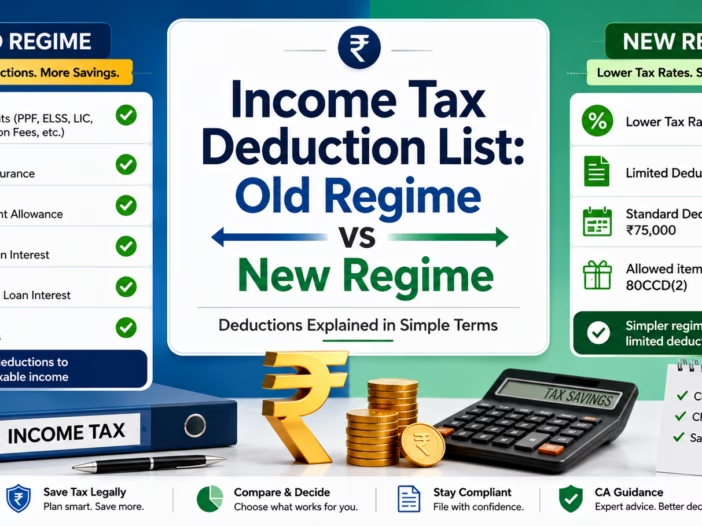
Many taxpayers get confused while choosing between the old tax regime and the new tax regime. The main reason is simple: the old tax regime allows more deductions, while the new tax regime gives lower tax rates but allows fewer deductions.
Therefore, before filing your Income Tax Return, you should compare both regimes carefully. A salaried person, business owner, professional, pensioner, or individual taxpayer in Greater Noida should not select a tax regime only by looking at the tax slab. Instead, they should also check which deductions are allowed and which deductions are not allowed.
In this article, we will explain the complete deduction list under the old tax regime and the new tax regime in simple layman’s language.
What Is the Old Tax Regime?
The old tax regime is the traditional income tax system. In this regime, the tax rates may be higher, but taxpayers can claim many deductions and exemptions.
For example, if you invest in LIC, PPF, ELSS, pay children’s tuition fees, pay home loan principal, pay medical insurance premium, live in a rented house, or pay home loan interest, the old regime may help you save tax.
In simple words, the old regime is useful for those taxpayers who do proper tax planning and have enough eligible deductions.
What Is the New Tax Regime?
The new tax regime gives lower tax rates, but it removes most common deductions and exemptions. From AY 2024-25 onwards, the new tax regime became the default regime, but eligible taxpayers can still choose the old tax regime while filing ITR.
Under the new regime, taxpayers cannot claim most popular deductions such as Section 80C, Section 80D, HRA, LTA, and home loan interest on self-occupied property. However, a few selected deductions are still allowed.
Why Deductions Matter While Choosing Tax Regime
Deductions reduce your taxable income. When taxable income goes down, tax liability also goes down.
For example, if your gross income is ₹10,00,000 and you claim deductions of ₹2,00,000, your taxable income becomes ₹8,00,000. This can reduce your tax amount significantly under the old regime.
However, under the new regime, you may not get these deductions. Therefore, you should compare both options before filing your return.
Deductions Allowed in Old Tax Regime
The old tax regime allows many deductions and exemptions. Some of the most common deductions are given below.
1. Standard Deduction for Salaried Persons
Salaried employees and pensioners can claim standard deduction from salary income.
This deduction reduces taxable salary income directly. It is one of the most commonly used deductions for salaried taxpayers.
2. Section 80C Deduction
Section 80C is one of the most popular tax-saving deductions under the old regime. A taxpayer can claim deduction up to ₹1,50,000 under this section.
Common eligible items include:
- Life insurance premium
- Public Provident Fund
- Employees’ Provident Fund
- ELSS mutual funds
- Children’s tuition fees
- National Savings Certificate
- Tax-saving fixed deposit
- Sukanya Samriddhi Yojana
- Principal repayment of housing loan
This deduction is not available under the new tax regime.
3. Section 80D Deduction for Medical Insurance
Section 80D gives deduction for medical insurance premium paid for self, spouse, dependent children, and parents.
This deduction is very useful because it gives tax benefit and also encourages health insurance planning.
However, this deduction is available only under the old tax regime. It is not allowed under the new regime.
4. HRA Exemption
House Rent Allowance, commonly known as HRA, is available to salaried employees who live in rented accommodation.
For example, if a person works in Greater Noida or Delhi NCR and lives in a rented house, he may claim HRA exemption if he receives HRA as part of salary and pays rent.
HRA exemption is allowed only under the old tax regime. It is not allowed under the new tax regime.
5. Home Loan Interest Deduction
Under the old regime, a taxpayer can claim deduction for interest paid on housing loan for a self-occupied house property, subject to the prescribed limit.
This is an important deduction for people who have purchased a house through a home loan.
In the new regime, interest on home loan for self-occupied house property is not allowed as a deduction.
6. Home Loan Principal Repayment
Principal repayment of home loan is covered under Section 80C. Therefore, it can be claimed within the overall limit of ₹1,50,000 under the old regime.
This deduction is not available under the new tax regime.
7. Section 80CCD(1B) Deduction for Own NPS Contribution
A taxpayer can claim an additional deduction up to ₹50,000 for own contribution to the National Pension System under Section 80CCD(1B).
This benefit is available under the old tax regime.
However, own NPS contribution under Section 80CCD(1B) is not allowed under the new tax regime.
8. Section 80E Deduction for Education Loan Interest
If a taxpayer pays interest on an education loan, he can claim deduction under Section 80E.
This deduction is available only for interest amount, not for principal repayment.
It is allowed under the old tax regime but not under the new tax regime.
9. Section 80G Deduction for Donations
Donations made to eligible funds and charitable institutions can be claimed under Section 80G.
The deduction may be 50% or 100%, depending on the type of donation and institution.
This deduction is generally available under the old regime but not available under the new tax regime.
10. Section 80TTA and 80TTB Deduction
Section 80TTA gives deduction for interest on savings bank account to individuals and HUFs.
Section 80TTB gives deduction to senior citizens for interest income from deposits, subject to the prescribed limit.
These deductions are allowed under the old regime but not under the new regime.
11. LTA Exemption
Leave Travel Allowance, or LTA, is available to salaried employees for travel expenses, subject to conditions.
This exemption is available only under the old tax regime.
It is not available under the new tax regime.
12. Deduction for Disabled Persons and Medical Treatment
The old tax regime also allows deductions under sections such as 80DD, 80DDB, and 80U, subject to conditions.
These deductions are useful in cases involving disability, dependent disability, or specified medical treatment.
These deductions are not available under the new tax regime.
Deductions Allowed in New Tax Regime
The new tax regime allows only limited deductions. Therefore, taxpayers should not assume that all deductions are available in the new regime.
The Income Tax Department states that Chapter VI-A deductions are generally not allowed under the new regime, except specific deductions such as Section 80CCD(2), Section 80CCH, and Section 80JJAA. Standard deduction is also available for salaried taxpayers under the new regime.
1. Standard Deduction for Salaried Persons
Under the new tax regime, salaried employees can claim standard deduction up to ₹75,000.
This is one of the most important deductions allowed in the new regime.
2. Family Pension Deduction
Family pension deduction is also available under the new tax regime.
This deduction is useful where a person receives family pension after the death of a family member.
3. Employer Contribution to NPS under Section 80CCD(2)
Employer’s contribution to NPS is allowed as deduction under the new tax regime.
For AY 2026-27, the Income Tax Department’s ITR validation rules mention that deduction under Section 80CCD(2) in the new tax regime should not be more than 14% of salary.
This deduction is different from own NPS contribution. Own NPS contribution under Section 80CCD(1B) is not allowed in the new regime.
4. Section 80CCH Deduction for Agnipath Scheme
Deduction under Section 80CCH is available in relation to the Agnipath Scheme, subject to applicable conditions.
The Income Tax Department’s new vs old regime FAQ also mentions Section 80CCH as one of the deductions that can be claimed under the new regime.
5. Section 80JJAA Deduction
Section 80JJAA deduction is related to employment of new employees. It mainly applies to eligible businesses and employers.
This deduction is also one of the limited deductions allowed under the new tax regime, as per the Income Tax Department FAQ.
6. Conveyance and Official Duty Allowances
Certain allowances related to official duty may still be exempt under the new regime. For example, conveyance allowance or daily allowance may be exempt to the extent actually spent for official purposes.
These are not general tax-saving deductions. They apply only when the allowance is related to official duty and conditions are satisfied.
Old Regime vs New Regime Deduction Comparison
| Deduction / Exemption | Old Tax Regime | New Tax Regime |
|---|---|---|
| Standard deduction for salary | Allowed | Allowed |
| Section 80C | Allowed | Not allowed |
| Section 80D medical insurance | Allowed | Not allowed |
| HRA exemption | Allowed | Not allowed |
| LTA exemption | Allowed | Not allowed |
| Home loan interest on self-occupied property | Allowed | Not allowed |
| Home loan principal repayment | Allowed under 80C | Not allowed |
| Own NPS contribution under 80CCD(1B) | Allowed | Not allowed |
| Employer NPS contribution under 80CCD(2) | Allowed | Allowed |
| Education loan interest under 80E | Allowed | Not allowed |
| Donation under 80G | Allowed | Generally not allowed |
| Savings interest under 80TTA | Allowed | Not allowed |
| Senior citizen interest under 80TTB | Allowed | Not allowed |
| Agnipath Scheme under 80CCH | Allowed, subject to conditions | Allowed, subject to conditions |
| 80JJAA employment deduction | Allowed, subject to conditions | Allowed, subject to conditions |
Deductions Not Allowed in New Tax Regime
The following common deductions are not allowed under the new tax regime:
- Section 80C deduction
- Section 80D medical insurance deduction
- HRA exemption
- LTA exemption
- Home loan interest on self-occupied house
- Home loan principal repayment deduction
- Own NPS contribution under Section 80CCD(1B)
- Education loan interest under Section 80E
- Donation deduction under Section 80G
- Savings account interest deduction under Section 80TTA
- Senior citizen interest deduction under Section 80TTB
Therefore, if a taxpayer has many deductions, the old tax regime may still be better.
Which Tax Regime Should You Choose?
You should choose the regime after comparing actual tax liability under both options.
The old tax regime may be better if you have:
- LIC, PPF, ELSS, EPF, tuition fee or home loan principal
- Medical insurance premium
- HRA exemption
- Home loan interest
- NPS own contribution
- Education loan interest
- Donation deduction
On the other hand, the new tax regime may be better if you do not have many deductions and want a simple tax calculation with lower slab rates.
For example, many salaried employees in Greater Noida and Delhi NCR pay rent, invest in LIC or mutual funds, and pay home loan EMIs. Such taxpayers should compare both regimes before filing ITR.
Practical Example
Suppose a salaried person has gross income of ₹12,00,000.
If he chooses the old regime and claims deductions such as 80C, 80D, HRA, and home loan interest, his taxable income may reduce significantly.
However, if he chooses the new regime, he may get lower tax rates but may lose most of these deductions.
Therefore, the best regime depends on the taxpayer’s income, investment, rent, home loan, insurance, and other deductions.
Common Mistake Taxpayers Make
Many taxpayers choose the new regime only because the slab rates look lower. However, they forget that deductions are very limited in the new regime.
Similarly, some taxpayers choose the old regime only because they have heard that it gives more deductions. But if they do not actually have enough deductions, the new regime may save more tax.
Therefore, always calculate tax under both regimes before filing ITR.
Conclusion
The old tax regime and the new tax regime work differently. The old regime allows more deductions and exemptions, while the new regime allows only limited deductions with lower tax rates.
If you have deductions like 80C, 80D, HRA, home loan interest, education loan interest, donation, or NPS own contribution, the old regime may be useful. However, if you do not have many deductions, the new regime may be simpler and more beneficial.
Before filing your Income Tax Return, compare both regimes properly. A small mistake in selecting the tax regime can increase your tax liability. Therefore, taxpayers in Greater Noida and other cities should take professional advice where required.
FAQs
1. Which deductions are allowed in the new tax regime?
The new tax regime allows limited deductions such as standard deduction for salaried persons, family pension deduction, employer’s NPS contribution under Section 80CCD(2), Section 80CCH, and Section 80JJAA, subject to conditions.
2. Is Section 80C allowed in the new tax regime?
No, Section 80C deduction is not allowed in the new tax regime. Therefore, LIC, PPF, ELSS, tuition fee, tax-saving FD, and home loan principal repayment cannot be claimed under Section 80C in the new regime.
3. Is Section 80D medical insurance deduction allowed in the new tax regime?
No, Section 80D deduction for medical insurance premium is not allowed in the new tax regime.
4. Is HRA allowed in the new tax regime?
No, HRA exemption is not allowed in the new tax regime. If you want to claim HRA, you need to choose the old tax regime, subject to eligibility.
5. Is standard deduction allowed in the new tax regime?
Yes, standard deduction is allowed for salaried taxpayers under the new tax regime.
6. Is home loan interest allowed in the new tax regime?
Interest on home loan for self-occupied house property is not allowed as a deduction under the new tax regime.
7. Is employer NPS contribution allowed in the new tax regime?
Yes, employer contribution to NPS under Section 80CCD(2) is allowed under the new tax regime, subject to the prescribed limit.
8. Which regime is better if I have many deductions?
If you have many deductions like 80C, 80D, HRA, home loan interest, and NPS contribution, the old tax regime may be better. However, you should calculate tax under both regimes before making the final decision.
9. Which regime is better if I have no investment?
If you do not have tax-saving investments or deductions, the new tax regime may be better because it gives lower tax rates and simple calculation.
10. Can I change my tax regime every year?
Salaried individuals without business income can generally choose between old and new regimes every year while filing ITR. However, taxpayers having business or professional income must follow specific rules for opting in or opting out.