
Introduction
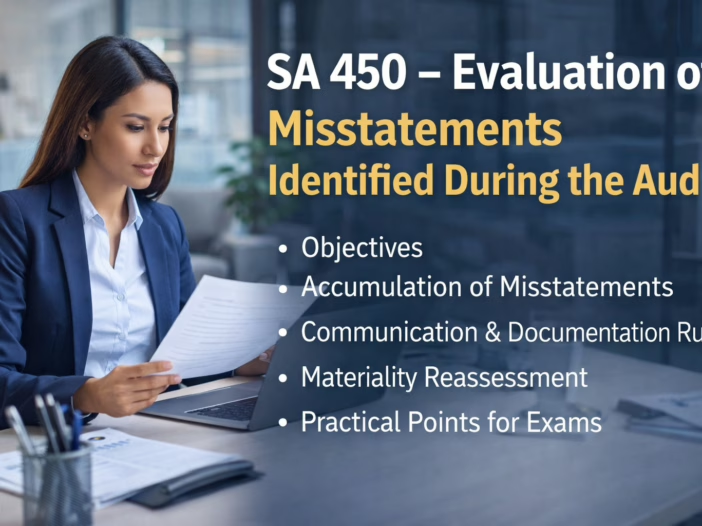
During the course of an audit, the auditor may identify errors, omissions, or incorrect disclosures in the financial statements. These are known as misstatements. SA 450 provides a clear framework for dealing with such misstatements in a systematic and professional manner.
This Standard ensures that the auditor evaluates every identified misstatement properly, communicates it to management and those charged with governance, and determines whether the financial statements as a whole remain free from material misstatement.
Objective of the Auditor
The auditor evaluates:
- The effect of identified misstatements on the audit process; and
- The effect of uncorrected misstatements, if any, on the financial statements.
Therefore, the auditor carefully assesses the impact of all detected errors before forming an audit opinion.
Accumulation of Misstatements
During the audit, the auditor accumulates all misstatements identified, except those that are clearly trivial.
Even small errors must be recorded unless they are insignificant both individually and in aggregate.
Revision of Audit Strategy
If the nature or circumstances of identified misstatements indicate the possible existence of additional misstatements, the auditor revises the audit strategy and audit plan.
Moreover, if the aggregate of misstatements approaches materiality determined under SA 320 (Revised), the auditor performs additional audit procedures.
Thus, the auditor continuously reassesses risk throughout the audit.
Communication with Management
The auditor communicates all accumulated misstatements to the appropriate level of management on a timely basis, unless law or regulation prohibits such communication.
Further, the auditor requests management to correct those misstatements.
This step ensures transparency and gives management an opportunity to rectify errors before finalizing the financial statements.
Reassessment of Materiality
Before evaluating uncorrected misstatements, the auditor reassesses materiality determined under SA 320.
Since actual financial results may differ from initial estimates, reassessment confirms whether the previously determined materiality level remains appropriate.
Communication with Those Charged with Governance (TCWG)
The auditor communicates the following matters to those charged with governance:
- Uncorrected misstatements;
- Their effect, individually or in aggregate, on the auditor’s report;
- Material uncorrected misstatements separately;
- The effect of prior-period uncorrected misstatements on current financial statements.
Additionally, the auditor requests correction of uncorrected misstatements.
This communication strengthens accountability and improves financial reporting quality.
Written Representation
The auditor requests written representation from management and, where appropriate, from those charged with governance stating that:
- They believe the effects of uncorrected misstatements are immaterial;
- Their evaluation considers both individual and aggregate impact on the financial statements as a whole.
A summary of such uncorrected misstatements forms part of, or is attached to, the written representation.
Audit Documentation Requirements
The auditor documents:
- The threshold below which misstatements are considered clearly trivial;
- All misstatements accumulated during the audit;
- Whether management corrected them;
- The conclusion on whether uncorrected misstatements are material, individually or in aggregate;
- The basis for that conclusion.
Proper documentation supports professional judgment and the final audit opinion.
Conclusion
SA 450 plays a vital role in ensuring the reliability of financial statements. It guides the auditor to identify, evaluate, communicate, and document misstatements in a structured manner.
By following this Standard, the auditor ensures that no material misstatement remains unaddressed and that the audit opinion reflects a true and fair view of the entity’s financial position.
Ultimately, SA 450 strengthens audit quality, enhances transparency, and protects the interests of stakeholders.