
Introduction
The Income-tax Act, 2025 came into effect on 1 April 2026. As a result, the Income Tax Department introduced new numbers and formats for several income-tax forms.
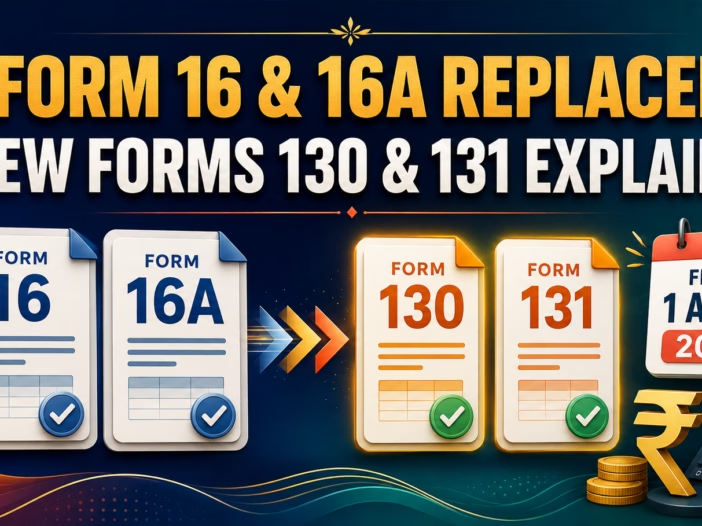
Under the new system, Form 16 has become Form 130, whereas Form 16A has become Form 131. Although the form numbers have changed, their basic purpose remains the same. Both certificates continue to show income, TDS deducted and tax deposited with the Government.
Therefore, salaried employees, professionals, employers and tax deductors in Greater Noida should understand these changes. A clear understanding will help them issue the correct TDS certificate and file their Income Tax Returns accurately.
What Has Changed in Form 16 and Form 16A?
The following table explains the change:
| Old form | New form | Purpose |
|---|---|---|
| Form 16 | Form 130 | TDS certificate for salary income |
| Form 16A | Form 131 | TDS certificate for income other than salary |
Section 395(4) of the Income-tax Act, 2025, read with Rule 215 of the Income-tax Rules, 2026, prescribes these new certificates.
However, the date on which the deductor issues a certificate does not alone decide whether the old or new form applies. Instead, the relevant income or payment period determines the correct form. Consequently, taxpayers may continue to receive old certificates during the transition period.
What Is Form 130?
Form 130 is the new TDS certificate for salary income. In other words, it replaces Form 16 under the Income-tax Act, 1961.
An employer issues Form 130 annually when it deducts TDS from an employee’s salary. The certificate explains how the employer calculated the employee’s taxable salary and TDS.
Form 130 generally contains the following information:
- Salary paid to the employee
- Exemptions considered by the employer
- Deductions allowed while calculating TDS
- Taxable salary
- Other income reported by the employee
- TDS deducted from salary
- TDS deposited with the Government
- Employer’s PAN and TAN
- Employee’s PAN
- Final tax calculation
Furthermore, Form 130 also covers eligible specified senior citizens in cases where a specified bank deducts tax from pension and interest income under the relevant provisions.
Thus, Form 130 acts as important proof of salary, eligible deductions and TDS deposited on behalf of the employee.
Different Parts of Form 130
Form 130 contains three main parts: Part A, Part B and Part C. Each part serves a different purpose.
Part A
Part A contains the basic details of the employer, employee and certificate. It generally includes:
- Employer’s name and address
- Employer’s PAN and TAN
- Employee’s name and address
- Employee’s PAN
- Relevant Tax Year
- Certificate details
Therefore, employees should first check Part A to confirm that the employer has used the correct personal and tax information.
Part B
Part B provides a summary of the amount paid or credited and the TDS deducted from it. In addition, it helps reconcile the salary and tax details reported by the employer.
Employees should compare this information with their salary slips and Form 26AS. If they notice any difference, they should contact the employer before filing their ITR.
Part C
Part C contains detailed information through two annexures.
First, Annexure I applies to salary income. It includes the detailed salary calculation, exemptions, deductions, other income reported by the employee and final tax computation.
In contrast, Annexure II applies to eligible specified senior citizens. It shows pension, interest and TDS details reported by the specified bank.
Together, these parts provide a complete summary of the relevant income and TDS calculation.
What Is Form 131?
Form 131 is the new TDS certificate for income other than salary. Accordingly, it replaces Form 16A under the earlier income-tax law.
A person must issue Form 131 when they deduct TDS from eligible non-salary payments. Such payments may include:
- Interest
- Professional fees
- Consultancy fees
- Commission
- Brokerage
- Contract payments
- Rent
- Other payments subject to TDS
For example, suppose a company in Greater Noida pays professional fees to a consultant and deducts TDS. In that case, the company must issue Form 131 after filing the applicable quarterly TDS statement.
Similarly, a bank may issue Form 131 when it deducts TDS from fixed deposit interest for a period covered by the new law.
Unlike Form 130, which employers issue annually, deductors issue Form 131 quarterly. This difference makes it easier to identify the purpose of each certificate.
Who Must Issue Form 131?
The person or organisation deducting TDS from a non-salary payment must issue Form 131 to the deductee.
However, the deductor cannot issue the certificate immediately after deducting tax. Instead, they must first complete the following process:
- Deduct TDS at the applicable rate.
- Deposit the deducted amount with the Government.
- File the applicable quarterly TDS statement.
- Allow the Income Tax Department to process the statement.
- Request Form 131 through the TRACES portal.
- Download and issue the certificate to the deductee.
Thus, the deductor cannot generate Form 131 before filing the relevant quarterly TDS statement. TRACES generates the certificate only after processing that statement.
As a result, any mistake in the TDS statement may also appear in Form 131. The deductor should, therefore, check all details carefully before issuing the certificate.
Form 130 vs Form 131
The following table explains the main differences:
| Particulars | Form 130 | Form 131 |
|---|---|---|
| Earlier form | Form 16 | Form 16A |
| Type of income | Salary income | Income other than salary |
| Issued by | Employer or specified bank | Person deducting TDS |
| Frequency | Annually | Quarterly |
| Main recipients | Employees and specified senior citizens | Professionals, contractors, landlords, deposit holders and other deductees |
| Purpose | Proof of TDS on salary or specified eligible income | Proof of TDS on non-salary payments |
| Related TDS statement | Form 138, earlier Form 24Q | Forms 140 and 144, earlier Forms 26Q and 27Q |
In simple words, Form 130 mainly covers salary income. On the other hand, Form 131 covers most non-salary payments on which a person deducts TDS.
Due Date for Issuing Form 130
An employer must issue Form 130 by 15 June of the financial year immediately following the relevant Tax Year.
For instance, an employer must issue Form 130 for salary paid during Tax Year 2026-27 by 15 June 2027.
Since the new certificate applies to salary for the period beginning on 1 April 2026, employees will generally receive their first Form 130 in 2027.
Meanwhile, Form 16 will continue to apply to salary for FY 2025-26. Employees should, therefore, not expect Form 130 for income earned before 1 April 2026.
Due Dates for Issuing Form 131
A deductor must issue Form 131 within 15 days from the due date of filing the relevant quarterly TDS statement.
| Quarter | Payment period | Due date for Form 131 |
|---|---|---|
| Q1 | April to June | 15 August |
| Q2 | July to September | 15 November |
| Q3 | October to December | 15 February |
| Q4 | January to March | 15 June of the following financial year |
Accordingly, a deductor must issue Form 131 for the April–June 2026 quarter by 15 August 2026.
However, the deductor must file the relevant TDS statement before generating the certificate. Any delay in filing or processing the statement may consequently delay the issue of Form 131.
Which Form Applies for FY 2025-26?
The new form numbers do not apply retrospectively to income and TDS relating to FY 2025-26.
Therefore, the following transition rules apply:
- Employers must issue Form 16 for salary paid during FY 2025-26.
- Deductors must issue Form 16A for non-salary payments made or credited up to 31 March 2026.
- The due date for issuing Form 16 for FY 2025-26 was 15 June 2026.
- The due date for Form 16A for the January–March 2026 quarter was 15 June 2026.
- Form 130 applies to salary for Tax Year 2026-27.
- Form 131 applies to eligible non-salary payments made or credited from 1 April 2026.
Thus, taxpayers may receive an old form even after the new Act has come into effect. Before treating such a certificate as incorrect, they should check the period to which it relates.
For example, an employer issuing a salary certificate for FY 2025-26 must use Form 16, even if it issues the certificate after 1 April 2026. Similarly, a deductor must use Form 16A for non-salary payments relating to the January–March 2026 quarter.
Transition from Old Forms to New Forms
The following table provides a simple summary:
| Income or payment period | Applicable TDS certificate |
|---|---|
| Salary for FY 2025-26 | Form 16 |
| Non-salary payments up to 31 March 2026 | Form 16A |
| Salary for Tax Year 2026-27 | Form 130 |
| Non-salary payments from 1 April 2026 | Form 131 |
For instance, an employee will receive Form 16 for salary earned during FY 2025-26. However, the same employee will receive Form 130 for salary earned during Tax Year 2026-27.
Likewise, a professional may receive Form 16A for the January–March 2026 quarter. From the April–June 2026 quarter onwards, the professional will receive Form 131.
Consequently, both old and new form numbers may remain in use during the transition period. Taxpayers should focus on the relevant income period instead of relying only on the date printed on the certificate.
Has the Purpose of the TDS Certificate Changed?
No, the basic purpose of the TDS certificate has not changed.
Forms 130 and 131 continue to:
- Confirm the amount paid or credited
- Show the applicable TDS rate
- Provide details of TDS deducted
- Confirm that the deductor deposited the tax
- Help the taxpayer claim TDS credit
- Support accurate Income Tax Return filing
Therefore, the changes mainly relate to the form numbers, legal references, reporting format and certificate structure.
Nevertheless, taxpayers should become familiar with the new numbers. Otherwise, they may confuse Form 130 or Form 131 with an entirely different tax document.
How Should Taxpayers Use Forms 130 and 131?
Taxpayers should not file their Income Tax Returns by relying only on the TDS certificate. Instead, they should compare the certificate with all relevant financial and tax records.
They should check Form 130 or Form 131 against:
- Form 26AS
- Annual Information Statement
- Taxpayer Information Summary
- Salary slips
- Bank statements
- Professional fee invoices
- Rent receipts or agreements
- Other income records
This comparison helps taxpayers identify missing income, an incorrect PAN, a wrong TDS amount or a missing tax credit.
If the TDS shown in the certificate does not appear in Form 26AS, the taxpayer should contact the employer or deductor. Thereafter, the deductor should verify the PAN, challan, payment and TDS statement details.
If the deductor finds an error, they should file a correction statement. Once the correction is processed, the deductor should issue a revised certificate.
Can Employees Download Form 130 Directly?
Normally, the employer requests and downloads Form 130 from the TRACES portal. After that, the employer issues it to the employee.
Similarly, the deductor downloads Form 131 from TRACES and provides it to the deductee.
Therefore, employees, professionals and other taxpayers should obtain the relevant certificate from the employer, bank, tenant, client or other person who deducted the tax.
After receiving it, they should check their name, PAN, income and TDS details. If they find a mistake, they should immediately ask the deductor to correct it.
Why Are These Changes Important for Greater Noida Taxpayers?
Businesses, employers, professionals and salaried employees in Greater Noida must use the correct certificate for the relevant income or payment period.
Using the wrong form may create confusion during:
- TDS statement filing
- TDS certificate issuance
- Income Tax Return preparation
- TDS reconciliation
- TDS credit claims
- Income-tax notice proceedings
Therefore, businesses should update their payroll software, accounting systems and internal compliance checklists.
At the same time, taxpayers should verify the income period, PAN, amount paid and TDS details before using the certificate for ITR filing. By carrying out this simple check, they can reduce the chances of incorrect TDS claims, delayed refunds and unnecessary income-tax notices.
Conclusion
The Income-tax Act, 2025 has changed the numbering of TDS certificates. Accordingly, Form 16 has become Form 130, while Form 16A has become Form 131.
However, the old forms still apply to income and TDS relating to periods up to 31 March 2026. Taxpayers must, therefore, select the correct certificate according to the relevant salary or payment period.
Employers, businesses and professionals in Greater Noida should update their compliance systems and issue the correct certificates within the prescribed time. Meanwhile, taxpayers should compare these certificates with Form 26AS, AIS and their financial records before filing their Income Tax Returns.
Ultimately, the change is easier to understand when taxpayers remember one simple rule: Form 16 and Form 16A apply to the old period, while Form 130 and Form 131 apply to relevant income and payments covered by the new law from 1 April 2026.
Frequently Asked Questions
1. Has Form 16 been discontinued?
Form 16 continues to apply to salary for FY 2025-26 and earlier periods. However, Form 130 replaces it for salary covered by the Income-tax Act, 2025 from Tax Year 2026-27.
2. What is the new form number for Form 16?
Form 130 is the new form number for Form 16.
3. What is the new form number for Form 16A?
Form 131 is the new form number for Form 16A.
4. When did Forms 130 and 131 become applicable?
The Income-tax Act, 2025 and Income-tax Rules, 2026 became effective on 1 April 2026. Accordingly, Form 131 applies to eligible non-salary payments made or credited from that date. Employers will generally issue the first Form 130 for Tax Year 2026-27 by 15 June 2027.
5. Will employees receive Form 16 or Form 130 in 2026?
Employees will receive Form 16 for salary relating to FY 2025-26. In contrast, they will generally receive Form 130 for Tax Year 2026-27 by 15 June 2027.
6. Is Form 131 issued monthly or quarterly?
The deductor issues Form 131 quarterly after filing and processing the relevant quarterly TDS statement.
7. Can a salaried person receive both Form 130 and Form 131?
Yes. A person may receive Form 130 for salary and Form 131 for non-salary income, such as bank interest, rent or professional fees.
8. Can a deductor issue Form 131 without filing a TDS statement?
No. The deductor must first file the applicable quarterly TDS statement. Subsequently, TRACES generates Form 131 after processing that statement.
9. Are Forms 130 and 131 compulsory for filing an ITR?
These certificates help taxpayers verify their income and TDS credit. Nevertheless, taxpayers should also check Form 26AS, AIS and their financial records before filing the return.
10. What should I do if Form 130 or Form 131 contains an error?
First, contact the employer or deductor and explain the error. If the TDS statement contains incorrect information, the deductor should file a correction statement and issue a corrected certificate.
11. What should I do if TDS does not appear in Form 26AS?
Ask the employer or deductor to check your PAN, challan details and TDS statement. If they find a mistake, they should correct the statement so that the TDS credit appears properly.
12. Does Form 131 apply to bank interest?
Yes. A bank may issue Form 131 when it deducts TDS from eligible interest income for a period covered by the Income-tax Act, 2025.