Introduction
Foreign donations help many NGOs, trusts, societies and Section 8 companies carry out social, educational, medical, religious and charitable activities. However, India does not allow organisations to receive foreign money without proper control.
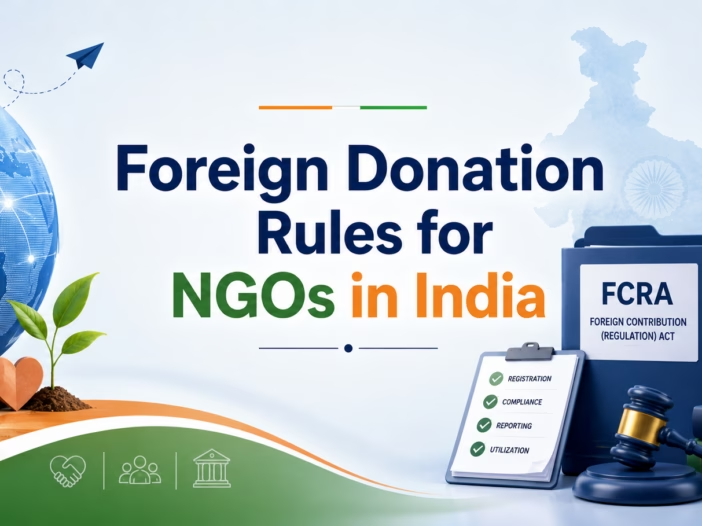
The Foreign Contribution Regulation Act, commonly known as FCRA, regulates foreign donations in India. It ensures that NGOs receive foreign contribution only through approved channels and use it only for permitted purposes.
As of July 2026, the government has made FCRA compliance stricter. The latest changes require NGOs to give more details about their activities, working areas, key functionaries, digital presence, publications, utilisation of funds and renewal status.
Therefore, every NGO in India, including NGOs in Greater Noida, should understand these rules before receiving foreign donation.
What is FCRA?
FCRA stands for Foreign Contribution Regulation Act. It controls how NGOs and other eligible organisations in India can receive and use foreign contribution.
In simple words, if an NGO receives money, articles, securities or any other contribution from a foreign source, it must follow FCRA rules.
For example, if an NGO in Greater Noida receives funds from a foreign donor for education, healthcare, religious work or social welfare, it must first check whether it needs FCRA registration or prior permission.
Who Needs FCRA Registration?
An NGO, trust, society or Section 8 company needs FCRA registration if it wants to receive foreign donations regularly.
The organisation must work for approved purposes such as social welfare, education, healthcare, religious activities, cultural activities, economic development or charitable work.
However, charitable objects alone are not enough. The organisation must obtain FCRA registration or prior permission from the Ministry of Home Affairs before receiving foreign contribution.
Can an NGO Receive Foreign Donation Without FCRA?
No, an NGO should not receive foreign donation without FCRA registration or prior permission.
If an NGO receives foreign contribution without proper approval, it may face penalties, bank account restrictions, freezing of funds, cancellation of registration or other legal action.
Therefore, before accepting any foreign donation, the NGO should check whether the donor is a foreign source and whether FCRA approval is required.
FCRA Registration and Prior Permission
NGOs can receive foreign donation legally through two main routes.
FCRA Registration
FCRA registration is suitable for NGOs that want to receive foreign donations regularly.
Usually, an established NGO with proper charitable activities, past records, books of account and genuine work applies for FCRA registration.
Prior Permission
Prior permission is suitable when an NGO wants to receive a specific foreign donation from a specific donor for a specific project.
For example, if a foreign donor wants to donate funds to a trust in Greater Noida for a school project, and the trust does not have regular FCRA registration, the trust may apply for prior permission for that particular donation.
Latest FCRA Amendment Rules, 2026
The Foreign Contribution Regulation Amendment Rules, 2026 were notified in June 2026. These rules introduced stricter operational restrictions and expanded disclosure requirements for NGOs receiving foreign donations.
These rules affect NGOs that already have FCRA registration, NGOs applying for fresh registration, NGOs applying for renewal and organisations applying for prior permission.
The main focus of the 2026 rules is transparency. The government now wants NGOs to clearly disclose their purpose of work, area of operation, key functionaries, digital activity, annual publications and utilisation of foreign funds.
Purpose-Based FCRA Registration
The 2026 rules have changed the way NGOs apply for FCRA registration.
Now, NGOs cannot treat FCRA registration as a blanket permission for all types of activities. They must select specific purposes or objectives from the prescribed Schedule. They must also mention the States or Union Territories where they will carry out their activities.
This means the NGO must clearly tell the government what work it will do and where it will do that work.
For example, if an NGO works in education and healthcare in Uttar Pradesh and Delhi, it must mention those purposes and locations clearly in the application.
Additional Fee for States and Purposes
The new rules also introduce additional fees based on the number of States or Union Territories and the number of purposes selected by the NGO.
An NGO must pay an additional fee of ₹300 for every State or Union Territory and ₹300 for every distinct purpose listed in the application.
Therefore, NGOs should select only their actual working areas and genuine purposes. They should not add unnecessary States or purposes only for future planning.
One-Year Window for Existing FCRA NGOs
The 2026 rules also apply to already registered NGOs.
Existing FCRA-registered organisations must file Form FC-6F within one year from 22 June 2026. In this form, they must declare the exact purposes and States or Union Territories they want to retain under their FCRA registration.
After filing this form, the NGO’s FCRA permission will remain linked to the declared purposes and locations. If the NGO wants to change its working area or purpose later, it will need fresh government approval.
Therefore, existing NGOs should review their activities carefully before filing Form FC-6F.
Expanded Meaning of Key Functionary
The 2026 rules have also expanded the meaning of key functionary.
Now, key functionary includes company directors, firm partners, trustees and the Karta of a Hindu Undivided Family, along with traditional office-bearers and persons who control the organisation.
This change is important because the government wants complete details of the persons who manage or control the NGO.
Therefore, NGOs should maintain proper KYC, identity records, background details and role details of all key functionaries.
Restriction on Foreign National as Key Functionary
The rules also restrict applications where a foreign national is involved as a key functionary.
Generally, if an association has a foreign national as a key functionary, the government may not consider its application for FCRA registration or prior permission. However, this restriction does not ordinarily apply in the same way to Persons of Indian Origin or Overseas Citizens of India.
Therefore, NGOs should check their board, trustees, directors, partners and controlling persons before applying for FCRA registration or prior permission.
Prior Permission and the 75% Utilisation Rule
The 2026 rules have also tightened the prior permission route.
If an NGO receives foreign contribution in installments through prior permission, it cannot automatically receive the next installment. It must first file Form FC-3BB and prove that it has utilised at least 75% of the previous installment.
This rule ensures that NGOs properly use earlier funds before receiving more foreign contribution.
Therefore, NGOs should maintain proper utilisation records, bills, vouchers, bank statements, project reports and activity evidence.
Reasonable Activity Requirement for Renewal
For renewal of FCRA registration, the NGO must prove that it has carried out reasonable activity.
Under the 2026 rules, an NGO must show that it has spent at least ₹10 lakh during the preceding two financial years on its stated social, charitable or approved objectives. It must also support this claim with a detailed activity report.
This rule may create difficulty for inactive NGOs or organisations that have not used funds for their stated objectives.
Therefore, NGOs should regularly carry out genuine activities and maintain proper documentary proof.
Disclosure of Social Media Accounts
The 2026 rules also focus on digital transparency.
NGOs must disclose their official social media accounts during registration. These accounts may include platforms where the organisation publishes updates, project reports, campaigns, articles or public communication.
This requirement shows that the government now wants to monitor both financial activity and public communication of organisations receiving foreign funds.
Therefore, NGOs should maintain proper control over their official digital accounts.
New Details in Annual Return Form FC-4
FCRA-registered NGOs must file their annual return in Form FC-4.
After the 2026 changes, Form FC-4 requires more detailed information. The NGO must include the Unique Document Identification Number, or UDIN, on the Chartered Accountant certificate.
In addition, the NGO must provide details of blogs, articles, books and social media posts published by the organisation and its key functionaries during the year.
Therefore, NGOs should maintain a yearly record of website posts, social media posts, articles, reports, books and other publications.
Restriction on News, Current Affairs and Political Commentary
NGOs receiving foreign contribution must remain careful about the type of content they publish.
They may publish field impact reports, research updates, project reports and awareness material connected with their approved objectives. However, they should avoid publishing content that qualifies as news, current affairs reporting or political commentary.
Such content may create serious FCRA compliance issues.
Therefore, NGOs should review their publications carefully before releasing them on websites, blogs or social media.
Religious Activity and Conversion Restriction
The 2026 rules have also clarified the use of foreign funds for religious purposes.
An organisation cannot use foreign contribution for proselytisation or religious conversion. In simple words, foreign funds cannot be used to convert people from one religion to another.
Therefore, religious institutions and faith-based NGOs should use foreign contribution only for permitted religious or charitable activities.
FCRA Amendment Bill, 2026 and Asset Takeover Framework
Apart from the 2026 rules, the FCRA Amendment Bill, 2026 proposes a major framework for foreign funds and assets when an NGO’s FCRA registration ends.
The Bill proposes a system where a Designated Authority and administrators may manage foreign funds and assets in certain cases.
This proposal is important because it may affect not only unutilised foreign funds but also assets created fully or partly from foreign contribution, such as land, buildings, schools, hospitals, equipment or other properties.
Deemed Cessation of FCRA Certificate
The Bill proposes the concept of deemed cessation.
An FCRA certificate may be treated as ceased if the NGO does not apply for renewal at least six months before expiry, if the renewal application is rejected, or if the existing certificate expires before renewal is granted.
This means NGOs should not wait until the last moment for renewal. They should track the expiry date and apply for renewal well in advance.
Provisional Vesting of Foreign Funds and Assets
Under the proposed framework, if FCRA registration is cancelled, surrendered or treated as ceased, foreign funds and assets created from foreign contribution may provisionally vest in the Designated Authority.
The authority may take possession, supervise and manage such funds and assets.
This rule may affect schools, hospitals, land, buildings, equipment and other assets created from foreign contribution.
Restoration of Assets After Successful Renewal
If the NGO successfully renews its registration or obtains fresh registration after a gap, the unutilised foreign funds and assets may be restored to the NGO as per the proposed framework.
Therefore, timely renewal and proper compliance can help the NGO protect its funds and assets.
Permanent Vesting in Government
If the NGO fails to renew or restore its registration within the prescribed period, or if the NGO becomes defunct, the assets may vest permanently in the Central Government.
The authority may transfer such assets to government ministries or liquidate them. The sale proceeds may be credited to the Consolidated Fund of India.
Also, key functionaries of the penalised NGO may not be allowed to acquire any interest in such assets during disposal.
This proposed rule makes FCRA compliance extremely important for NGOs that own assets created from foreign donations.
Core FCRA Rules Still Applicable
The 2026 changes are important, but the basic FCRA rules introduced earlier continue to apply.
SBI New Delhi FCRA Account
All initial foreign contributions must be received only in the designated FCRA account at the State Bank of India, Main Branch, New Delhi.
An NGO cannot receive foreign contribution directly in a normal bank account.
After receiving the funds in the designated FCRA account, the NGO may use permitted utilisation accounts as allowed under FCRA rules.
Ban on Transfer of Foreign Contribution
An NGO cannot transfer foreign contribution to another person or entity in India.
This restriction applies even if the other organisation also has valid FCRA registration.
Therefore, an NGO must use the foreign contribution for its own approved project and cannot pass it to another NGO as a sub-grant.
Administrative Expense Limit
Administrative expenses remain capped at 20% of the foreign contribution received during the financial year.
This means NGOs must carefully classify expenses between programme expenses and administrative expenses.
For example, office expenses, management expenses, administrative staff salary and other overheads may fall under administrative expenses depending on the nature of the expense.
Proper Books of Account and Records
Every NGO receiving foreign contribution must maintain proper books of account.
The NGO should keep donor-wise records, project-wise records, bank statements, invoices, vouchers, utilisation certificates, activity reports and supporting documents.
Proper documentation helps during audit, annual return filing, renewal and departmental verification.
Common Mistakes NGOs Should Avoid
Many NGOs face problems because they do not understand FCRA rules properly.
Common mistakes include receiving foreign donation without registration or prior permission, using a normal bank account for foreign contribution, selecting wrong purposes or States in the application, failing to file Form FC-6F, not maintaining social media records, publishing restricted content, not filing annual return on time, not adding UDIN in CA certificate, using funds for unapproved purposes, transferring foreign funds to another NGO, exceeding the administrative expense limit and missing the renewal deadline.
NGOs should avoid these mistakes because FCRA violations can lead to penalties, restrictions, suspension, cancellation or loss of control over foreign contribution assets.
Why FCRA Compliance is Important for NGOs in Greater Noida
Greater Noida has many trusts, societies, educational institutions, welfare organisations, religious institutions and Section 8 companies. Many of these organisations may receive support from NRIs, foreign charities, international donors or overseas organisations.
However, before receiving any foreign donation, they must understand FCRA rules properly.
A small mistake can create serious legal and financial problems. Therefore, NGOs in Greater Noida should take professional guidance before accepting foreign contribution.
Proper planning helps NGOs receive donations legally, maintain clean records and continue their charitable work smoothly.
How a CA Can Help in FCRA Compliance
A Chartered Accountant can help NGOs manage FCRA compliance properly.
A CA can assist in checking FCRA applicability, preparing registration or prior permission documents, maintaining books of account, preparing donor-wise and project-wise records, checking utilisation of foreign funds, monitoring administrative expense limits, preparing annual return details, issuing CA certificate with UDIN, helping with renewal, reviewing Form FC-6F details and replying to departmental notices.
Since FCRA involves legal, accounting, audit and reporting requirements, NGOs should maintain proper compliance from the beginning.
Conclusion
Foreign donations can support meaningful charitable work, but NGOs must receive and use them only through the proper legal route.
As of July 2026, FCRA rules have become stricter and more detailed. NGOs must now clearly mention their purposes, States and Union Territories, disclose key functionaries, maintain social media and publication records, file annual returns properly, follow the 75% utilisation rule in prior permission cases and ensure timely renewal.
The proposed asset takeover framework under the FCRA Amendment Bill, 2026 also shows that non-compliance may affect not only registration but also foreign contribution assets.
Therefore, every NGO, trust, society and Section 8 company in Greater Noida and across India should review its FCRA compliance carefully. Proper registration, clean accounting, timely filing and professional guidance can help the NGO continue its charitable work without legal difficulty.
FAQs on Foreign Donation Rules for NGOs in India
1. Can an NGO receive foreign donation in India?
Yes, an NGO can receive foreign donation in India, but it must first obtain FCRA registration or prior permission, wherever applicable.
2. Is FCRA registration compulsory for foreign donation?
Yes, FCRA registration or prior permission is generally required before receiving foreign contribution from a foreign source.
3. Can an NGO receive foreign donation in a normal bank account?
No, an NGO cannot receive foreign contribution in a normal bank account. Initial foreign contribution must be received in the designated FCRA account at State Bank of India, Main Branch, New Delhi.
4. What is purpose-based FCRA registration?
Purpose-based FCRA registration means the NGO must select specific approved purposes or objectives for which it wants to receive and use foreign donation.
5. Does an NGO need to mention States and Union Territories in the FCRA application?
Yes, under the 2026 rules, the NGO must mention the States or Union Territories where it will carry out activities using foreign contribution.
6. What is Form FC-6F?
Form FC-6F is required for existing FCRA-registered organisations to declare the purposes and States or Union Territories they want to retain under their registration.
7. What is the time limit for filing Form FC-6F?
Existing FCRA-registered NGOs must file Form FC-6F within one year from 22 June 2026.
8. What is the 75% utilisation rule?
If an NGO receives foreign contribution through prior permission in installments, it must show that it has utilised at least 75% of the previous installment before receiving the next installment.
9. What is the reasonable activity requirement for renewal?
For renewal, an NGO must show that it has spent at least ₹10 lakh during the preceding two financial years on its approved objectives, supported by a detailed activity report.
10. Is UDIN required in FCRA annual return?
Yes, after the 2026 changes, Form FC-4 requires UDIN on the Chartered Accountant certificate.
11. Can an NGO transfer foreign contribution to another NGO?
No, an NGO cannot transfer foreign contribution to another person or entity in India, even if the other NGO also has FCRA registration.
12. What is the administrative expense limit under FCRA?
Administrative expenses cannot exceed 20% of the foreign contribution received during the financial year.
13. Can NGOs publish news or political content using foreign contribution?
No, NGOs receiving foreign contribution should avoid publishing news, current affairs reporting or political commentary, as it may create FCRA compliance issues.
14. Can foreign funds be used for religious conversion?
No, foreign contribution for religious purposes cannot be used for proselytisation or religious conversion.
15. Do NGOs in Greater Noida need FCRA compliance support?
Yes, NGOs in Greater Noida should take professional guidance if they receive or plan to receive foreign donation. FCRA rules are technical, and proper compliance can prevent penalties and registration issues.