
Introduction
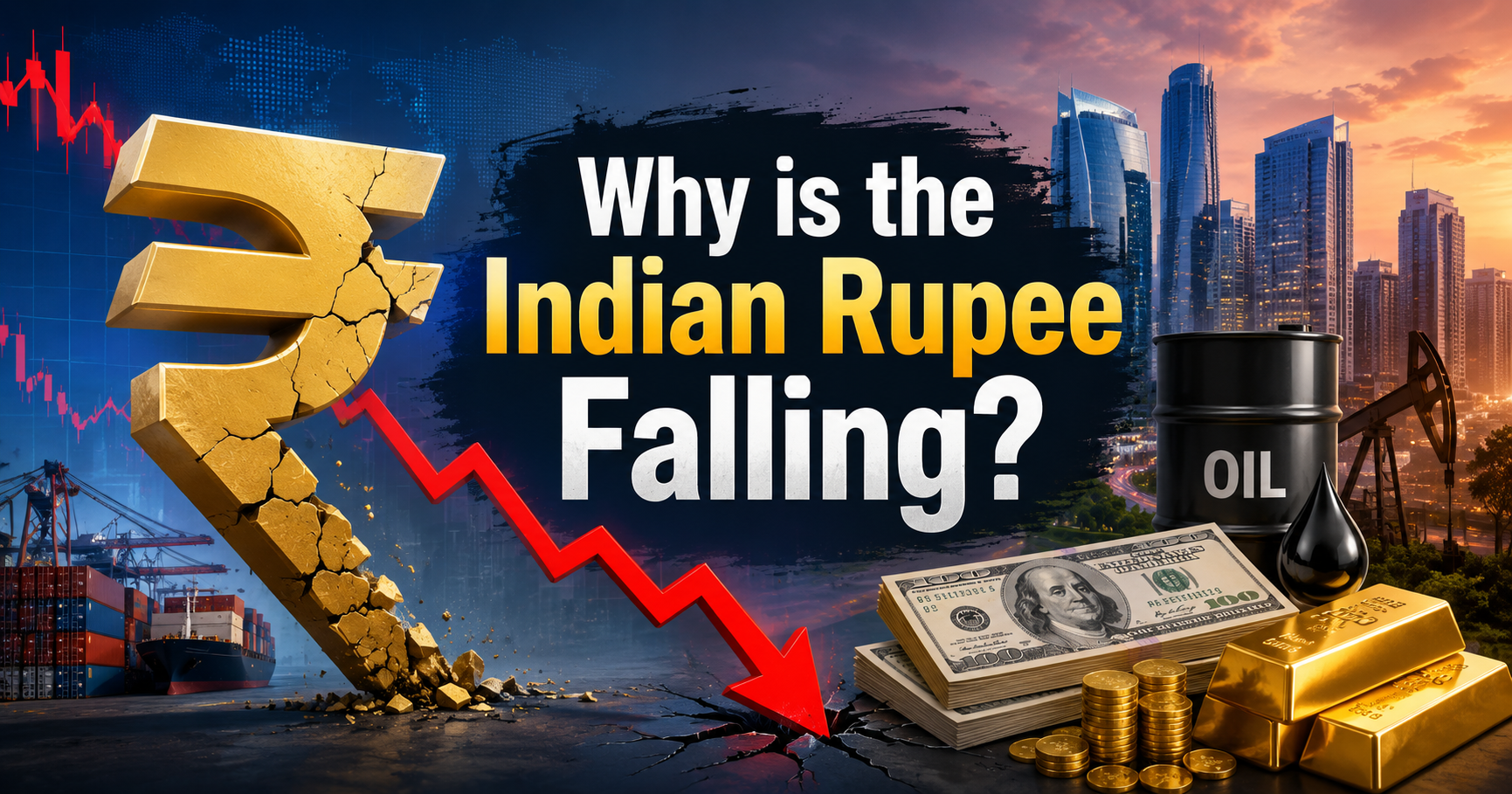
The Indian rupee falls when demand for the US dollar becomes higher than demand for the rupee. Recently, the rupee crossed the 96 level against the US dollar because crude oil prices, trade deficit, gold imports, foreign investor outflows, and strong dollar demand created pressure on India’s currency.
However, this fall does not always mean that India’s domestic economy is weak. Instead, it often shows pressure from external factors such as global oil prices, dollar strength, foreign money movement, and higher import payments.
For example, a business owner in Greater Noida who imports machinery, electronic parts, raw material, or packaging material may face higher costs when the rupee weakens. As a result, the business may need more working capital.
What Does Rupee Falling Mean?
Rupee falling means the Indian rupee loses value against another currency, mainly the US dollar.
For example, if 1 US dollar was equal to ₹83 earlier and later becomes ₹96, it means a person now needs more rupees to buy the same 1 dollar.
In simple words, the dollar becomes expensive, and the rupee becomes weak.
Therefore, importers, foreign travellers, students studying abroad, and businesses using imported goods may have to spend more money when the rupee falls.
Why Does the Rupee Fall?
The rupee falls mainly because of demand and supply in the foreign exchange market. When importers, companies, banks, investors, or individuals demand more dollars, the dollar becomes stronger. At the same time, the rupee becomes weaker.
Moreover, India imports many important items, especially crude oil. Since most international payments happen in dollars, Indian companies need dollars to make foreign payments. Therefore, whenever dollar demand rises sharply, the rupee comes under pressure.
1. Rising Crude Oil Prices
Crude oil is one of the biggest reasons behind rupee weakness. India imports a large part of its crude oil requirement. Therefore, when global crude oil prices rise, India needs more dollars to pay its oil bill.
Recently, oil prices moved close to $110 per barrel. As a result, India’s dollar demand increased and the rupee came under pressure.
For example, if a transport business in Greater Noida uses diesel vehicles, higher crude oil prices may increase fuel costs. Eventually, transport charges and product prices may also rise.
2. West Asia Tension and Energy Risk
West Asia plays an important role in global crude oil supply. Therefore, any tension in this region can quickly affect oil prices.
When geopolitical tension rises near important oil routes, global markets become nervous. As a result, crude oil prices may increase, and oil-importing countries like India may need more dollars.
Therefore, geopolitical tension does not affect only international relations. It also affects fuel prices, imports, inflation, and the rupee.
3. Higher Trade Deficit
Trade deficit means India imports more goods than it exports. In simple words, India spends more dollars on imports than it earns from exports.
When imports rise faster than exports, India needs more dollars for payment. As a result, the rupee may weaken.
Therefore, a higher trade deficit directly increases pressure on the Indian rupee.
4. Increase in Gold Imports
Gold also puts pressure on the rupee because India imports a large quantity of gold. When people buy more gold, India needs more dollars to pay for those imports.
Therefore, high gold demand can increase dollar outflow. Consequently, the rupee may face additional pressure.
In simple words, when more dollars go out of India for gold imports, the rupee may weaken.
5. Strong US Dollar
The US dollar is one of the most powerful currencies in the world. During global uncertainty, investors usually prefer the dollar because they consider it safer.
Therefore, when the dollar strengthens globally, emerging market currencies like the Indian rupee often face pressure.
In simple words, the rupee may fall not only because of India’s domestic reasons but also because the US dollar becomes stronger worldwide.
6. Foreign Investor Outflows
Foreign investors invest money in Indian stock markets, debt markets, and businesses. However, when they sell Indian assets and take money out, they usually convert rupees into dollars.
As a result, demand for dollars increases. At the same time, the rupee weakens.
Therefore, heavy selling by foreign investors can create extra pressure on the rupee.
7. Inflation Pressure
Inflation means a rise in the prices of goods and services. A falling rupee can increase inflation because imported goods become costlier.
For example, India imports crude oil. Therefore, when the rupee weakens, India may pay more rupees for the same amount of oil. After that, fuel prices, transport costs, and production costs may increase.
Similarly, a manufacturer in Greater Noida may use imported parts or imported raw material. If the rupee falls, the cost of those imports may rise. As a result, the manufacturer may increase product prices.
8. Foreign Travel and Other Dollar Outflows
Foreign travel, overseas education, foreign investments, and other remittances also create demand for dollars. When these outflows rise, they add pressure to India’s foreign exchange position.
Therefore, reducing unnecessary dollar outflows can help ease pressure on the rupee.
However, people should not panic. Instead, they should understand that high foreign currency spending can increase demand for dollars.
9. RBI Intervention
The Reserve Bank of India monitors rupee movement closely. When the rupee falls sharply, RBI may sell dollars from its forex reserves to reduce sudden volatility.
However, RBI usually does not fix the rupee at one permanent level. Instead, it tries to avoid sharp and disorderly movement.
Therefore, India’s forex reserves act like a safety cushion. However, RBI uses them carefully because reserves are not unlimited.
How Does a Falling Rupee Affect Common People?
A falling rupee affects common people through fuel prices, imported products, education, travel, and inflation.
1. Petrol and Diesel May Become Costlier
Since India imports crude oil, a weak rupee can increase the cost of oil imports. As a result, petrol, diesel, and transport costs may rise.
2. Imported Goods Become Expensive
Imported goods such as mobile phones, laptops, machinery, medical equipment, electronic parts, and some raw materials may become costlier.
Therefore, consumers and businesses may have to pay higher prices.
3. Foreign Education Becomes Costly
Students studying abroad need dollars for tuition fees, hostel fees, and living expenses. Therefore, when the rupee falls, parents have to spend more rupees for the same foreign currency amount.
4. Foreign Travel Becomes Expensive
Foreign travel also becomes costly when the rupee weakens. Flights, hotels, shopping, food, and local travel abroad may cost more in rupee terms.
5. Business Costs May Increase
Many businesses use imported raw materials, imported machines, or imported components. When the rupee falls, these items become expensive.
Consequently, businesses may increase product prices to protect their margins.
How Does a Falling Rupee Affect Greater Noida Businesses?
Greater Noida has many manufacturers, traders, exporters, importers, startups, and service providers. Therefore, rupee movement affects local businesses in different ways.
For example, a Greater Noida business that imports machinery or electronic parts may face higher purchase costs when the rupee falls. As a result, the business may need more working capital.
On the other hand, exporters from Greater Noida may benefit because dollar earnings convert into more rupees. However, if they also import raw materials, their benefit may reduce.
Therefore, businesses in Greater Noida should track currency movement, import cost, export pricing, and cash flow carefully.
Is Rupee Falling Always Bad?
A falling rupee is not bad for everyone. It creates both benefits and challenges.
Exporters may benefit because they earn in dollars and receive more rupees after conversion. For example, IT service providers, exporters, freelancers, and businesses earning foreign income may gain from a weaker rupee.
However, importers may suffer because they need more rupees to buy the same amount of dollars.
Therefore, the impact depends on whether a person or business earns dollars or spends dollars.
Why Forex Reserves Matter
Forex reserves are foreign currency assets held by RBI. These reserves help India manage foreign payments and currency stability.
When the rupee falls sharply, RBI can use forex reserves to supply dollars in the market. This may reduce sudden pressure on the rupee.
However, forex reserves are not unlimited. Therefore, RBI uses them carefully.
Simple Example to Understand Rupee Fall
Suppose a Greater Noida business imports machinery worth $10,000.
If 1 dollar equals ₹83, the cost will be ₹8,30,000.
However, if 1 dollar equals ₹96, the cost will become ₹9,60,000.
Therefore, the same machine becomes ₹1,30,000 costlier only because of rupee depreciation.
This example clearly shows how a falling rupee can increase business costs.
What Can India Do to Strengthen the Rupee?
India cannot strengthen the rupee with one single step. Instead, it needs long-term economic strength and balanced policies.
India can support the rupee by:
- Increasing exports
- Reducing unnecessary imports
- Promoting domestic manufacturing
- Reducing dependence on imported crude oil
- Encouraging foreign direct investment
- Maintaining strong forex reserves
- Controlling inflation
- Improving investor confidence
- Promoting renewable energy
- Supporting Make in India products
Therefore, a stronger rupee depends on higher exports, lower import dependence, stable investment, controlled inflation, and strong manufacturing.
Conclusion
The Indian rupee falls when demand for dollars becomes higher than demand for rupees. Crude oil prices, West Asia tension, trade deficit, gold imports, foreign investor outflows, and strong dollar demand can increase pressure on the rupee.
For common people, a weak rupee can increase the cost of fuel, imported goods, foreign education, and foreign travel. For businesses in Greater Noida, it can increase import costs and working capital needs.
However, exporters may benefit if they earn in dollars. Therefore, the impact depends on the nature of income and expenses.
FAQs on Why the Indian Rupee is Falling
1. Why is the Indian rupee falling?
The Indian rupee usually falls due to higher crude oil prices, trade deficit, strong dollar demand, gold imports, foreign investor outflows, inflation pressure, and global uncertainty.
2. What does rupee depreciation mean?
Rupee depreciation means the Indian rupee loses value against another currency, mainly the US dollar. It means a person needs more rupees to buy one dollar.
3. How does crude oil affect the rupee?
India imports a large quantity of crude oil. When crude oil prices rise, India needs more dollars to pay oil bills. As a result, dollar demand increases and the rupee may weaken.
4. How does gold buying affect the rupee?
India imports gold by paying in foreign currency. Therefore, higher gold imports increase dollar demand and may put pressure on the rupee.
5. Does a falling rupee increase inflation?
Yes, a falling rupee can increase inflation because imported goods, crude oil, fuel, and raw materials become costlier.
6. Who benefits from a weak rupee?
Exporters, IT service providers, freelancers, and people earning in dollars may benefit because dollar income converts into more rupees.
7. Who suffers when the rupee falls?
Importers, foreign students, foreign travellers, and businesses using imported goods may suffer because they need more rupees for the same dollar amount.
8. Can RBI stop the rupee from falling?
RBI can reduce sharp volatility by using forex reserves and policy measures. However, it cannot permanently control the rupee if global and domestic pressures remain strong.
9. How does rupee fall affect Greater Noida businesses?
Greater Noida businesses that import machinery, electronics, raw materials, or components may face higher costs. However, exporters may benefit if they earn in dollars.
10. How can India make the rupee stronger?
India can strengthen the rupee in the long run by increasing exports, reducing import dependence, attracting foreign investment, controlling inflation, building forex reserves, and promoting domestic manufacturing.