
Introduction
Faceless assessment has changed the way income tax assessments work in India. Under this system, the taxpayer does not meet the income tax officer physically. Instead, the taxpayer receives notices online and submits replies through the income tax e-filing portal.
In simple words, faceless assessment means online income tax assessment without face-to-face interaction with the officer.
For example, if a salaried person, professional, trader, or company in Greater Noida receives an income tax notice, they can submit replies, documents, explanations, and evidence online. As a result, the process becomes more transparent, paperless, and easier to track.
What is Faceless Assessment?
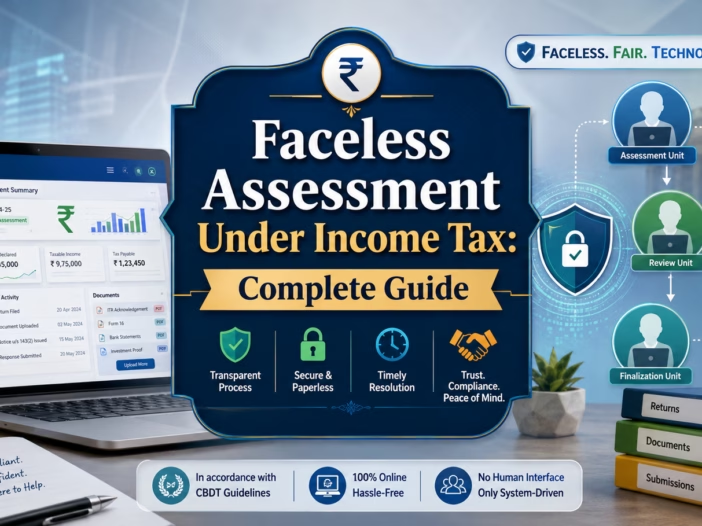
Faceless assessment is an online assessment system under income tax law. The department completes the assessment through electronic communication, centralised processing, automated allocation, and specialised units.
Section 144B provides the procedure for faceless assessment. It includes the role of the National Faceless Assessment Centre, assessment units, verification units, technical units, and review units.
Therefore, taxpayers do not need to visit the income tax office physically. Instead, they can handle assessment proceedings through the e-filing portal.
Main Objective of Faceless Assessment
The main objective of faceless assessment is to reduce personal interaction and improve transparency.
Earlier, many taxpayers had to visit income tax offices, meet officers, submit papers manually, and follow up repeatedly. However, the faceless system reduces direct human interface and moves the process online.
The system also supports standardised assessment quality because different specialised units handle different functions. Moreover, automated allocation reduces local influence and territorial bias.
Key Features of Faceless Assessment
Faceless assessment has several important features.
No Physical Visit
The taxpayer does not need to visit the income tax office physically. All replies and documents are submitted online.
No Territorial Jurisdiction
The officer handling the matter may not be located in the same city as the taxpayer. For example, a taxpayer in Greater Noida may have their case processed by units located elsewhere.
Centralised Communication
The National Faceless Assessment Centre works as the central communication hub. All notices and replies flow through the digital system.
Automated Allocation
The system allocates cases and unit work electronically. Section 144B specifically refers to automated allocation for assigning requests to verification units, technical units, and review units in specified situations.
Digital Record
All notices, submissions, documents, and orders remain available online. Because of this, taxpayers can track the matter more easily.
Official Income Tax Portal Link
Taxpayers can check notices, file replies, upload documents, and track proceedings through the official income tax e-filing portal:
The official e-filing portal provides income tax return filing, forms, tax payment, intimation, rectification, refund, and related services.
Institutional Framework of Faceless Assessment
Faceless assessment works through different electronic centres and units. Each unit has a separate role.
National Faceless Assessment Centre
The National Faceless Assessment Centre, also called NaFAC, acts as the central hub. It facilitates faceless assessment proceedings in a centralised manner.
In simple words, NaFAC manages communication between the taxpayer and different units.
Assessment Unit
The Assessment Unit identifies issues, seeks information, analyses documents, and prepares income or loss determination proposals. It plays the main role in examining the case.
Verification Unit
The Verification Unit handles enquiry, cross-verification, examination of books of accounts, examination of witnesses, and recording of statements where required.
Technical Unit
The Technical Unit provides expert help on complex matters. This may include legal, accounting, forensic, information technology, valuation, transfer pricing, data analytics, management, or treaty-related matters.
Review Unit
The Review Unit checks whether the relevant evidence, facts, law, additions, or disallowances have been properly considered in the proposal. This review helps improve assessment quality before finalisation.
How Does Faceless Assessment Work?
Faceless assessment follows a structured online process. Therefore, taxpayers should understand each step clearly.
Step 1: Notice is Issued
First, the taxpayer receives a notice through the income tax portal.
The notice may ask for documents, information, reconciliation, or explanation. It may relate to scrutiny, reassessment, mismatch, high-value transaction, or other income tax issues.
Step 2: Case is Allocated
Next, the system allocates the case to the relevant unit through the faceless framework.
The taxpayer does not directly know or meet the officer. Instead, communication happens through NaFAC.
Step 3: Information is Requested
After that, the Assessment Unit may ask for additional information or documents.
For example, the taxpayer may receive a notice asking for bank statements, books of accounts, Form 26AS reconciliation, AIS explanation, capital gain details, loan confirmations, or business records.
Step 4: Taxpayer Files Reply Online
Then, the taxpayer submits the reply through the e-filing portal.
The reply should be clear, point-wise, and document-based. If the taxpayer needs more time, they should request an extension or adjournment through the portal before the deadline.
Step 5: Verification or Technical Review May Happen
If required, the Assessment Unit may seek help from the Verification Unit or Technical Unit.
For example, a valuation issue may go to a technical unit. Similarly, a transaction verification may require a verification unit report.
Step 6: Draft Proposal or Show Cause Notice is Prepared
After reviewing the records, the Assessment Unit may prepare an income or loss determination proposal.
If the proposed variation is against the taxpayer, the system should give the taxpayer an opportunity to explain. Section 144B provides that a show cause notice should be served through NaFAC where a variation prejudicial to the taxpayer is proposed.
Step 7: Taxpayer Responds to Show Cause Notice
Once a show cause notice is issued, the taxpayer should reply carefully.
The reply should address each proposed addition or disallowance. In addition, the taxpayer should attach evidence, reconciliation, legal explanation, and supporting documents.
Step 8: Final Assessment Order is Passed
Finally, the department passes the assessment order online.
The order may accept the taxpayer’s reply, make additions, raise tax demand, initiate penalty proceedings, or grant refund, depending on the case. Section 144B provides that the final order and demand notice are served through NaFAC.
Right to Personal Hearing Through Video Conferencing
Faceless assessment does not mean the taxpayer loses the right to be heard.
If the department proposes an adverse addition or variation, the taxpayer may request a personal hearing. Section 144B provides that where such request is received, the relevant authority shall allow hearing through NaFAC by video conferencing or video telephony, subject to the prescribed procedure and technological feasibility.
Therefore, if a complex matter involves large additions, unexplained cash credits, business turnover mismatch, capital gains, or legal interpretation, the taxpayer should consider requesting a video hearing.
Why Show Cause Notice is Important
A show cause notice is very important because it gives the taxpayer a chance to defend the case before the final order.
If the officer proposes an addition, the taxpayer should get a chance to explain why the addition should not be made. This supports the principle of natural justice.
For example, if a Greater Noida business receives a proposed addition due to GST turnover mismatch, it should submit GST returns, books of accounts, reconciliation, invoices, and explanation before the final order.
Common Reasons for Faceless Assessment Notice
A taxpayer may receive a faceless assessment notice for many reasons.
Common reasons include:
- Mismatch between ITR and Form 26AS
- Mismatch between ITR and AIS
- High-value transactions
- Cash deposits in bank accounts
- Property purchase or sale
- Capital gain mismatch
- Foreign income or foreign assets
- TDS mismatch
- Business income mismatch
- GST turnover and ITR turnover difference
- Unexplained investment
- Wrong deduction claim
- Non-disclosure of interest income
- Suspicious refund claim
- Incomplete response to earlier notices
For example, a trader in Greater Noida may receive a notice if turnover reported in GST returns does not match turnover shown in the income tax return.
Documents Required for Faceless Assessment Reply
The documents depend on the issue raised in the notice. However, taxpayers should keep common records ready.
Documents for Salaried Persons
Salaried taxpayers may need Form 16, salary slips, bank statements, rent receipts, investment proofs, home loan certificates, AIS, Form 26AS, and TDS certificates.
Documents for Business Owners
Business owners may need books of accounts, profit and loss account, balance sheet, bank statements, GST returns, sales register, purchase register, invoices, audit report, and loan confirmations.
Documents for Capital Gains
For capital gains, taxpayers may need purchase deed, sale deed, demat statement, broker statement, capital gain working, cost details, improvement proof, indexation working, and bank proof.
Documents for Cash Deposits
In cash deposit cases, taxpayers may need bank statements, cash book, sales records, withdrawal proof, loan documents, gift deed, or source explanation.
Documents for Deductions and Exemptions
For deduction claims, taxpayers may need investment proofs, insurance receipts, donation receipts, education loan certificates, housing loan certificates, and other supporting documents.
How to Reply to Faceless Assessment Notice Online
You should reply through the official income tax e-filing portal.
Step 1: Login to the Portal
Visit https://www.incometax.gov.in and log in with your PAN or user ID and password.
Step 2: Open Pending Actions
After login, go to the pending actions or e-proceedings section.
Step 3: Select the Notice
Next, select the relevant notice and read it carefully.
Check the assessment year or tax year, issue raised, due date, and documents required.
Step 4: Prepare the Response
After reading the notice, prepare a clear reply.
Your response should address every point raised by the department. Also, prepare supporting documents in proper order.
Step 5: Upload Documents
Upload the requested documents in clear PDF format.
Use proper file names such as “Bank Statement FY 2024-25” or “GSTR Turnover Reconciliation” instead of unclear names like “doc1” or “file2”.
Step 6: Submit Before Due Date
Submit the response before the deadline.
If you need more time, file an adjournment or extension request through the portal before the due date.
Step 7: Save Acknowledgement
After submission, download and save the acknowledgement.
This proof may help if the department later says that no reply was filed.
How to Draft a Strong Reply
A strong reply can reduce the chance of additions and further disputes.
First, read the notice carefully. Next, identify every question raised by the department. After that, prepare a point-wise reply.
Your reply should include:
- Notice reference number
- Assessment year or tax year
- Issue raised in the notice
- Clear explanation
- Supporting documents
- Reconciliation, if required
- Case law or legal explanation, if needed
- Final request to accept the reply
Moreover, avoid vague statements. Instead, support every claim with documents.
Practical Documentation Tips
Good documentation is very important in faceless assessment because the officer reviews your case online.
Use Clear File Names
Use descriptive file names such as “AIS Reconciliation”, “Bank Statement HDFC FY 2024-25”, or “Capital Gain Working”.
Prepare an Index
If you upload multiple documents, prepare a simple index. This helps the officer understand the attachments quickly.
Add Reconciliation Tables
For mismatch cases, prepare a proper reconciliation. For example, match GST turnover with ITR turnover month-wise or invoice-wise.
Upload Readable Documents
Do not upload unclear scans. Every document should be readable.
Avoid Unnecessary Documents
Upload relevant documents only. Too many unrelated documents may confuse the matter.
Example of Faceless Assessment Reply
Subject: Reply to notice under faceless assessment proceedings
Respected Sir/Madam,
This is in reference to the notice issued for Assessment Year / Tax Year [mention year].
We have carefully reviewed the issues raised in the notice. Our point-wise reply is as under:
- The first issue relates to [mention issue]. In this regard, we submit that [give explanation].
- The second issue relates to [mention issue]. We submit that [give explanation].
- We are enclosing the following documents for your kind verification:
- Copy of income tax return
- Form 26AS
- AIS statement
- Bank statement
- Ledger account
- Relevant invoices
- Reconciliation statement
- Other supporting documents
Based on the above facts and documents, we request your good office to kindly accept our submission and complete the assessment accordingly.
Thanking you,
Name: [Taxpayer Name]
PAN: [PAN]
Place: Greater Noida
Date: [Date]
Benefits of Faceless Assessment
Faceless assessment offers many benefits to taxpayers.
Saves Time
Taxpayers do not need to visit the income tax office physically.
Reduces Direct Interaction
The taxpayer and the department communicate through the portal. As a result, the process becomes more transparent.
Improves Record Keeping
All notices, replies, and orders remain available online.
Reduces Local Bias
The system does not depend on local territorial jurisdiction in the same traditional manner.
Helps Greater Noida Businesses
Businesses in Greater Noida can respond from their office or consultant’s office without unnecessary travel.
Challenges in Faceless Assessment
Faceless assessment is convenient, but it also requires careful handling.
Technical Issues
Taxpayers may face portal errors, upload problems, login issues, or document size issues.
Short Deadlines
Notices may have strict due dates. Therefore, taxpayers should check the portal and email regularly.
Written Reply Becomes Very Important
Since there is no routine physical meeting, the written reply must be complete, clear, and well-supported.
Poor Document Format Can Hurt the Case
Unclear documents, missing indexes, and weak reconciliation may create confusion.
Multiple Notices May Come
The department may issue more than one notice. Because of this, taxpayers should track every communication carefully.
Common Mistakes to Avoid
Taxpayers should avoid these mistakes during faceless assessment:
- Ignoring the notice
- Missing the due date
- Uploading incomplete documents
- Giving vague replies
- Not reconciling AIS and Form 26AS
- Not checking bank statements
- Not explaining cash deposits properly
- Filing reply without evidence
- Using emotional language
- Uploading unreadable documents
- Not saving acknowledgement
- Not checking further notices
A well-drafted written reply is very important because the officer reviews the matter online.
What If You Receive an Unfavourable Order?
Sometimes, the taxpayer may receive an unfavourable assessment order.
In that situation, first read the order carefully. Then, check whether the department considered your reply and documents.
Depending on the facts, possible remedies may include:
- Rectification application for mistake apparent from record
- Appeal before the Commissioner of Income Tax (Appeals)
- Writ petition before High Court in serious procedural violation cases
- Stay application against demand, where applicable
- Professional review of the order and demand notice
For example, if the final order ignores uploaded submissions or violates the mandatory procedure, the taxpayer should take proper legal advice.
Faceless Assessment for Greater Noida Taxpayers
Greater Noida has salaried employees, freelancers, traders, startups, contractors, manufacturers, and professionals. Many of them may receive income tax notices due to data mismatches or high-value transactions.
For example, a Greater Noida business may receive a notice because GST turnover differs from ITR turnover. Similarly, a salaried person may receive a notice if interest income appears in AIS but is not shown in ITR.
Therefore, taxpayers in Greater Noida should maintain income records, bank statements, GST returns, investment proofs, and tax documents properly.
Practical Checklist for Faceless Assessment
Before submitting your reply, check the following points:
- Download the notice
- Check notice date and due date
- Identify assessment year or tax year
- Read every point carefully
- Collect documents
- Reconcile AIS and Form 26AS
- Reconcile bank entries
- Prepare point-wise reply
- Add proper index
- Attach clear documents
- Review reply before submission
- Submit before due date
- Save acknowledgement
- Track further notices
- Request video hearing, if needed
This checklist can help you handle faceless assessment systematically.
Conclusion
Faceless assessment makes income tax assessment more digital, transparent, and structured. It removes physical interaction and allows taxpayers to respond online through the e-filing portal.
However, taxpayers must handle every notice carefully. A clear reply, strong documents, proper reconciliation, and timely submission can protect the taxpayer from unnecessary additions and tax demand.
For taxpayers and businesses in Greater Noida, faceless assessment offers convenience. At the same time, it requires regular portal checking, proper records, and professional handling in complex matters.
FAQs on Faceless Assessment Under Income Tax
1. What is faceless assessment in income tax?
Faceless assessment is an online income tax assessment process where the taxpayer and the department communicate through the income tax portal without physical interaction.
2. Which section deals with faceless assessment?
Section 144B provides the framework and procedure for faceless assessment under income tax law.
3. What is NaFAC?
NaFAC means National Faceless Assessment Centre. It works as the central communication hub for faceless assessment proceedings.
4. Where can I check faceless assessment notice?
You can check notices on the official income tax e-filing portal at https://www.incometax.gov.in.
5. Is physical visit required in faceless assessment?
No, the process is mainly online. Taxpayers submit replies and documents electronically.
6. Can I upload documents online?
Yes, taxpayers can upload replies and supporting documents through the income tax portal.
7. Can I ask for more time to reply?
Yes, you may request more time through the portal where the option is available. However, approval depends on the department.
8. Can I request a video hearing?
Yes, where adverse variation is proposed, the taxpayer may request a personal hearing through video conferencing as per Section 144B procedure.
9. What happens if I ignore faceless assessment notice?
The department may proceed on the basis of available information, which may lead to additions, tax demand, interest, penalty, or further proceedings.
10. What documents are required for faceless assessment?
Documents depend on the issue. Common documents include ITR, Form 16, AIS, Form 26AS, bank statements, books of accounts, invoices, GST returns, and reconciliation statements.
11. How can Greater Noida taxpayers handle faceless assessment?
Greater Noida taxpayers should check the income tax portal regularly, maintain proper records, prepare point-wise replies, attach clear documents, and submit responses before the due date.