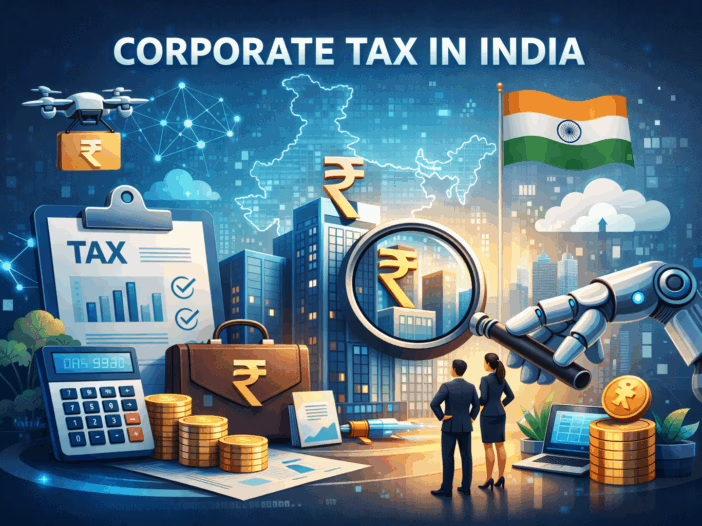
India’s corporate tax framework is designed to balance fiscal discipline with incentives for growth, reflecting the government’s focus on boosting investment and simplifying compliance. Here’s a detailed analysis of the current corporate tax rate in India, corporate tax structure, recent reforms, international comparisons, and frequently asked questions.
1. Tax Rates for Domestic Companies
Domestic companies in India are taxed based on their turnover and eligibility for special regimes:
- Standard Rates:
- 25%: For companies with annual turnover up to ₹400 crore.
- 30%: For companies with annual turnover exceeding ₹400 crore.
- Reduced Rates for Eligible Companies:
- 22%: Under Section 115BAA, applicable to companies that forgo certain exemptions and deductions, such as SEZ benefits and accelerated depreciation.
- 15%: Under Section 115BAB, for new manufacturing entities incorporated after October 2019, provided they meet specific criteria, including no prior plant usage and no business reconstruction.
These reduced rates aim to attract manufacturing investments and align with India’s goal of becoming a global production hub.
2. Taxation of Foreign Companies
Foreign companies with a permanent establishment (PE) in India face a base rate of 40% on income sourced domestically. Surcharge applies as follows:
- 2%: For income between ₹1 crore and ₹10 crore.
- 5%: For income exceeding ₹10 crore.
Non-resident companies without a PE are taxed only on India-sourced income, such as royalties or technical service fees, at rates up to 50%.
3. Surcharge and Cess
- Surcharge for Domestic Companies:
- 7%: For income between ₹1 crore and ₹10 crore.
- 12%: For income exceeding ₹10 crore.
- Flat 10%: For companies under Sections 115BAA and 115BAB.
- Health and Education Cess: A flat 4% on income tax and surcharge.
4. Minimum Alternate Tax (MAT)
MAT ensures companies pay a minimum tax of 15% on book profits if their normal tax liability falls below this threshold. Exemptions apply to companies opting for Sections 115BAA and 115BAB. MAT credits can be carried forward for 15 years.
5. Key Reforms in Budget 2025
The Union Budget 2025 introduced measures to enhance India’s appeal as an investment destination:
- Extended Sunset Clauses: Tax exemptions for sovereign wealth funds, startups, and units in International Financial Services Centres (IFSCs) extended to March 2030.
- Presumptive Taxation: Non-residents providing technology or services to electronics manufacturers face a 10% effective rate on 25% of gross receipts.
- Streamlined Mergers: Fast-track approvals and expanded scope for corporate restructuring.
- IFSC Incentives: Exemptions for aircraft and ship leasing, as well as derivative contracts, to strengthen Gujarat’s GIFT City as a financial hub.
6. International Comparison of Corporate Tax Rates
Understanding how India’s corporate tax rates compare globally provides insight into its competitiveness:
- United Kingdom: As of April 2024, the main corporation tax rate is 25% for companies with profits over GBP 250,000. A lower rate of 19% applies to companies with profits below GBP 50,000, with a sliding scale for profits in between.
- United States: The federal corporate tax rate is 21%. However, when considering state taxes, the combined rate averages around 25.8%.
- Singapore: Singapore offers a flat corporate tax rate of 17%, with partial tax exemptions and incentives that can further reduce the effective tax rate for companies.
- United Arab Emirates (UAE): Historically, the UAE did not levy a federal corporate tax, except on oil companies and branches of foreign banks. However, a federal corporate tax of 9% has been introduced for taxable income exceeding AED 375,000, effective from June 2023.
Frequently Asked Questions (FAQs)
Q1: Is there any slab for corporate tax in India?
A1: Yes, India’s corporate tax rates are structured based on turnover and specific conditions:
- 25%: For domestic companies with turnover up to ₹400 crore.
- 30%: For domestic companies with turnover exceeding ₹400 crore.
- 22%: For companies opting for taxation under Section 115BAA.
- 15%: For new manufacturing companies qualifying under Section 115BAB.
Q2: What is the Minimum Alternate Tax (MAT) in India?
A2: MAT is a provision to ensure that companies pay a minimum amount of tax, even if their taxable income is low due to various exemptions and deductions. The MAT rate is 15% of book profits. Companies opting for tax regimes under Sections 115BAA and 115BAB are exempt from MAT.
Q3: How does corporate tax rate in India compare globally?
A3: India’s standard corporate tax rates are comparable to global averages. With the concessional rates under Sections 115BAA and 115BAB, India’s rates are competitive, especially for manufacturing entities, aligning with rates in countries like the UK and Singapore.
Q4: Are there any incentives for new manufacturing companies in India?
A4: Yes, new domestic manufacturing companies incorporated after October 1, 2019, and commencing production