SLAB RATE FOR THE FY 2024-25 – Individual taxpayers have two options to select either new regime or old regime. Let us discuss it step by step.
- New Tax Regime (FY 2024-25)
The new tax regime, introduced in Budget 2020, offers lower tax rates but does not allow most deductions and exemptions (e.g., Section 80C, HRA, etc.). It is expected to remain largely unchanged for FY 2024-25.
| Income Range | Tax Rate |
| Up to ₹3 lakh | 0% |
| ₹3 lakh – ₹6 lakh | 5% |
| ₹6 lakh – ₹9 lakh | 10% |
| ₹9 lakh – ₹12 lakh | 15% |
| ₹12 lakh – ₹15 lakh | 20% |
| Above ₹15 lakh | 30% |
Note: A rebate under Section 87A is available for individuals with taxable income up to ₹7 lakh, making their effective tax liability zero upto income Rs. 7 lakh.
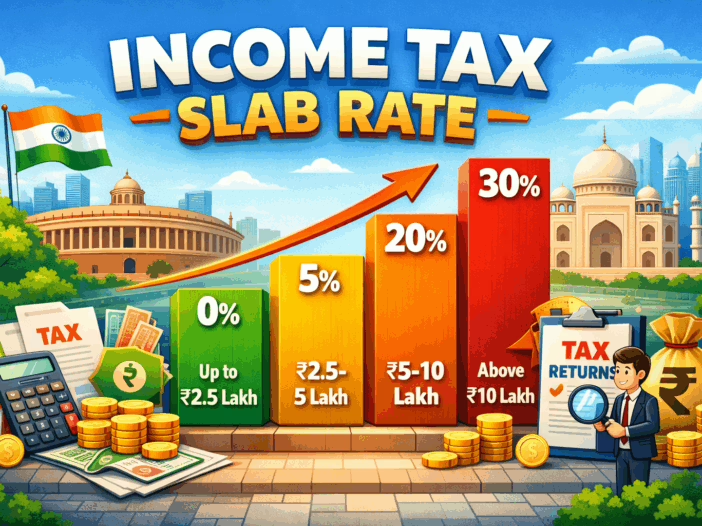
- Old Tax Regime (FY 2024-25)
The old tax regime allows taxpayers to claim various deductions and exemptions, but the tax rates are higher.
| Income Range | Tax Rate |
| Up to ₹2.5 lakh | 0% |
| ₹2.5 lakh – ₹5 lakh | 5% |
| ₹5 lakh – ₹10 lakh | 20% |
| Above ₹10 lakh | 30% |
SLAB RATE FOR THE FY 2025-26 – Individual taxpayer has two options to select either new regime or old regime. Let us discuss it step by step.
- NEW TAX REGIME – (FY 2025-26)
| Income Range (₹) | Tax Rate (%) |
| 0 – 4,00,000 | 0% |
| 4,00,001 – 8,00,000 | 5% |
| 8,00,001 – 12,00,000 | 10% |
| 12,00,001 – 16,00,000 | 15% |
| 16,00,001 – 20,00,000 | 20% |
| 20,00,001 – 24,00,000 | 25% |
| Above 24,00,000 | 30% |
Enhanced Rebate under Section 87A: The rebate limit has been increased from ₹25,000 to ₹60,000, ensuring that individuals with incomes up to ₹12 lakh pay no tax.
2. Old Tax Regime (FY 2025-26)
The old tax regime remains unchanged, allowing taxpayers to continue claiming deductions and exemptions under sections like 80C, 80D, and HRA. The tax slabs for individuals below 60 years are as follows:
| Income Range (₹) | Tax Rate (%) |
| 0 – 2,50,000 | 0% |
| 2,50,001 – 5,00,000 | 5% |
| 5,00,001 – 10,00,000 | 20% |
| Above 10,00,000 | 30% |
Which Tax Regime is Beneficial?
Choosing between the New Tax Regime and the Old Tax Regime depends on your income level and investment habits.
- Choose the New Tax Regime if:
✅ You do not claim many deductions (like HRA, 80C, 80D, home loan interest, etc.).
✅ You prefer simpler tax calculations with lower tax rates.
✅ Your income is up to ₹12 lakh, as the Section 87A rebate ensures zero tax liability.(2025-25) - Choose the Old Tax Regime if:
✅ You claim multiple deductions and exemptions (like 80C, 80D, HRA, home loan interest deduction, etc.).
✅ Your deductions exceed ₹3-4 lakh annually (which would result in lower tax liability than the new regime).
✅ You are a salaried individual with high savings and investments in tax-free schemes.
💡 General Rule:
- If your total deductions exceed ₹3-4 lakh, the old regime is more beneficial.
- If your deductions are low, the new regime is more tax-efficient.
What Taxpayers Should Do?
✔ Evaluate Both Regimes: Compare the tax liability under both regimes before filing.
✔ Plan Investments Wisely: If choosing the old regime, maximize deductions under 80C, 80D, and HRA.
✔ Use a Tax Calculator: Online tax calculators help in quick comparison of tax payable under both regimes.
Conclusion
The income tax slab rates for will play a crucial role in determining the tax liability of individuals. While the new tax regime is likely to remain the default option, taxpayers should carefully analyse their financial situation to choose the most beneficial regime. Once the official rates are announced, it is advisable to consult a tax advisor or use online tax calculators to plan your finances effectively.
Frequently Asked Questions (FAQs)
Q1. Can I switch between the old and new tax regimes every year?
✅Salaried individuals can switch between the two regimes every financial year.
✅Business owners/self-employed can switch only once in a lifetime.
Q2. If my salary is ₹12 lakh, will I pay tax under the new regime in FY 2025-26?
❌ No.
- Due to the enhanced rebate under Section 87A, your tax liability will be zero if your income is ₹12 lakh or below.
- For income above ₹12 lakh, tax will apply as per the slab rates.
Q3. What are the major deductions not allowed under the new tax regime?
The new tax regime does not allow deductions like:
❌Section 80C (PPF, ELSS, LIC, EPF, etc.)
❌HRA (House Rent Allowance)
❌Section 80D (Medical Insurance)
❌Home Loan Interest (Section 24b)
Q4. Can I claim a standard deduction under the new tax regime?
✅ Yes, salaried taxpayers and pensioners can claim a standard deduction of ₹50,000 (2024-25) & 75,000 (2025-26) under the new tax regime as well.
Q5. Which tax regime is better for senior citizens?
- Old Regime is better if they have medical expenses, home loans, and investments in 80C schemes.
- New Regime is better for those without major deductions and seeking lower tax rates.