
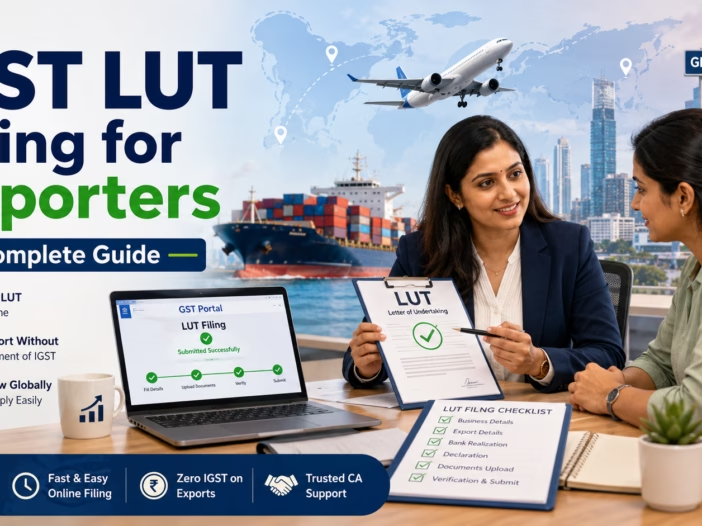
Exporters often face a common problem under GST: cash-flow blockage. If they pay IGST on exports first, they may need to wait for a refund later.
Fortunately, GST law offers a practical solution through a Letter of Undertaking, commonly known as LUT.
By filing LUT, an eligible exporter can export goods or services without paying IGST at the time of export. As a result, the exporter can protect working capital and manage GST compliance more efficiently.
This facility benefits manufacturers, merchant exporters, software companies, consultants, freelancers, startups, and other businesses that deal with overseas customers.
For businesses in Greater Noida, LUT filing can make export compliance smoother and reduce unnecessary tax blockage.
In this guide, we explain LUT filing in simple language. We also cover eligibility, validity, documents, refund rules, invoice requirements, timelines, common mistakes, and important practical points.
What Is LUT Under GST?
LUT stands for Letter of Undertaking.
A GST-registered exporter files LUT when they want to make eligible zero-rated supplies without paying IGST.
The exporter files LUT in Form GST RFD-11 through the GST portal.
Once the exporter files a valid LUT, they can make qualifying exports without paying IGST, subject to GST conditions.
In simple terms, LUT allows an exporter to avoid paying IGST first and claiming it back later.
Therefore, LUT mainly helps improve cash flow.
Why Do Exporters File LUT?
Exporters file LUT mainly to avoid blocking money in GST payments.
Suppose an exporter pays IGST on an export invoice. The exporter may later claim a refund. However, the refund process can take time.
On the other hand, LUT allows the exporter to make the export without paying IGST in the first place.
As a result, the business can keep more money available for daily operations.
For example, suppose a software company in Greater Noida provides services worth ₹10 lakh to a foreign client.
If the company has a valid LUT and the transaction qualifies as an export of services, it can issue the invoice without charging IGST.
Therefore, the company does not need to block funds only for GST payment.
What Is a Zero-Rated Supply?
GST law treats exports of goods and services as zero-rated supplies.
In addition, supplies made to an SEZ developer or SEZ unit for authorised operations may also qualify as zero-rated supplies, subject to applicable conditions.
However, zero-rated does not mean that GST law ignores the transaction.
Instead, the law allows exporters to claim eligible input tax credit even though they do not charge GST on the outward export supply.
This benefit becomes important because exporters often pay GST on:
- Office rent
- Raw materials
- Packing material
- Professional services
- Software subscriptions
- Logistics
- Business services
Therefore, the exporter can claim eligible ITC on such expenses.
If the credit accumulates, the exporter may also claim a refund, subject to GST refund rules.
Who Can File LUT Under GST?
Most GST-registered exporters can file LUT.
For example, the following persons may use the LUT facility:
- Proprietorship firms
- Partnership firms
- LLPs
- Private limited companies
- Manufacturers
- Merchant exporters
- IT companies
- Consultants
- Freelancers
- Service exporters
However, GST law restricts the LUT facility in certain prosecution cases involving specified tax offences and tax evasion above the prescribed limit.
In such cases, the person may need to furnish a bond instead.
Nevertheless, most regular exporters can use LUT without major difficulty.
Is GST Registration Required for LUT Filing?
Yes.
A person generally needs an active GST registration before filing LUT for eligible zero-rated supplies.
Therefore, the exporter should first check whether the GST registration is active.
In addition, the business should verify:
- Legal name
- Trade name
- Registered address
- Authorised signatory details
- Email and mobile details
If any detail is incorrect, the taxpayer should update it through the appropriate GST amendment process.
For instance, suppose a consulting firm in Greater Noida provides services to customers outside India.
First, the firm should confirm whether the supply qualifies as an export of services.
Then, if the firm has an active GST registration and meets the conditions, it can file LUT and issue export invoices without charging IGST.
What Is the Validity of LUT?
An LUT remains valid for the financial year for which the exporter files it.
Therefore, an exporter should file a fresh LUT for every financial year if the business wants to continue exporting without payment of IGST.
A previous LUT does not automatically continue into the next financial year.
For this reason, regular exporters should ideally file LUT at the beginning of each financial year.
This approach reduces the risk of invoice errors and compliance issues.
When Should an Exporter File LUT?
An exporter should file LUT before making eligible exports without payment of IGST under the LUT route.
Therefore, businesses that regularly export goods or services should file it early in the financial year.
Similarly, a new exporter can file LUT after obtaining GST registration and before making qualifying exports without payment of IGST.
By filing LUT on time, the exporter can maintain correct invoicing from the beginning.
Which Form Is Used for LUT Filing?
Exporters file LUT in Form GST RFD-11.
The GST portal allows taxpayers to file the form electronically.
After successful submission, the portal generates an acknowledgement or ARN.
The exporter should download and save the acknowledgement.
This document may help during:
- GST refund filing
- Departmental verification
- Reconciliation
- Audit
- Record keeping
Therefore, businesses should keep the LUT acknowledgement safely.
How to File LUT on the GST Portal
The online process is straightforward if the GST registration details are correct.
Follow these steps:
- Log in to the GST portal.
- Go to Services.
- Select User Services.
- Choose the option to furnish a Letter of Undertaking.
- Select the relevant financial year.
- Enter previous LUT details, where applicable.
- Read the declarations carefully.
- Select the authorised signatory.
- Enter the required place and other details.
- Submit the form through DSC or EVC, as applicable.
- Download the acknowledgement after successful filing.
After filing, the exporter should save both the LUT and its acknowledgement.
Documents and Information Required for LUT Filing
The exporter mainly files LUT online.
However, the business should keep the following information ready:
- GST registration details
- Legal name
- Trade name
- Registered business address
- Authorised signatory details
- Previous LUT details, where applicable
- Export-related business information
- Supporting records for verification
In addition, the exporter should make sure that all GST registration details are correct.
If the portal contains wrong information, the taxpayer should correct it before or alongside compliance, as applicable.
What Should You Mention on an Export Invoice Under LUT?
An exporter who makes a supply without payment of IGST under LUT should include the prescribed export endorsement on the invoice.
A commonly used declaration is:
“SUPPLY MEANT FOR EXPORT UNDER BOND OR LETTER OF UNDERTAKING WITHOUT PAYMENT OF INTEGRATED TAX”
Apart from this declaration, the exporter should also mention all other mandatory invoice details.
These may include:
- Invoice number
- Invoice date
- Supplier details
- Recipient details
- Value of supply
- Currency
- Destination details
- Other prescribed particulars
Therefore, exporters should prepare export invoices carefully.
Incorrect invoice wording may create problems during refund processing, customs reconciliation, or GST verification.
How Should Exporters Report LUT Exports in GST Returns?
Filing LUT does not remove the requirement to file GST returns.
The exporter must report export invoices correctly in GSTR-1.
Similarly, the exporter must report the relevant zero-rated turnover in GSTR-3B.
In addition, the figures should match the books of accounts and export documents.
For exporters of goods, shipping bill and customs details also become important.
For service exporters, foreign remittance and banking records play a major role.
Therefore, businesses should regularly reconcile:
- Books of accounts
- Export invoices
- GSTR-1
- GSTR-3B
- Shipping documents
- Bank receipts
- Foreign inward remittance records
Regular reconciliation can reduce refund delays and compliance errors.
Can an Exporter Claim Input Tax Credit After Filing LUT?
Yes.
Filing LUT does not stop an exporter from claiming eligible input tax credit.
For example, an exporter may pay GST on:
- Office rent
- Professional fees
- Software
- Raw materials
- Packing material
- Freight
- Logistics
- Other business services
If these expenses satisfy the normal ITC conditions, the exporter can claim the credit.
However, because the exporter does not pay IGST on exports under LUT, the ITC may accumulate in the electronic credit ledger.
Therefore, the exporter may claim a refund of eligible accumulated ITC, subject to GST refund rules.
How Can an Exporter Claim a Refund of Accumulated ITC?
An exporter who makes eligible zero-rated supplies without payment of tax can apply for a refund of accumulated ITC.
The exporter generally files the refund application in Form GST RFD-01.
Before filing the refund claim, the exporter should check all related GST returns.
In addition, the exporter should reconcile the refund data with books and export records.
For exports of goods, shipping bill and customs data become important.
For exports of services, the exporter should maintain proper evidence of receipt of export proceeds.
Depending on the case, BRC or FIRC-related banking documents may also become relevant.
Therefore, accurate records can make the refund process smoother.
Time Limit for Export of Goods Under LUT
An exporter who supplies goods without payment of IGST under LUT must export those goods within the prescribed period.
Broadly, Rule 96A requires the exporter to complete the export within three months from the date of the export invoice, unless the proper authority grants an extension.
If the exporter fails to export the goods within the permitted time, tax and applicable interest may become payable.
Therefore, exporters should track both:
- Export invoice date
- Actual shipment date
This simple control can prevent future tax problems.
Time Limit for Receipt of Payment for Export Services
Service exporters must also monitor export proceeds.
Broadly, Rule 96A requires the exporter to receive payment within the prescribed period.
The general period is one year from the date of the export invoice, unless an extension applies.
If the exporter does not receive the payment within the permitted time, tax and applicable interest may become payable.
However, the exporter may receive the amount in convertible foreign exchange or in Indian rupees where the Reserve Bank of India allows such receipt.
Therefore, consultants, software companies, freelancers, and other service exporters should maintain proper invoice and payment records.
Example of Export Under LUT
Suppose a digital marketing company in Greater Noida provides qualifying export services worth ₹5 lakh to a foreign client.
The company has:
- An active GST registration
- A valid LUT
- Proper export documentation
The company raises an invoice for ₹5 lakh without charging IGST.
It also mentions the required LUT declaration on the invoice.
Next, the company reports the transaction correctly in GSTR-1 and GSTR-3B.
During the same period, the company pays GST on office rent, software subscriptions, and other eligible expenses.
Therefore, the company may claim a refund of accumulated eligible ITC, subject to GST rules.
In this way, LUT helps the company save working capital.
Common Mistakes in LUT Filing and Export Compliance
Although LUT filing is simple, exporters often make mistakes during ongoing compliance.
Some common errors include:
- Filing LUT for the wrong financial year
- Using an old LUT after its validity ends
- Making exports without filing the relevant LUT
- Using incorrect wording on export invoices
- Reporting wrong export values in GSTR-1
- Reporting incorrect figures in GSTR-3B
- Creating mismatches between returns and shipping bills
- Failing to track export proceeds
- Filing refund claims without reconciliation
- Keeping incomplete export records
Therefore, exporters should review compliance throughout the year.
They should not wait until refund filing to identify mistakes.
Is LUT Mandatory for Every Exporter?
No.
LUT is a facility for eligible registered exporters who want to make zero-rated supplies without paying IGST.
Therefore, it is not compulsory in every export situation.
Different supplies may require different GST treatment.
For example, exempt goods or non-GST goods may require separate analysis.
Hence, an exporter should first identify the nature of the goods or services.
After that, the exporter should apply the correct GST treatment.
LUT Filing for Service Exporters
Many service providers in India work with foreign clients.
These may include:
- Software companies
- IT service providers
- Consultants
- Designers
- Digital marketing agencies
- Management consultants
- Architects
- Freelancers
- Other professionals
However, receiving money from a foreign customer does not automatically make the transaction an export of services.
The supply must satisfy the conditions prescribed under the IGST law.
Therefore, the exporter should check factors such as:
- Location of the supplier
- Location of the recipient
- Place of supply
- Nature of the transaction
- Receipt of consideration
Only after checking these conditions should the business treat the supply as an export under LUT.
GST LUT Filing for Exporters in Greater Noida
Greater Noida has many manufacturers, IT companies, startups, consultants, e-commerce businesses, and professional service providers.
Many of these businesses deal with overseas customers.
Therefore, LUT filing can help them manage exports more efficiently.
However, businesses should not focus only on Form GST RFD-11.
They should also review:
- Export invoice wording
- GSTR-1 reporting
- GSTR-3B reporting
- Shipping documents
- Foreign remittance records
- Refund eligibility
- Input tax credit
- Export timelines
A Chartered Accountant in Greater Noida can help businesses review the entire export GST process.
As a result, exporters can reduce mistakes, refund delays, and unnecessary notices.
Why Proper LUT Compliance Matters
LUT filing may look like a one-time annual task.
However, proper compliance continues throughout the year.
The exporter must correctly issue invoices, report exports, maintain documents, track payments, and reconcile GST returns.
Therefore, businesses should treat LUT as part of a complete export GST system.
When all records match, refund processing also becomes easier.
Moreover, proper compliance can reduce the risk of future notices and disputes.
Conclusion
GST LUT filing offers a valuable benefit to eligible exporters.
It allows them to export goods or services without paying IGST upfront.
As a result, exporters can protect working capital and simplify export transactions.
The exporter files Form GST RFD-11 for the relevant financial year.
However, LUT filing alone does not complete GST export compliance.
Exporters must also issue correct invoices, report transactions properly in GSTR-1 and GSTR-3B, maintain export documents, track export proceeds, and follow prescribed timelines.
Therefore, businesses in Greater Noida should review LUT and export GST compliance regularly.
Good records, timely filing, and proper reconciliation can help avoid notices, refund delays, and tax disputes.
Frequently Asked Questions on GST LUT Filing
1. What is the full form of LUT in GST?
LUT stands for Letter of Undertaking.
Eligible GST-registered exporters use LUT to make qualifying exports without payment of IGST.
2. Which form is used for LUT filing?
Exporters file LUT in Form GST RFD-11.
3. Can I file LUT online?
Yes.
Eligible taxpayers can file LUT electronically through the GST portal.
4. How long does an LUT remain valid?
An LUT remains valid for the financial year for which the exporter files it.
Therefore, the exporter should file a fresh LUT for each financial year.
5. Should I file LUT before making an export?
Yes.
An exporter should file LUT before making eligible supplies without payment of IGST under the LUT route.
6. Do I need to pay GST on exports under LUT?
An eligible exporter does not pay IGST on a qualifying export made under a valid LUT.
However, the exporter must follow all applicable GST conditions.
7. Can a freelancer file LUT?
Yes.
A GST-registered freelancer can file LUT if the services qualify as exports and the freelancer satisfies the prescribed conditions.
8. Can a software company file LUT?
Yes.
A GST-registered software company can use LUT for qualifying export services.
9. Can I claim ITC after filing LUT?
Yes.
An exporter can claim eligible input tax credit subject to normal GST conditions.
10. Can I claim a GST refund after exporting under LUT?
Yes.
An eligible exporter can claim a refund of accumulated ITC by filing Form GST RFD-01, subject to the applicable GST refund provisions.
11. What happens if goods are not exported within the prescribed time?
If the exporter does not export the goods within the prescribed period and no extension applies, tax and applicable interest may become payable.
12. What happens if export service payment is not received on time?
If the exporter does not receive payment within the permitted period and no extension applies, tax and applicable interest may become payable.
13. Do I need to visit the GST office to file LUT?
Normally, no.
The exporter can file LUT electronically through the GST portal.
14. Can I file LUT after the financial year has started?
Yes.
However, the exporter should file it before making eligible supplies without payment of IGST under the LUT route.
15. Is LUT compulsory for all exports?
No.
The requirement depends on the nature of the supply and the method used for making the export.
16. Can a business in Greater Noida file LUT online?
Yes.
A GST-registered exporter in Greater Noida can file Form GST RFD-11 through the GST portal.
17. What is the main benefit of LUT filing?
The biggest benefit is better cash flow.
The exporter can make eligible zero-rated supplies without paying IGST upfront and may claim a refund of eligible accumulated ITC separately.