
Introduction
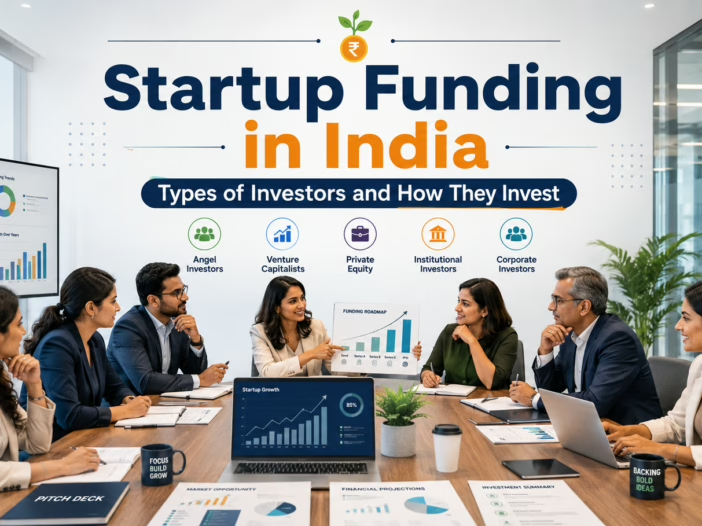
Starting a business needs money, planning, patience, and the right support. Many founders have strong business ideas. However, they often struggle to arrange funds for product development, marketing, hiring, technology, office setup, and daily business expenses.
Therefore, startup funding becomes an important part of business growth. It helps founders convert their ideas into real businesses. Moreover, it gives them the financial support they need to test the market, build a product, and expand operations.
However, every investor does not invest in the same way. Some investors support startups at the idea stage. On the other hand, some investors invest only when the business already has customers, revenue, and a clear growth plan.
For example, a startup based in Greater Noida may need funds to build an app, open an office, hire employees, or expand across Delhi NCR. In such a situation, the founder can approach different types of investors depending on the stage, business model, and funding requirement of the company.
What is Startup Funding?
Startup funding means money raised by a new business to start, run, or grow its operations. A startup may raise money from founders, family members, angel investors, venture capital firms, banks, government schemes, or other funding sources.
In simple words, startup funding helps a business move from an idea stage to a working business. After that, it helps the business move from a small setup to a growing company.
Why Do Startups Need Funding?
Startups need funding for many reasons. A founder may have a good business idea. However, without money, it becomes difficult to execute that idea properly.
For example, a fintech, food delivery, education, or e-commerce startup in Greater Noida may need funds to build technology, reach customers, and expand services in Noida, Delhi, Ghaziabad, and nearby areas.
Startups usually use funding for:
- Product development
- Website or app development
- Office setup
- Hiring employees
- Marketing and branding
- Purchase of equipment
- Technology expenses
- Legal and compliance work
- Business expansion
- Working capital requirements
Therefore, funding gives startups the power to operate smoothly and grow faster.
Different Stages of Startup Funding
Before understanding investors, it is important to understand the stages of startup funding. Investors usually decide whether to invest based on the stage of the business.
1. Bootstrapping Stage
Bootstrapping means starting the business with your own money. At this stage, the founder does not take money from outside investors.
Usually, the founder uses personal savings, family support, or income from another source. As a result, the founder keeps full control over the business.
However, bootstrapping may limit the speed of growth because the founder has limited funds.
2. Seed Stage
Seed funding is the early funding stage. At this stage, the startup may have an idea, a basic product, or a small customer base.
Generally, angel investors, friends, family members, and seed funds invest at this stage. Therefore, seed funding helps the founder test the business idea and build the first version of the product.
3. Early Stage
At the early stage, the startup has already started its operations. It may have some customers, revenue, or market response.
Therefore, venture capital investors may show interest if they see strong growth potential in the business. Moreover, they may help the startup expand its team, improve technology, and increase sales.
4. Growth Stage
At the growth stage, the startup already has customers, revenue, and a tested business model. Now, the company raises funds to expand faster.
At this stage, venture capital firms, private equity investors, and strategic investors may invest in the company. As a result, the startup can enter new markets, hire more people, and improve operations.
5. Late Stage
At the late stage, the startup becomes a large business. It may raise funds before IPO, acquisition, or large-scale expansion.
Usually, large funds, private equity firms, and institutional investors invest at this stage. Therefore, late-stage funding is generally suitable for established startups.
Types of Startup Investors in India
1. Founder’s Own Investment
The founder is usually the first investor in any startup. When founders invest their own money, it shows confidence in the business.
For example, a founder in Greater Noida may use personal savings to register a private limited company, build a website, rent an office, and start basic operations.
How Founders Invest
Founders usually invest through:
- Equity capital
- Unsecured loan
- Personal savings
- Direct business expenses
This is the simplest form of startup funding. However, founders should maintain proper accounting records from the beginning. Otherwise, they may face confusion during future funding or due diligence.
2. Friends and Family Investors
Friends and family investors are people who personally know the founder. They may invest because they trust the founder and believe in the business idea.
Usually, this type of funding happens at the very early stage of a startup. Since the relationship is personal, founders may take this funding casually. However, they should still prepare proper documents.
How Friends and Family Invest
They may invest through:
- Equity shares
- Loan
- Convertible instruments
- Informal financial support
However, founders should avoid verbal arrangements. Instead, they should prepare written agreements to prevent future disputes.
3. Angel Investors
Angel investors are individuals who invest their own money in startups. They usually invest at an early stage when the startup has high risk but also high growth potential.
In addition to money, angel investors may also guide the founder with business strategy, networking, and market knowledge. Therefore, they can be very useful for first-time founders.
How Angel Investors Invest
Angel investors usually invest through:
- Equity shares
- Compulsorily convertible preference shares
- Convertible notes
- Other convertible instruments
- Debentures, depending on the structure
In return, they usually get ownership in the company. For example, an angel investor may invest ₹25 lakh in a startup and take a certain percentage of equity.
4. Venture Capital Investors
Venture capital investors, also called VC investors, invest in startups with strong growth potential. They usually invest through venture capital funds.
However, VC investors do not usually invest only in ideas. They prefer startups with a strong team, scalable business model, market demand, and clear growth plan.
How Venture Capital Investors Invest
VC investors usually invest through:
- Equity shares
- Preference shares
- Convertible preference shares
- Multiple funding rounds
- Structured investment agreements
As a result, they get ownership in the company and expect high returns in the future. Moreover, they may also ask for investor rights, reporting requirements, and board participation.
5. Seed Funds
Seed funds invest in startups at an early stage. They help founders build the product, test the market, and prepare for the next level of growth.
Therefore, seed funding is useful when the startup needs money before approaching large venture capital investors.
How Seed Funds Invest
Seed funds may invest through:
- Equity
- Convertible instruments
- Preference shares
- Startup investment agreements
Before investing, they usually check the founder’s background, business idea, market size, and growth plan. Therefore, founders should prepare a clear pitch deck and basic financial plan.
6. Incubators and Accelerators
Incubators and accelerators support startups with funding, office space, mentorship, networking, and business guidance.
Many startups join these programs to improve their business model and meet investors. Moreover, these programs help founders understand the market in a better way.
How Incubators and Accelerators Invest
They may support startups through:
- Small funding amount
- Mentorship
- Office space
- Investor connections
- Business training
- Equity-based support
For example, a Greater Noida-based startup may join an incubation program in Delhi NCR to get mentorship and investor access. As a result, the startup can improve its business plan before raising a bigger funding round.
7. Government Schemes and Grants
The government also supports startups through various schemes, grants, loans, and incentives. These schemes help startups reduce financial pressure.
In many cases, government support can be useful because it may come with lower cost or better terms than private funding. However, startups must meet the eligibility conditions.
How Government Funding Works
Government support may come in the form of:
- Grants
- Subsidies
- Loans
- Credit guarantee support
- Tax benefits
- Startup recognition benefits
However, startups must check eligibility conditions, documentation, and compliance requirements before applying. Therefore, proper preparation can improve the chances of approval.
8. Bank Loans
Banks provide loans to startups and small businesses. Unlike equity investors, banks do not take ownership in the company. Instead, they charge interest on the loan amount.
Therefore, bank loans are useful when the startup has stable income, assets, or a clear repayment plan. However, early-stage startups may find it difficult to get bank loans without financial history.
How Banks Fund Startups
Banks usually provide:
- Term loans
- Working capital loans
- Cash credit limits
- Machinery loans
- Business loans
However, banks may ask for documents, collateral, business plans, financial statements, and repayment capacity. Therefore, startups should keep their financial records updated.
9. NBFCs and Fintech Lenders
NBFCs and fintech lenders also provide business loans to startups and small businesses. Their process may be faster than traditional banks.
However, their interest rates can be higher. Therefore, startups should compare the cost carefully before taking funds.
How NBFCs and Fintech Lenders Fund Startups
They may provide:
- Business loans
- Working capital loans
- Revenue-based financing
- Invoice financing
- Short-term loans
Before taking such loans, startups should compare interest rates, processing fees, repayment terms, and hidden charges. Otherwise, the loan may create pressure on cash flow.
10. Strategic Investors
Strategic investors are companies or business groups that invest in startups for business benefits. They may invest because the startup’s product or service supports their own business goals.
For example, a large FMCG company may invest in a food-tech startup if it sees future business value.
How Strategic Investors Invest
Strategic investors may invest through:
- Equity investment
- Joint venture
- Business partnership
- Acquisition of stake
- Technology or distribution support
In addition, they may help the startup with customers, supply chain, branding, and market access. Therefore, strategic investors can offer more than just money.
11. Private Equity Investors
Private equity investors usually invest in mature businesses. They prefer companies that already have revenue, profits, customers, and expansion plans.
Therefore, private equity funding is not common for very early-stage startups. It usually comes at a later stage.
How Private Equity Investors Invest
Private equity investors may invest through:
- Equity shares
- Preference shares
- Buyout transactions
- Growth capital
- Structured deals
Usually, they invest larger amounts and expect strong business performance. As a result, they may also closely monitor the company’s financial growth.
12. Crowdfunding
Crowdfunding means raising small amounts of money from many people. Startups may use crowdfunding for product launches, social causes, creative projects, or community-driven businesses.
However, equity crowdfunding has regulatory restrictions in India. Therefore, startups should take proper legal advice before choosing this route.
How Crowdfunding Works
Crowdfunding may work through:
- Donation-based support
- Reward-based support
- Pre-order model
- Community funding
To raise funds successfully, founders should clearly explain the project, funding goal, and benefits to supporters. Moreover, they should maintain transparency with contributors.
Difference Between Equity Funding and Debt Funding
Startup funding mainly comes in two forms: equity and debt. Therefore, founders should understand both before accepting money.
Equity Funding
In equity funding, the investor gives money to the company and receives ownership in return. The company does not need to repay this money like a loan.
However, the founder’s ownership reduces because the investor gets shares in the company. Therefore, founders should carefully decide how much equity they want to give.
Debt Funding
In debt funding, the company takes a loan and repays it with interest. The lender does not get ownership in the company.
However, the company must repay the loan on time, even if the business does not perform well. Therefore, startups should take debt only when they have a repayment plan.
Which Funding Option is Better for Startups?
There is no single best funding option for every startup. The right option depends on the business stage, money requirement, risk level, and growth plan.
For example, if a startup is at the idea stage, bootstrapping, friends and family funding, or angel investment may work better. However, if the startup already has revenue and wants to expand, venture capital or bank funding may be more suitable.
Therefore, founders should first understand their business needs. After that, they should choose the right funding source.
What Do Investors Check Before Investing?
Investors do not invest only because the idea sounds good. Instead, they check many things before making a decision.
Usually, investors look at:
- Founder’s experience
- Business model
- Market size
- Product demand
- Revenue potential
- Competition
- Legal structure
- Financial records
- Customer response
- Growth plan
- Exit opportunity
- Compliance status
For example, if a Greater Noida startup has proper company registration, clean accounting records, GST compliance, income tax filings, and a clear pitch deck, it can create a better impression on investors. Therefore, proper compliance can support the funding process.
Important Documents Required for Startup Funding
A startup should keep important documents ready before approaching investors. Proper documents help investors trust the business.
Important documents include:
- Certificate of incorporation
- PAN and TAN of the company
- GST registration, if applicable
- Startup India recognition, if available
- MOA and AOA
- Shareholding pattern
- Financial statements
- Bank statements
- Business plan
- Pitch deck
- Valuation report, if required
- Founders’ KYC documents
- Board resolutions
- Investment agreement
- Compliance records
With proper documentation, the funding process becomes smoother. Moreover, investors get confidence that the startup follows legal and financial discipline.
Common Mistakes Startups Make While Raising Funds
Many startups make mistakes while raising funds. These mistakes can create legal, financial, or ownership problems later.
Common mistakes include:
- Giving too much equity at an early stage
- Not making proper agreements
- Ignoring valuation
- Not maintaining books of accounts
- Mixing personal and business expenses
- Taking money without proper documentation
- Not understanding investor rights
- Ignoring ROC and tax compliance
- Making unrealistic promises
- Not planning future funding rounds
Therefore, founders should take professional advice before accepting investment. In addition, they should understand the long-term impact of every funding decision.
Startup Funding Example in Simple Words
Suppose two founders start a technology company in Greater Noida. First, they invest ₹5 lakh from their own savings. Then, they build a basic product. After that, they need ₹25 lakh for marketing and hiring.
At this stage, they approach an angel investor. The angel investor likes the idea and invests ₹25 lakh in exchange for equity.
After one year, the company gains customers and earns regular revenue. Now, the company wants to expand across India. Therefore, it may approach a venture capital firm for a larger funding round.
This is how a startup can move from founder funding to angel funding and then to venture capital funding. As the business grows, the type of investor may also change.
Role of a CA in Startup Funding
A Chartered Accountant plays an important role in startup funding. Investors want proper financial records and clean compliance before investing.
A CA can help startups with:
- Company registration
- Startup India registration
- Accounting and bookkeeping
- GST and income tax compliance
- Financial statements
- Valuation support
- Due diligence support
- Share issue compliance
- Investor documentation
- ROC filing
For startups in Greater Noida, Noida, Delhi NCR, and nearby areas, professional guidance can help founders avoid mistakes during funding. Moreover, a CA can help founders present financial records in a proper manner.
Conclusion
Startup funding in India helps founders start, run, and grow their businesses. However, every investor has a different role, investment style, and expectation.
Therefore, founders should first understand their funding needs and business stage. After that, they should choose the right investor, prepare proper documents, and complete legal compliance carefully.
Whether the startup is based in Greater Noida or any other city in India, proper planning, clean records, and the right investor can help the business grow faster and stronger.
FAQs on Startup Funding in India
1. What is startup funding?
Startup funding means money raised by a new business to start, operate, or expand its activities.
2. Who are the main startup investors in India?
The main startup investors include founders, friends and family members, angel investors, venture capital firms, seed funds, incubators, banks, government schemes, and private equity investors.
3. What is angel investment?
Angel investment means funding given by individual investors at an early stage of a startup. Usually, angel investors take equity in return.
4. What is venture capital funding?
Venture capital funding means investment made by VC firms in startups with high growth potential. VC investors usually invest in exchange for ownership in the company.
5. What is the difference between equity and debt funding?
In equity funding, investors get ownership in the company. In debt funding, the company takes a loan and repays it with interest.
6. Can a startup raise funds without revenue?
Yes, a startup can raise funds without revenue if it has a strong idea, capable founders, market potential, and a clear growth plan. However, it may be more difficult.
7. What documents do investors ask for?
Investors may ask for incorporation documents, financial records, pitch deck, business plan, shareholding details, bank statements, tax filings, and compliance documents.
8. Is company registration necessary for startup funding?
Company registration is highly recommended. Most investors prefer investing in a private limited company because it offers a clear legal structure.
9. Can a Greater Noida startup raise funding from investors?
Yes, a Greater Noida startup can raise funding from angel investors, venture capital firms, banks, government schemes, and other funding sources if it has a strong business model and proper documentation.
10. Should startups take professional advice before raising funds?
Yes, startups should take professional advice before raising funds. Proper advice helps founders understand valuation, equity dilution, tax impact, legal documents, and compliance requirements.