
[Your Name]
[Your Address]
[City, State, PIN Code]
[Email Address]
[Date]
To
The Editor
[Publication/Organization Name]
[Address]
[City, State, PIN Code]
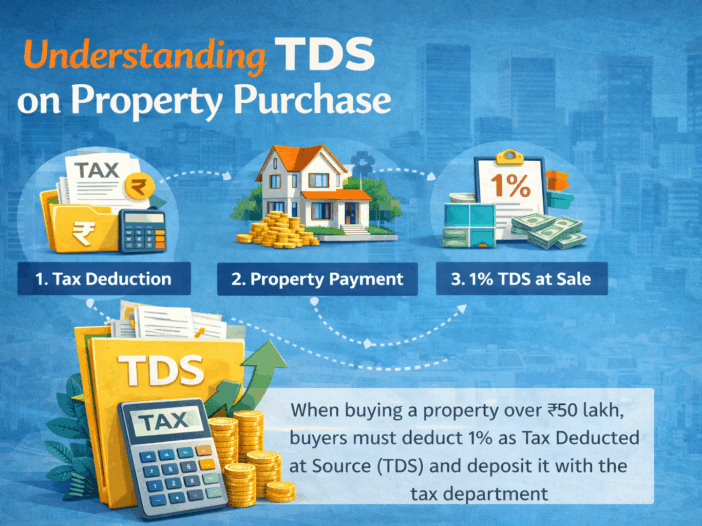
Subject: Understanding TDS on Property Purchase: A Comprehensive Guide to Section 194-IA
Dear Sir/Madam,
I am writing to shed light on an important yet often misunderstood aspect of real estate transactions in India — the deduction of Tax Deducted at Source (TDS) on the purchase immovable property under Section 194-IA of the Income Tax Act, 1961. As property investments are among the most significant financial decisions made by individuals, it is crucial for both buyers and sellers to be aware of the legal obligations and compliance procedures associated with such transactions.
This letter aims to serve as a comprehensive guide to understanding the applicability, rate, and procedural aspects of TDS under this provision, with the objective of making the process simpler for first-time buyers are those unfamiliar with tax laws.
What is Section 194-IA?
Section 194-IA was introduced by the Finance Act, 2013, and became effective from 1st June 2013. The primary intention of this provision is to capture high-value real estate transactions and ensure that the seller declares the capital gains on property sales. This section mandates buyers of immovable property (other than agricultural land) to deduct tax at source before making payment to the seller, provided the consideration for the property exceeds a specified limit.
Applicability of Section 194-IA
The key conditions under which TDS is applicable are:
- Type of Property: The provision applies to immovable property such as land (other than agricultural land), buildings, or part of a building.
- Value of Consideration: TDS deducted are sale consideration is ₹50 lakh or more. It’s important to note that this includes all charges related to the transfer such as club membership fees, car parking fees, electricity and water charges, maintenance fees, and any other incidental charges.
- Who Deducts TDS?: The buyer (purchaser) of the property is responsible for deducting TDS and depositing it with the government.
- Who Receives TDS?: The seller of the property provide they resident of India. If the seller is a non-resident, then Section 195 applies instead.
Even if there are multiple buyers or sellers, and each individual’s share is below ₹50 lakh, the section still applies if the total consideration exceeds ₹50 lakh.
TDS Rate and Payment Timeline
- Rate of TDS: The applicable rate 1% of the total sale consideration.
- Surcharge and Cess: No additional surcharge or health and education cess is applicable.
- Threshold Limit: No TDS needs to be deducted if the total consideration is less than ₹50 lakh.
- Time of Deduction: The buyer must deduct TDS at the time of payment or credit of amount to the seller, whichever is earlier.
- Deposit Deadline: The TDS amount must be deposited with the central government within 30 days from the end of the month in which the deduction was made.
Procedure for Compliance
- Form 26QB: The buyer needs to fill Form 26QB, a TDS challan-cum-statement, available on the TIN-NSDL website (now managed through the Income Tax e-filing portal).
- PAN Details: It is mandatory quote the PAN of both the buyer and seller while filing Form 26QB. Mismatch or absence of PAN could lead to higher TDS (20%) or non-processing of the challan.
- Payment Mode: The TDS can be paid using net banking or by generating a challan and submitting it at an authorized bank.
- Form 16B: After depositing TDS, the buyer must download Form 16B (TDS certificate) from the TRACES portal and issue it to the seller within 15 days of filing Form 26QB.
Penalties and Consequences of Non-Compliance
Non-compliance are the provisions of Section 194-IA may lead the following penalties:
- Interest for Late Deduction: 1% per month from the date tax was deductible the date it is actually deducted.
- Interest for Late Deposit: 1.5% per month from the date of deduction to the date of payment.
- Late Filing Fee: ₹200 per day under Section 234E, subject to the TDS amount.
- Penalty: The Assessing Officer may levy a penalty equal to the amount of tax not deducted or deposited under Section 271H.
Timely compliance is crucial to avoid interest, penalties, and legal issues.
Example Illustration
If you are buying a flat for ₹70,00,000, you must:
- Deduct ₹70,000 (1%) as TDS.
- Pay ₹69,30,000 to the seller.
- File Form 26QB and deposit ₹70,000 with the Income Tax Department within 30 days.
- Issue Form 16B to the seller.
Key Points to Remember
- TDS under Section 194-IA is applicable only to buyers (not brokers or agents).
- It does not require TAN (Tax Deduction Account Number) for compliance.
- PAN must be valid and active for both parties.
- Always ensure all payments are properly documented.
Final Thoughts
Understanding and adhering to the provisions of Section 194-IA is essential for every property buyer in India. While the process may appear tedious at first, the government has significantly streamlined the system through online portals, eliminating the need for extensive paperwork. With a little awareness and timely action, buyers can ensure full compliance and avoid unnecessary complications post-transaction.
I hope this detailed explanation will serve as a useful guide for your readers in navigating property-related TDS deductions confidently and lawfully.