
Introduction
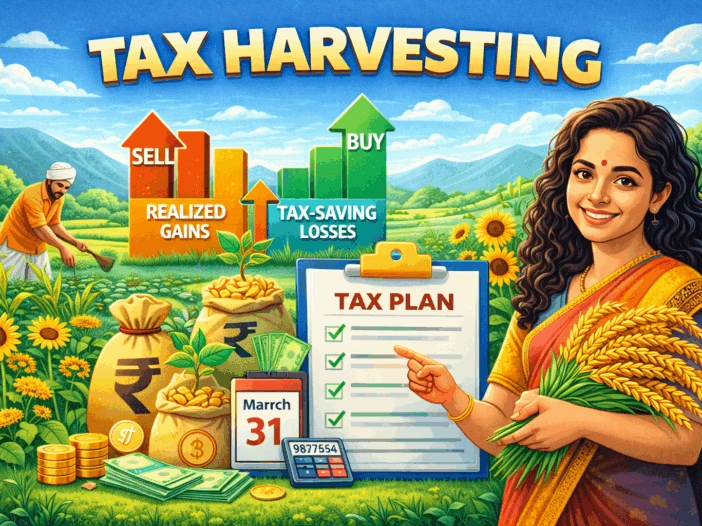
Tax harvesting is a smart tax planning strategy used by investors to reduce their tax liability on investments. In simple words, it means selling investments in a planned way to book gains or losses so that the overall tax becomes lower.
Many investors hold shares or mutual funds for the long term. However, sometimes these investments show losses on paper but the investor has not sold them. Through tax harvesting, you can sell such investments, book the loss for tax purposes, and then buy them again if you still want to hold them for the long term.
As a result, the loss gets recorded in your tax return and reduces your tax liability for that financial year.
Since we are currently in March 2026, this is the best time to review your portfolio for FY 2025-26 and use tax harvesting before 31 March 2026.
How Tax Harvesting Works in India
To understand tax harvesting, you must first understand capital gains taxation in India.
Capital gains arise when you sell a capital asset such as shares, mutual funds, property, gold, or other investments.
Capital gains are divided into two categories:
• Short-Term Capital Gains (STCG)
• Long-Term Capital Gains (LTCG)
Capital Gains Tax Rules in India
Listed Shares and Equity Mutual Funds
Short-Term Capital Gain (STCG)
If listed shares or equity mutual funds are held for less than 12 months, the gain is treated as short-term capital gain.
Tax Rate
Earlier: 15%
From 23 July 2024: 20%
Long-Term Capital Gain (LTCG)
If listed shares or equity mutual funds are held for more than 12 months, the gain is treated as long-term capital gain.
Latest Tax Rules
First ₹1,25,000 LTCG per year is tax-free.
Remaining gain is taxed at 12.5%.
Earlier this exemption limit was ₹1 lakh, but it has now increased to ₹1.25 lakh.
Unlisted Shares
STCG
If unlisted shares are held for less than 24 months, gains are taxed at the normal income tax slab rate.
LTCG
If held for more than 24 months, gains are taxed at 12.5% without indexation.
Immovable Property (Land or Building)
STCG
If property is sold within 24 months, the gain is taxed at the income tax slab rate.
LTCG
If property is held for more than 24 months, the gain is taxed at 12.5% without indexation.
Other Capital Assets (Gold, Debt Funds etc.)
STCG
If held for less than 24 months, gains are taxed at the slab rate.
LTCG
If held for more than 24 months, gains are taxed at 12.5% without indexation.
Selling at Loss and Reinvesting
Tax harvesting mainly works by booking losses intentionally to reduce tax on gains.
Investors can sell stocks, mutual funds, or other assets that are currently in loss. These losses can then offset capital gains earned from other investments.
Set-off rules are as follows:
Short-term capital loss (STCL) can be adjusted against both STCG and LTCG.
Long-term capital loss (LTCL) can only be adjusted against LTCG.
If losses remain after adjustment, they can be carried forward for up to 8 years.
Examples of Tax-Loss Harvesting
Example 1: Adjusting STCG with STCL
Suppose you earn ₹1,00,000 profit from Stock A (STCG).
You also have a ₹40,000 loss from Stock B (STCL).
Without tax harvesting:
Tax = ₹1,00,000 × 20% = ₹20,000
After tax harvesting:
Taxable gain = ₹1,00,000 − ₹40,000 = ₹60,000
Tax = ₹60,000 × 20% = ₹12,000
Tax saved = ₹8,000
Example 2: Reducing LTCG Tax Liability
Suppose you earn ₹2,00,000 LTCG from Stock C.
You also have ₹1,00,000 LTCL from Stock D.
After adjusting the loss:
Taxable LTCG = ₹1,00,000
Since LTCG up to ₹1.25 lakh is tax-free, the final tax payable becomes zero.
Tax saving = ₹12,500
Example 3: Carry Forward Losses
Suppose you earn ₹3,00,000 LTCG from mutual funds.
You also have ₹5,00,000 LTCL from other investments.
After adjusting ₹3,00,000 gain, the taxable gain becomes zero.
Remaining ₹2,00,000 loss can be carried forward to future years.
These losses can be used to offset future capital gains for up to 8 years.
LTCG Harvesting Strategy (₹1.25 Lakh Rule)
One popular tax harvesting strategy is harvesting long-term capital gains.
If your unrealized LTCG in shares or equity mutual funds is below ₹1.25 lakh, you can sell the investment, book the gain, and buy the same investment again.
Because LTCG up to ₹1.25 lakh is tax-free, this resets your purchase price higher and helps reduce future tax liability.
No Wash Sale Rule in India
Unlike the United States, India does not have a wash sale rule.
This means you can sell a stock, book the loss, and buy it again immediately.
However, many tax experts suggest waiting 1–2 days before repurchasing the same stock to avoid any tax scrutiny.
How to Find Tax Harvesting Opportunities
Step 1
Review your investment portfolio for stocks or mutual funds with unrealized losses.
Step 2
Identify taxable capital gains such as STCG or LTCG.
Step 3
Sell underperforming investments to book losses.
Step 4
Ensure proper matching of losses:
STCL can offset STCG or LTCG
LTCL can offset LTCG only
Step 5
Carry forward unused losses for up to 8 years.
Best Time to Find Tax Harvesting Opportunities
December (Mid-Year Review)
Investors can review their portfolio and identify underperforming stocks early.
March (End of Financial Year)
Investors should finalize tax harvesting decisions before the financial year ends.
Last Date for Tax Harvesting
Tax harvesting must be completed before the end of the financial year.
For FY 2025-26, the last date for tax harvesting is 31 March 2026.
Any transaction after this date will be considered in the next financial year.
Conclusion
Tax harvesting is a simple and effective way to reduce tax liability on investments. By reviewing your portfolio and strategically booking gains or losses, you can lower your tax burden and improve overall investment returns.
In addition, investors can take advantage of the ₹1.25 lakh tax-free LTCG limit, adjust capital losses against gains, and carry forward unused losses for future years.
Therefore, before the end of every financial year, investors should review their investment portfolio and identify tax harvesting opportunities. Proper tax planning helps save taxes and manage investments more efficiently.