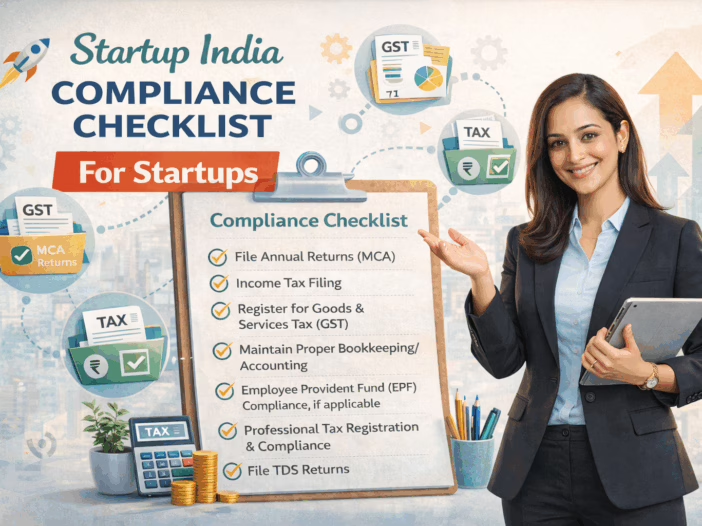
The Government of India launched the Startup India initiative in 2016 to promote innovation, support entrepreneurship, and ease regulatory burdens on new businesses. As we enter the Financial Year 2025 (FY2025), understanding the regulatory compliance checklist under this initiative is crucial for startups aiming to sustain, scale, and secure funding while enjoying the benefits of the scheme.
This article outlines a comprehensive compliance checklist tailored for startups under the Startup India scheme for FY2025 and answers some frequently asked questions.
-
Eligibility Criteria for Startup Recognition (FY2025)
Before diving into compliance, a business must ensure it qualifies as a “startup” under the Department for Promotion of Industry and Internal Trade (DPIIT). The criteria are:
- Incorporated as a Private Limited Company, Registered Partnership Firm, or LLP.
- Never older than 10 years from the date of incorporation.
- Turnover not exceeding ₹100 crore in any of the financial years since incorporation.
- Working towards innovation, development or improvement products and services.
- Should not be formed by splitting or reconstructing are existing business.
-
Annual Compliance Checklist for Startup India (FY2025)
- A. DPIIT Startup Recognition
- Apply for DPIIT recognition via the Startup India portal.
- Upload documents including incorporation certificate, PAN, and brief about the business model.
- Renew any industry-specific registrations if applicable.
- MCA (Ministry of Corporate Affairs) Compliance
For Private Limited Companies:
- Annual Return (Form MGT-7) – Within 60 days of AGM.
- Financial Statement Form AOC-4 With in 30 days of AGM.
- Hold Annual General Meeting – Within 6 months of financial year end.
- DIR-3 KYC for all directors are Due by 30th September.
- Form DPT-3 (if applicable) for disclosing deposits.
For LLPs:
- Annual Return Form 11 Due by 30th May.
- Statement of Accounts (Form 8) – Due by 30th October.
- DIR-3 KYC compliance for Designated Partners.
- Income Tax Compliance
- Filing of ITR (ITR-5/6 as applicable) by 31st October (if audit applicable).
- Form 3CEB if applicable for transfer pricing are filed by 30th November.
- Tax Audit (Form 3CA/3CB and 3CD) – if turnover exceeds limits as per Sec 44AB.
- Advance Tax Payments (June, Sept, Dec, March).
- Form 10I EA are opting for the new tax regime.
- GST Compliance
- Monthly/Quarterly GST Returns (GSTR-1 and GSTR-3B).
- Annual Return (GSTR-9) – Due by 31st December.
- GST Audit GSTR-9C Mandatory if turnover exceeds ₹5crore.
- E-invoicing & E-way bills – As per turnover threshold.
- Other Statutory Registrations & Returns
- ESI or PF Returns are 10 or more employees (ESI) or 20 or more employees (PF).
- Professional Tax – As per state regulations.
- Shops & Establishment Registration – Mandatory in most states.
- Labour Law Returns – Registers & periodic filings under CLRA, Payment of Wages Act, etc.
-
Benefits Available Under Startup India Scheme (FY2025)
To encourage compliance and innovation, recognized startups enjoy:
- Income Tax Exemptions for 3 consecutive years under Section 80-IAC.
- Exemption from Angel Tax (Sec 56(2)(viib)) for DPIIT-recognized startups.
- Self-certification under 9 labour laws and 3 environment laws for 3–5 years.
- Faster IP filing 80% rebate on patent filing fees.
- Access to Fund of Funds for Startups (FFS) and Credit Guarantee Schemes.
- Easier Public Procurement norms.
-
Important Dates & Deadlines for FY2025
| Compliance | Due Date |
| DIR-3 KYC | 30th September 2025 |
| MCA Annual Return (Pvt Ltd) | 30–60 days from AGM |
| LLP Form 11 | 30th May 2025 |
| LLP Form 8 | 30th October 2025 |
| Income Tax Return | 31st October / 30th November 2025 |
| GST Annual Return | 31st December 2025 |
| Form DPT-3 | 30th June 2025 |
-
Best Practices for Compliance in FY2025
- Use cloud-based accounting software for real-time tracking are compliance.
- Set a compliance calendar alerts for ROC, tax and labour law deadlines.
- Engage a professional CA or CS to file correctly and avoid penalties.
- Maintain a proper documentation trail of board meetings, financials, and tax assessments.
- Stay updated with changes in regulations through the MCA, GST, and DPIIT portals.
-
Common Mistakes Startups Should Avoid
- Ignoring post-incorporation compliances.
- Not applying for DPIIT recognition timely.
- Delaying ROC or tax return filings.
- Misclassifying income/expenses leading to incorrect ITRs.
- Non-maintenance of statutory registers and minutes.
Frequently Asked Questions (FAQs)
Q1. Is Startup India registration mandatory?
No, but it’s highly recommended. DPIIT recognition is needed to avail tax and regulatory benefits under Startup India.
Q2. A sole proprietorship are recognized under Startup India?
No. Only a Private Limited Company, LLP, or Registered Partnership Firm is eligible.
Q3. What is the cost of registering for Startup India recognition?
There is no government fees for DPIIT Startup recognition.
Q4. Do all startups get tax exemption for 3 years?
Only DPIIT-recognized startups that meet eligibility norms under Section 80-IAC can apply for exemption with the Inter-Ministerial Board.
Q5. What happens if a startup misses compliance deadlines?
Penalties vary:
- ROC late filing fees: ₹100/day.
- Income tax delay: ₹5,000–₹10,000 under Sec 234F.
- GST non-compliance: Interest, late fee & potential cancellation.
Q6. Are audit requirements applicable to all startups?
Not necessarily. Audit applicability depends on:
- Turnover thresholds under Income Tax (Sec 44AB).
- Company type (e.g., Pvt Ltd requires statutory audit regardless of turnover).
Conclusion
The Startup India initiative offers a robust ecosystem for an entrepreneur. However, enjoying its benefits requires vigilant compliance with evolving regulations. FY2025 brings new opportunities, but also demands stricter adherence to statutory obligations. By following this comprehensive checklist, startups can focus more on innovation and growth while staying legally secure.