
Micro, Small, and Medium Enterprises (MSMEs) plays very important part for the development of the Indian economy, it contributes in various sectors i.e. industrial growth, employment generation and exports. The Government of India has introduced the Udyam Registration portal to simplify the process of MSME registration. This registration provides numerous benefits, including access to government schemes, subsidies, and easier access to credit. In this article, we will tell you the whole process of registering your business as MSME in India.
1. What is MSME Registration?
MSME registration, also known as Udyam Registration, is a government-recognized process that classifies businesses as micro, small, or medium enterprises based on their investment in plant and machinery or equipment and their annual turnover. The registration is entirely online and free of cost.
2. Benefits of MSME Registration
- Access to Government Schemes: By registering as MSME, one can avail of various government schemes, such as credit guarantee scheme, credit linked capital subsidy scheme, many other subsidies and incentives.
- Collateral-Free Loans: Government also provides easy loans with lower interest rates under various credit schemes.
- Tax Benefits: MSMEs enjoy various tax rebates and exemptions.
- Preference in Government Tenders: Registered MSMEs get priority in government procurement tenders.
- Protection Against Delayed Payments: The MSME Act ensures timely payments from buyers, with provisions for interest on delayed payments.
- Concession on Electricity Bills: MSMEs can avail of concessions on electricity bills in some states.
3. Eligibility Criteria for MSME Registration
The Companies are classified of MSMEs on the following basis:
| Category | Investment in Plant & Machinery/Equipment | Annual Turnover | ||
| Current | Revised (Budget 2025) | Current | Revised (Budget 20205) | |
| Micro Enterprise | Up to ₹1 crore | Up to ₹2.5 crore | Up to ₹5 crore | Up to ₹10 crore |
| Small Enterprise | Up to ₹10 crore | Up to ₹25 crore | Up to ₹50 crore | Up to ₹100 crore |
| Medium Enterprise | Up to ₹50 crore | Up to ₹125 crore | Up to ₹250 crore | Up to ₹ 500crore |
4. Documents Required for MSME Registration
- Aadhaar Card: The Aadhaar number of the applicant (proprietor, partner, or director).
- PAN Card: PAN of the business entity.
- Business Address Proof: Any document proving the business address, such as a rental agreement or utility bill.
- Bank Account Details: Bank account number and their IFSC code.
- Incorporation Certificate: For companies, LLP, or partnership firms.
- Details of Business Activity: Nature of business, NIC code, and number of employees.
5. Step-by-Step Process for MSME Registration
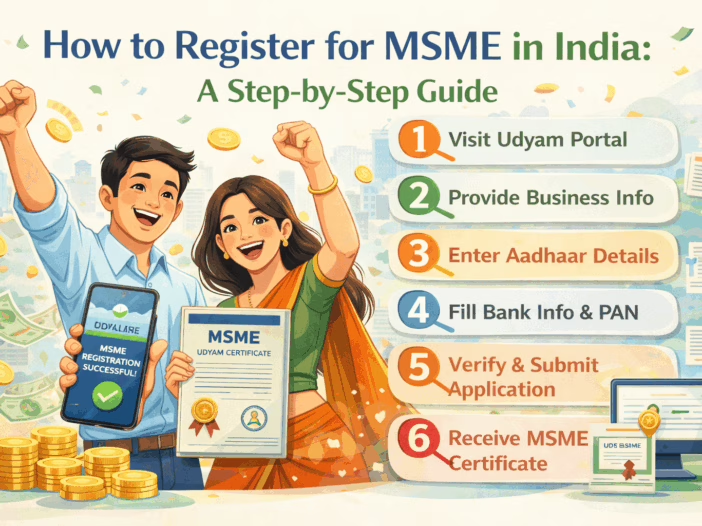
MSME registration is entirely online and can be completed through the Udyam Registration Portal. Follow these steps:
Step 1: Visit the Udyam Registration Portal
Firstly, one has to visit official Udyam Registration website: https://udyamregistration.gov.in.
Step 2: Enter Aadhaar Number
- Enter the 12-digit Aadhaar number of the proprietor, partner, or director.
- Click on “Validate & Generate OTP.”
- Enter the OTP received on your registered mobile number.
Step 3: Fill in Personal and Business Details
- Provide personal details such as name, gender, and social category.
- Enter business details, including:
- Name of the enterprise.
- Type of organization (proprietorship, partnership, company, etc.).
- PAN of the business (optional for proprietorships).
- Location of the business.
- Bank account details.
Step 4: Provide Business Activity Details
- Select the NIC code (National Industrial Classification) that best describes your business activity.
- Mention the number of employees and investment in plant and machinery/equipment.
Step 5: Submit the Application
- Review all the details entered.
- Accept the self-declaration and submit the application.
Step 6: Receive Udyam Registration Certificate
- Once the application is submitted, you will receive an Udyam Registration Number (URN).
- The Udyam Registration Certificate will be issued shortly and can be downloaded from the portal.
6. Updating MSME Registration Details
If there are any changes in your business, such as an increase in investment or turnover, you can update your MSME registration details online. The portal allows you to make changes and reclassify your business if necessary.
7. Important Points to Remember
- No Fees: Registration in MSME is free of cost. But there are many fake websites and agents who charges fees, therefore one has to beware of fraudulent websites or agents.
- Validity: The Udyam Registration Certificate is valid for a lifetime and does not require renewal.
- Multiple Businesses: A single Aadhaar number can be used to register multiple businesses.
- No Physical Documentation: The entire process is paperless and online.
8. Conclusion
Registering your business as an MSME in India is a simple and beneficial process that can open doors to numerous opportunities and government support. By following the steps outlined above, you can easily complete your Udyam Registration and start enjoying the benefits of being an MSME. Whether you are a small business owner or a medium-sized enterprise, MSME registration is a step toward growth, credibility, and financial stability.
Take the first step today and register your business on the Udyam Registration portal to unlock the potential of your enterprise!