
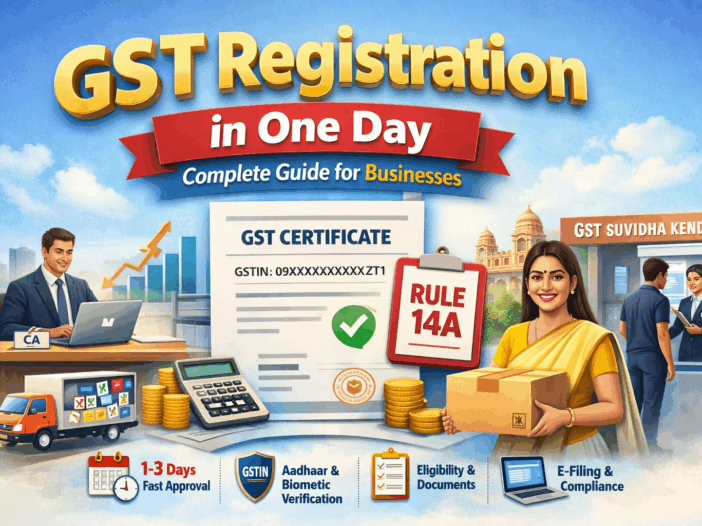
Starting a business today requires speed, compliance, and credibility. One of the most important legal steps is GST registration. Earlier, obtaining a GSTIN often took 7 to 30 days, depending on departmental scrutiny.
In 2025, this has changed significantly. Government has launched GST 2.0 and the introduction of the Simplified Registration Scheme under Rule 14A, GST registration has become faster, technology-driven, and largely automated.
While I can not guaranteed 24-hour GSTIN , GST registration within one to three working days is now a practical and achievable reality for eligible businesses—especially when handled by a professional CA firm.
Who Needs to Take GST Registration?”
GST registration is the process by which a business obtains a Goods and Services Tax Identification Number (GSTIN) from the Government of India. GST registration legally recognizes your business as a taxable person under GST law and authorizes it to:
- Collect GST from customers
- Issue GST-compliant tax invoices
- Claim Input Tax Credit (ITC)
- File GST returns
- Carry out inter-state and online sales
GST registration creates a formal tax identity and is mandatory once prescribed limits or activities apply.
What Is a GSTIN?
A GSTIN is a 15-digit, PAN-based, state-specific identification number allotted to every registered taxpayer. It enables the GST authorities to track compliance, returns, and tax payments.
“Who Needs to Obtain GST Registration?”
If I fall in below category, GST registration is mandatory:
- Businesses Crossing Turnover Threshold
- Service providers with annual turnover exceeding ₹20 lakh
- Goods suppliers with annual turnover exceeding ₹40 lakh
(Lower limits apply in special category states)
- Inter-State Suppliers
Any person supplying goods or services from one state to another, irrespective of turnover.
- E-Commerce Sellers & Operators
Businesses selling through online platforms or operating e-commerce portals, regardless of turnover.
- Professionals & Consultants
Consultants, freelancers, IT professionals, designers, architects, and other service providers must register once they meet the turnover threshold or engage in inter-state supply.
- Persons Liable Under Reverse Charge (RCM)
- Casual & Non-Resident Taxable Persons
- Voluntary Registration
Businesses below the threshold may opt for GST registration voluntarily to:
- Claim ITC
- Improve credibility
- Work with corporates and government clients
Who Does Not Need to Register?
GST registration is not mandatory for:
- Agriculturists supplying produce from cultivation
- Persons supplying only exempt goods or services
- Businesses below threshold limits not engaged in compulsory registration activities
What Has Changed in GST Registration in 2025?
The GST system now emphasizes:
- Aadhaar-based authentication
- AI-driven risk assessment
- Auto-approval for low-risk applicants
- Reduced manual officer intervention
As a result, most genuine applications proceed without delays or repeated queries.
Rule 14A – Simplified GST Registration Scheme (2025)
Rule 14A was introduced to promote ease of doing business for:
- Startups and early-stage businesses
- Professionals and service providers
- Traders and small enterprises
- Eligible e-commerce sellers
It enables fast-track GST registration through automated approval.
Eligibility Criteria Under Rule 14A
To opt for Rule 14A, all of the following must be satisfied:
- B2B Tax Liability Limit
Estimated monthly GST liability on B2B supplies must not exceed ₹2,50,000 (CGST + SGST + IGST combined).
- No Limit on B2C Turnover
Unlimited B2C turnover is allowed, provided B2B tax remains within the limit.
- One GSTIN per State
Only one GST registration per State/UT per PAN is permitted.
How GST Registration in One Day / Three Days Works
When the applicant:
- Selects Rule 14A, and
- Successfully completes Aadhaar authentication,
the GST portal performs an AI-based risk assessment.
If the system does not detect any high-risk indicators:
-
The system bypasses manual officer scrutiny
-
It grants the GSTIN electronically
-
It generally completes approval within 72 hours
-
In exceptionally clean cases, it may grant approval on the same day
Normal Registration vs Simplified Registration (Rule 14A)
| Particulars | Normal Route | Rule 14A |
| Approval Timeline | 7–30 days | Within 3 working days |
| Verification | Manual | Automated |
| Aadhaar Authentication | Optional | Mandatory |
| B2B Tax Limit | No limit | ₹2.5 lakh/month |
| Physical Verification | Common | Rare |
Understanding the ₹2.5 Lakh Threshold
For businesses taxed at 18% GST, the maximum allowable monthly B2B turnover is approximately:
₹13.89 lakh per month
If projected B2B billing exceeds this, the normal registration route must be followed.
What Happens If the ₹2,50,000 B2B Tax Limit Is Exceeded? (Important Clarification)
Important GST Registration Updates (2025)
Mandatory Biometric Verification
In selected cases, directors, partners, or authorized signatories may be required to complete biometric verification at a GST Suvidha Kendra.
Bank Account Compliance
- Bank details must be furnished within 30 days of registration or before filing first GSTR-1, whichever is earlier
- Non-compliance may lead to GSTIN suspension
Enhanced Portal Security
Multi-factor authentication is now mandatory for GST portal logins.
Why GST Registration Should Be Done Through a CA Firm
Despite automation, delays usually occur due to:
- Incorrect or unclear address proof
- PAN–Aadhaar mismatches
- Wrong registration category selection
- Delay in Aadhaar or biometric verification
A CA firm ensures:
- Correct eligibility assessment
- Error-free documentation
- Minimal risk of departmental queries
- Faster and predictable GSTIN approval
Frequently Asked Questions (FAQs)
- Is GST registration in one day guaranteed?
No guaranteed 24-hour approval can be promised. However, 1–3 working days is now the standard timeline for eligible applications. - Is Aadhaar authentication compulsory?
Yes. Aadhaar authentication is mandatory for fast-track approval under Rule 14A. - What if my B2B tax exceeds ₹2.5 lakh later?
The system monitors filings. You must migrate to the normal registration route if the limit is breached. - Are e-commerce sellers eligible under Rule 14A?
Yes, subject to B2B tax limits and Aadhaar authentication. - Is a rent agreement sufficient for quick approval?
Yes, if it is clear, signed, and supported by a valid utility bill.
conclusion
If I need quick GST registration, I can opt for this scheme and obtain GST registration within 3 days. On the other hand, if I am planning to expand my business, I should choose the normal GST registration route, which generally takes around two weeks.
In conclusion, with the introduction of Rule 14A, AI-based approvals, and Aadhaar authentication, GST onboarding has become faster, more transparent, and business-friendly—especially when it is handled by a professional CA firm. Find here the completer notification for this.
Our GST Registration Services in Greater Noida
We provide:
- Express GST Registration (Rule 14A & Normal Route)
- Aadhaar & biometric compliance support
- Startup, professional & e-commerce onboarding
- End-to-end GST advisory and compliance