
Introduction
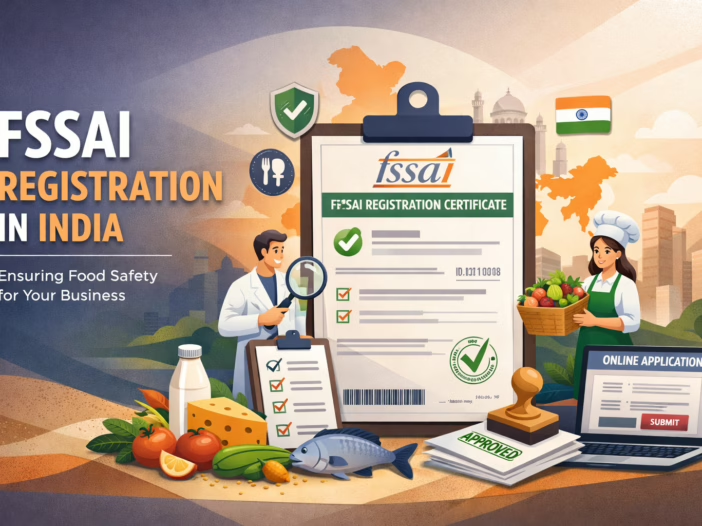
If you run any food business in India, you must obtain FSSAI Registration or License. The government has made this mandatory to ensure food safety, hygiene, and consumer protection.
Today, FSSAI works as a strict and technology-driven regulator. It monitors food businesses through digital systems, inspections, and structured compliance rules. Therefore, every Food Business Operator (FBO) must understand the latest requirements to operate legally and smoothly.
The Food Safety and Standards Authority of India (FSSAI) regulates food businesses under the Food Safety and Standards Act. If you manufacture, trade, store, distribute, or sell food products, you must comply with these rules.
What is FSSAI Registration?
FSSAI Registration is a 14-digit registration or license number issued to food businesses. You must print this number on food packages and display it at your business premises.
This number confirms that your business follows prescribed food safety standards. Without this registration or license, you cannot legally operate in India.
Who Must Obtain FSSAI Registration?
You must apply for FSSAI Registration or License if you are involved in:
- Food manufacturing
- Food trading
- Food packaging
- Food storage or warehousing
- Food distribution
- Restaurants, cafes, cloud kitchens
- Online food selling
- Health supplement trading
- Import or export of food items
In simple words, if you deal with food in any form, you must register.
Types of FSSAI Registration
FSSAI provides three categories based on turnover and scale of operations.
1. Basic Registration
You must take Basic Registration if your annual turnover is up to ₹12 lakh.
This category covers:
- Small vendors
- Petty retailers
- Home kitchens
- Small traders
The government fee is ₹100 per year.
2. State License
You must obtain a State License if your turnover is between ₹12 lakh and ₹20 crore.
This category includes:
- Medium-sized manufacturers
- Restaurants and cloud kitchens
- Mid-sized brands
- Businesses listed on food delivery platforms
The government fee ranges between ₹2,000 and ₹5,000 per year depending on the type of business.
3. Central License
You must apply for a Central License if your turnover exceeds ₹20 crore.
This license is also mandatory for:
- Multi-state operations
- Importers and exporters
- Large manufacturers
- E-commerce food businesses
The government fee is ₹7,500 per year.
Major Compliance Requirements
FSSAI now focuses on continuous monitoring instead of one-time approval. Therefore, you must maintain proper records and digital compliance.
Geo-Tagging of Premises
Manufacturing units and large storage facilities must upload geo-tagged photographs of their premises on the FoSCoS portal.
This step verifies the physical existence and location of the business. If you provide incorrect details, authorities may suspend your license.
Daily Production Records
Food manufacturers must maintain daily records of:
- Production quantity
- Raw material usage
- Storage details
- Batch information
Retailers and traders who do not manufacture food are not covered under this requirement.
However, manufacturers must maintain accurate documentation because inspectors may request these records at any time.
Scientific Evidence for Food Claims
If you print health, nutritional, or functional claims on product packaging, you must support them with scientific data.
You must maintain:
- Toxicology reports
- Safety studies
- Indian consumption data
- Laboratory reports
You cannot use misleading terms without proper proof. If you fail to provide evidence, authorities may take strict action.
Digital Inspections and Cross-Verification
FSSAI uses digital tools to monitor businesses. Authorities cross-check license numbers with online food delivery platforms and e-commerce portals.
If your license details do not match your online listings, authorities may issue notices or suspend your license.
Renewal and Modification Rules
You can apply for renewal up to 180 days before your license expires.
If you delay renewal beyond the expiry date, authorities charge a late fee of ₹100 per day.
If you change your business address, product category, capacity, menu, or structure, you must apply for modification through the FoSCoS portal. Renewal alone does not update these changes. Ignoring this rule may lead to suspension.
Mandatory Display and Training Requirements
You must display a Food Safety Display Board (FSDB) at your premises.
- Basic Registration holders must display A4 size boards.
- Licensed businesses must display A3 size boards.
In addition, every food business must appoint at least one trained Food Safety Supervisor for every 25 food handlers.
The supervisor must complete certification under the FoSTaC training program. Without proper training, your business may face penalties.
Festive Season Surveillance
Authorities conduct anti-adulteration drives during festive periods. They especially inspect milk products, sweets, and edible oils.
Therefore, you must maintain strict quality control, proper storage, and updated documentation during such periods.
Documents Required
Generally, you need:
- Identity proof
- Address proof
- Business address proof
- Passport-size photograph
- Food category details
- Declaration form
For State and Central licenses, you may also require:
- Layout plan
- List of directors or partners
- Water test report
- Authority letter
- NOC from local authority
Official Website for FSSAI Registration
You must apply only through the official government portals.
For registration, renewal, and modification, visit the FoSCoS portal:
https://foscos.fssai.gov.in
For guidelines, regulations, and official notifications, visit:
https://www.fssai.gov.in
Always use these official websites to avoid fraud or unnecessary charges from third-party agents.
Penalties for Non-Compliance
If you operate without registration or violate compliance rules, authorities may:
- Impose heavy penalties
- Suspend or cancel your license
- Seize food products
- Initiate legal proceedings
Therefore, you must treat FSSAI compliance as a continuous responsibility.
Conclusion
FSSAI Registration is not just a certificate. It is an ongoing compliance system that requires proper documentation, scientific validation, digital accuracy, and operational transparency.
You must choose the correct license category, maintain updated records, renew on time, apply for modification when required, and follow all food safety standards.
When you comply properly, you protect consumers, avoid penalties, and build strong trust in your food business.