
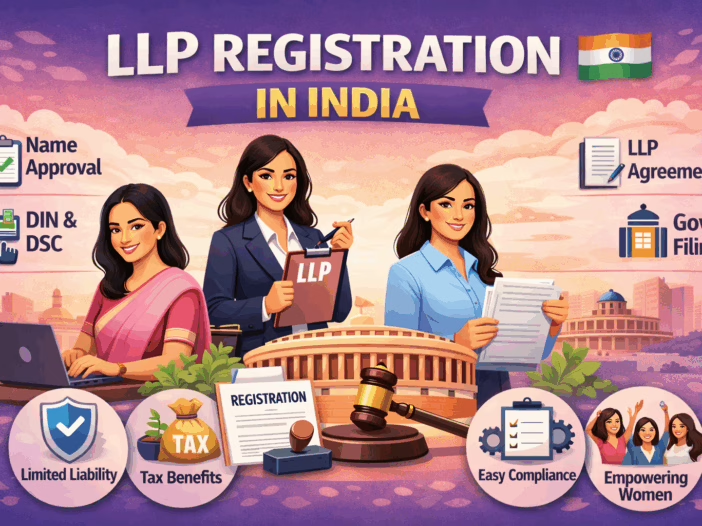
Starting a business in India? Choosing the right structure is one of the first and most important decisions. For many professionals and startups, the Limited Liability Partnership (LLP) offers the best balance — flexibility like a partnership, and protection like a company.
Introduced under the Limited Liability Partnership Act, 2008, LLPs are now one of India’s most preferred business structures. They are easy to LLP registration, affordable to maintain, and provide legal protection to partners from business liabilities.
With MCA’s digital initiatives, forming an LLP is now a streamlined process taking less than two weeks — making it easier than ever for entrepreneurs to start their ventures online.
This article provides an in-depth overview of LLPs—covering their features, benefits, legal framework, LLP registration process, compliance requirements, taxation, and practical aspects of running an LLP.
What is a Limited Liability Partnership (LLP)?
A Limited Liability Partnership (LLP) is a business structure introduced in India under the Limited Liability Partnership Act, 2008. It is a hybrid of a partnership firm and a private limited company, offering the flexibility of a partnership with the advantage of limited liability.
In simple terms, an LLP is:
- A separate legal entity distinct from its partners.
- Formed by a minimum of two partners (no maximum limit).
- Governed by an LLP agreement outlining partners’ roles, profit-sharing, and responsibilities.
Nature and Characteristics of an LLP Company
The nature of an LLP can be understood through its core characteristics:
- Separate Legal Entity – Can own property, enter into contracts, and sue or be sued in its own name.
- Limited Liability of Partners – Partners’ liability is limited to their agreed contribution.
- Perpetual Succession – LLP continues to exist even if partners change.
- Mutual Agreement Based – Rights and duties are governed by the LLP Agreement.
- Easy Compliance – Annual filings are simple compared to a private limited company.
- Professional Recognition – Suitable for professionals like CAs, lawyers, architects, consultants, etc.
Advantages of LLP
- Limited Liability – Protects personal assets of partners.
- Separate Legal Entity – Enhances credibility and legal standing.
- No Limit on Partners – Unlimited number of partners allowed.
- Taxation Benefits – LLP is taxed at a flat 30%, but no DDT is payable.
- No Minimum Capital – Can start with even a small contribution.
- Lower Compliance Cost – No requirement of board meetings or AGMs.
- Ownership of Assets – LLP itself owns property, not individual partners.
- Legal Protection – Partners are not personally liable for business debts.
- Low Cost of Incorporation – Cheaper than a private limited company.
- Flexible Management – Partners can decide rules in the LLP agreement.
Disadvantages of LLP
- Limited Fundraising Options – LLP cannot issue shares, limiting its ability to raise equity capital.
- Not Investor-Friendly – Venture capitalists prefer private limited companies.
- Higher Tax Rate – Flat 30% tax may be higher compared to companies taxed at 22%.
- Audit Requirement for Larger LLPs – Mandatory audit if turnover exceeds ₹40 lakhs or contribution exceeds ₹25 lakhs.
- Transfer Restrictions – Ownership transfer is not as flexible as in companies.
- Less Popular Globally – Foreign investors prefer private limited companies for international business expansion.
LLP Registration Documents in India [2025 Updated]
LLP registration requires submission of partner documents and LLP documents with the Ministry of Corporate Affairs (MCA).
1. Documents of Partners
- PAN Card (mandatory for Indian partners).
- Identity Proof – Aadhaar, Passport, Driving License, or Voter ID.
- Address Proof – Bank statement, utility bill, or government-issued proof (not older than 2 months).
- Passport-size photograph.
- Digital Signature Certificate (DSC).
2. Documents of LLP
- Proof of Registered Office – Rent agreement/lease deed or ownership proof.
- Utility Bill of Office – Electricity bill, water bill, or property tax receipt.
- No Objection Certificate (NOC) from property owner.
- Draft LLP Agreement – Stating capital contribution, rights, duties, and profit-sharing ratio.
3. For Foreign Nationals or NRIs
- Passport (notarized/apostilled).
- Overseas Address Proof (bank statement/utility bill).
LLP Registration Process in India
The registration process is conducted online through the MCA portal:
Step 1: Reserve LLP Name
File RUN-LLP (Reserve Unique Name) form to get MCA approval for LLP name.
Step 2: Obtain Digital Signature Certificate (DSC)
All designated partners need a DSC to sign documents electronically.
Step 3: Apply for Director Identification Number (DIN)
DIN is allotted to designated partners via the incorporation form.
Step 4: File FiLLiP Form (Incorporation Form)
Submit incorporation form with required documents and fees.
Step 5: Certificate of Incorporation
Once approved, MCA issues Certificate of Incorporation with LLPIN.
Step 6: Draft and File LLP Agreement
LLP Agreement must be filed in Form 3 within 30 days of incorporation.
LLP Registration Fees (MCA Fee Structure 2025)
| Contribution Amount | MCA Fees for Incorporation |
| Up to ₹1,00,000 | ₹500 |
| ₹1,00,001 – ₹5,00,000 | ₹2,000 |
| ₹5,00,001 – ₹10,00,000 | ₹4,000 |
| Above ₹10,00,000 | ₹5,000 |
Digital Signature Certificate (DSC):
The cost of obtaining a DSC is ₹2,000 per person.
LLP Formation (CA Fee):
The professional fee of the Chartered Accountant for LLP formation is ₹8,000 including DSC and government fee.
LLP Compliance in India
LLPs must file annual returns with MCA:
- Form 11 – Annual Return (due by 30th May each year).
- Form 8 – Statement of Accounts & Solvency (due by 30th October).
📌 Maintain Books of Accounts (cash or accrual basis)
📌 Penalty: Late filing attracts ₹100/day (no maximum cap).
Additionally:
- Income Tax Return (ITR-5) must be filed every year.
- Audit is mandatory if turnover > ₹40 lakh or capital > ₹25 lakh.
LLP vs Private Limited Company
| Particulars | LLP | Private Limited Company |
| Minimum Members | 2 Partners | 2 Directors & 2 Shareholders |
| Maximum Members | Unlimited | 200 Shareholders |
| Legal Status | Separate legal entity | Separate legal entity |
| Liability | Limited to contribution | Limited to shareholding |
| Compliance | Low | High |
| Audit Requirement | Only if turnover > ₹40 lakh | Mandatory |
| Fundraising | Limited (no shares) | Investor-friendly (shares, ESOPs) |
| Tax Rate | 30% flat | 22% (domestic companies) |
| Ideal For | Small businesses, professionals | Startups, growth-oriented firms |
Which is Better?
- Choose LLP if you want low compliance, flexibility, and are not seeking external funding.
- Choose Pvt Ltd if you want to attract investors, scale, and issue shares.
Can LLP be started without an office in India?
No, an LLP cannot be started without a registered office in India. A registered office address is mandatory at the time of incorporation. This address is used by the Ministry of Corporate Affairs (MCA) for official communication and legal notices.
- It can be a commercial, residential, or rented property, but proper ownership proof or a No Objection Certificate (NOC) from the owner is required.
- If you don’t have a permanent office at the time of registration, you can use a temporary address and later update it with the Registrar by filing Form 15.
Winding Up of LLP
An LLP can be wound up either:
- Voluntarily – When partners mutually agree to close operations.
- By Tribunal – In case of fraud, unlawful activities, or failure to file returns for consecutive years.
The process involves filing with the Registrar, settling liabilities, distributing assets, and striking off the name.
Frequently Asked Questions (FAQs)
- What is the minimum capital required to start an LLP?
There is no minimum capital requirement. Partners can contribute any amount.
- How many partners are required for LLP registration?
A minimum of 2 partners is required. There is no maximum limit.
- Can a single person start an LLP?
No, at least two partners are mandatory.
- Is an LLP better than a private limited company?
LLP is better for small businesses and professionals. Private limited company is better for startups seeking funding.
- Is audit compulsory for LLP?
Audit is required only if turnover exceeds ₹40 lakhs or capital contribution exceeds ₹25 lakhs.
- Can an LLP raise funds from investors?
LLP cannot issue shares, so raising equity funding is difficult. Debt funding is possible.
- How long does it take to register an LLP in India?
Typically 10–15 working days, depending on MCA approval.
- Can a foreign national be a partner in LLP?
Yes, foreign nationals and NRIs can be partners, but at least one designated partner must be a resident of India.
- Can LLP be converted into a private limited company?
Yes, an LLP can be converted into a private limited company under Companies Act, 2013.
- What government fees are applicable for LLP registration?
Fees vary based on contribution amount and generally range from ₹500 to ₹5,000.
Conclusion
A Limited Liability Partnership (LLP) is a flexible and cost-effective business structure, ideal for small enterprises and professionals. It offers limited liability protection, separate legal entity status, and easy compliance.
However, LLPs face limitations in fundraising and taxation compared to private limited companies. Entrepreneurs should carefully consider future business goals before deciding. If you plan to remain small and compliance-light, LLP is perfect. If your vision involves scaling and attracting investors, a Private Limited Company is the better choice.