
The Public Provident Fund (PPF) is one of India’s most popular long-term savings-cum-investment instruments; it provides tax-free returns and acts as a safe vehicle for wealth accumulation and retirement planning. You have to repay it with a small interest, and it helps avoid taking outside loans. PPF paying for company for employers are every month salary to deduct this PPF amount because employers get benefits for future life and take a loan facility on small interest.
What is a PPF Account?
A PPF (Public Provident Fund) account is savings scheme launched by the Government of India are encourage small savings and investment among Indian citizens with tax benefits. The investment in PPF is locked in for 15 years, but certain facilities like loan against balance and partial withdrawals are available from the 3rd and 7th year respectively.
Types of Withdrawals from PPF Account
There are mainly three types of withdrawals from a PPF account:
a. Partial Withdrawal (after 7 years)
Allowed from the 7th financial year onwards. You can withdraw a portion of balance, subject to certain limits.
b. Final Withdrawal (after 15 years)
Complete withdrawal is allowed on account matures after 15 financial years.
c. Premature Closure (after 5 years)
Allowed only under specific conditions is serious illness, higher education, or change in residency status.
PPF Withdrawal Timeline
| Type of Withdrawal | When Allowed | Conditions |
| Partial Withdrawal | From 7th year onwards | Limited to 50% of balance at end of 4th year or preceding year |
| Full Withdrawal | After 15 years | Full amount including interest can be withdrawn |
| Premature Closure | After 5 years | Allowed only on medical, education grounds or NRI status |
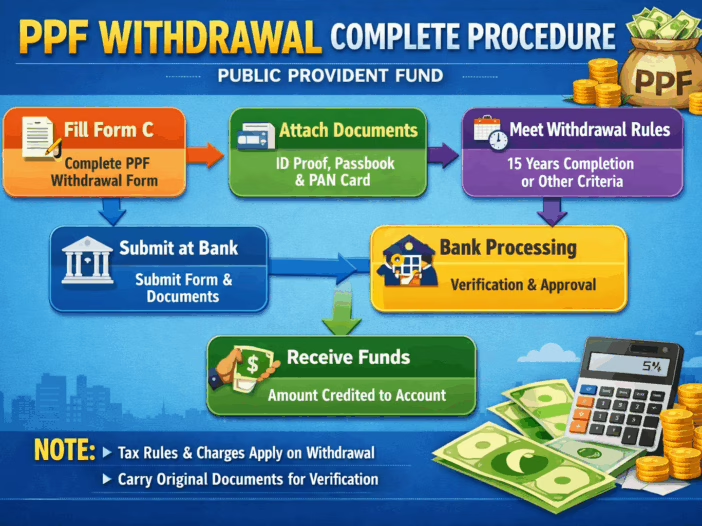
Complete Procedure for PPF Withdrawal
A. Partial Withdrawal Procedure (After 7 Years)
- Eligibility: you have completed 6th financial year
- Amount Limit: 50% of the balance at the end of:
- The 4th previous year of withdrawal, or
- The immediate preceding year, whichever is lower.
- Form Required: Form C (PPF Withdrawal Form).
- Documents to Submit:
- Duly filled Form C
- PPF passbook or account statement
- ID proof (if required by the bank/post office)
- Submit To:
- Post Office , Bank where the PPF account is held.
- Processing Time: Usually 7–10 working days.
B. Full Withdrawal (After Maturity – 15 Years)
- Eligibility: After completion 15 financial years from the end of the year of account opening.
- Amount: Entire balance including interest.
- Form Required: Form C or prescribed withdrawal form.
- Documents:
- Filled withdrawal form
- Original PPF passbook
- Identity proof and account number for credit
- Submit To: PPF servicing bank or post office.
- Processing Time: Within 7–15 working days.
Note: After maturity, you have 3 options:
- Withdraw full amount and close account.
- Extend account with fresh contributions (in 5-year blocks).
- Extend account without fresh contributions.
C. Premature Closure of PPF Account
Permitted only after 5 years in specific cases:
- Medical Treatment: For life-threatening disease of account holder, spouse, children, or parents.
- Higher Education: account holder or dependent children.
- NRI Status: If account holder becomes an NRI (Non-Resident Indian).
Procedure:
- Fill Form for Premature Closure.
- Submit documents:
- Medical certificates or admission proof
- Proof of NRI status (if applicable)
- PPF passbook
- Penalty: 1% less interest is paid on account from inception.
- Processing time: Up to 15 days.
PPF Withdrawal Forms Explained
Form C (For Partial/Full Withdrawal)
This form is divided into three sections:
- Section 1: Basic details like account number, amount, and purpose.
- Section 2: Declaration by the account holder.
- Section 3: For office/bank use.
Documents Required Along with Form C:
- PPF Passbook
- Identity proof
- Account number for NEFT/cheque transfer
PPF Withdrawal in Case of Death of Account Holder
- PPF account cannot be operated after the death of the holder.
- Nominee/legal heir must submit:
- Claim Form (Form G)
- Death certificate
- ID/address proof
- The balance is paid to the nominee, no penalty or tax is applicable.
PPF Withdrawal Online
Public Provident Fund (PPF) withdrawal online refers to the process of withdrawing money from your PPF account through internet banking or a bank’s mobile application, without visiting the bank branch physically.
Steps to Withdraw PPF Amount Online
Step 1: Login to your net banking (e.g., SBI, HDFC, ICICI).
lass=”yoast-text-mark” />>Step 2: Go to PPF Account Services or Accounts → PPF/Deposits section.
>Step 3: Choose Withdraw Funds or Request Partial Withdrawal.
class=”yoast-text-mark” />>Step 4: Enter the amount eligible for withdrawal.
>Step 5: Submit the online form (digitally signed in some banks or Form C upload if needed).
>Step 6: Amount is transferred to your linked savings account.
Required Documents for Online Withdrawal
Some may ask for:
-
- Scanned copy of Form C
- Identity proof
- PPF passbook image (optional)
Taxation of PPF Withdrawals
PPF enjoys EEE Status – Exempt-Exempt-Exempt:
- Contribution: Exempt under Section 80C
- Interest: Exempt
- Withdrawal: Entire amount is tax-free
Frequently Asked Questions (FAQs)
Q1. Can I withdraw from PPF before 15 years?
Yes, partial withdrawals from 7th year and premature closure after 5 years under specific conditions are allowed.
Q2. Can I make multiple withdrawals in a year?
No, only one withdrawal per financial year is allowed.
Q3. How is the 50% withdrawal limit calculated?
It is calculated as 50% of the balance at the end of the 4th financial year or immediately preceding year, whichever is lower.
Q4. Is PPF withdrawal taxable?
No. All withdrawals from PPF are completely tax-free.
Q5. Can I extend my PPF after 15 years?
Yes. You can extend in 5-year blocks with or without contributions, by submitting Form H within 1 year of maturity.
Conclusion
The PPF account is designed to promote long-term savings while offering flexible withdrawal options after specific timelines. Knowing the right procedure, using the correct form, and following the rules for partial, full, or premature withdrawal can help you avoid delays, penalties, and rejection of your application.
For smooth withdrawal:
- Maintain proper documentation.
- Submit accurate forms.
- Ensure your PPF account is updated and active.