
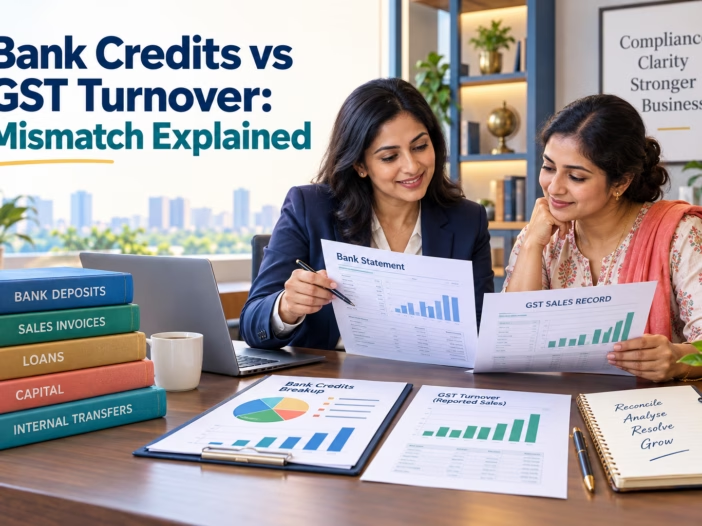
Many businesses compare their bank credits with GST turnover and become concerned when the figures do not match. However, this mismatch does not automatically indicate an accounting error or unreported sales.
Bank credits show the money received in a bank account. In contrast, GST turnover represents the value of supplies made under GST law. Therefore, both figures follow different principles and may differ even when the books are accurate.
Moreover, businesses often receive loans, capital contributions, refunds, and internal transfers. These amounts increase bank credits but do not necessarily increase GST turnover. Similarly, credit sales and cash sales may increase GST turnover even before the business receives or deposits the money.
Consequently, businesses should classify every transaction before comparing bank credits with GST turnover.
What Are Bank Credits?
Bank credits are amounts received in a bank account during a particular period. Generally, they may include:
- Customer payments
- Cash deposits
- Loan receipts
- Capital introduced
- Partner or shareholder contributions
- Transfers from another bank account
- Supplier refunds
- Interest received
- Sale proceeds of assets
- Security deposits
- Payment gateway settlements
- Temporary advances
Therefore, every bank credit does not represent a sale or taxable supply.
For example, if a business receives a loan of ₹10 lakh, the bank balance increases. Nevertheless, the business has not made a supply against that amount. As a result, the loan should not be treated as GST turnover.
What Is GST Turnover?
GST turnover generally represents the value of supplies made by a taxpayer during a relevant period.
For aggregate-turnover purposes, businesses generally consider:
- Taxable supplies
- Exempt supplies
- Zero-rated supplies
- Inter-State supplies
- Supplies made under the same PAN across India
However, GST, cess, and certain inward supplies taxable under reverse charge are generally excluded according to the applicable provisions.
Thus, GST turnover depends mainly on the value and nature of supplies. It does not depend only on the amount received in the bank.
Bank Credits vs GST Turnover
| Particular | Bank Credits | GST Turnover |
|---|---|---|
| Meaning | Money received in a bank account | Value of supplies made |
| Main basis | Bank transactions | Sales and supply records |
| Loan receipts | Included in bank credits | Generally excluded |
| Capital introduced | Included in bank credits | Not treated as turnover |
| Internal transfers | May appear as credits | Not treated as sales |
| Credit sales | Included after payment is received | Included when the supply is reported |
| GST component | Usually included in bank receipts | Generally excluded from turnover |
| Cash sales | Appear after deposit | Included when the supply is made |
| Exempt supplies | Included only if received through bank | Generally included in aggregate turnover |
Accordingly, businesses should not compare these figures directly. Instead, they should prepare a detailed reconciliation.
Why Bank Credits May Be Higher Than GST Turnover
Loan Receipts
A business may receive a bank loan of ₹8 lakh. Consequently, the bank statement shows a credit. However, the amount represents borrowed funds rather than sales.
Therefore, the business should record it as a loan liability. It should not include the amount in GST turnover.
Capital Introduced
A proprietor, partner, or shareholder may introduce money into the business.
| Particular | Amount |
|---|---|
| Capital introduced | ₹5,00,000 |
| GST turnover generated | Nil |
Although the bank balance increases, the business has not supplied goods or services. Hence, the capital contribution does not become GST turnover.
Transfers Between Own Accounts
Businesses frequently transfer money between current accounts, savings accounts, collection accounts, and payment accounts.
As a result, the receiving account records a bank credit. Nevertheless, the transfer does not create new income. Therefore, the business must remove it during reconciliation.
Otherwise, the same amount may be counted twice.
Supplier Refunds
A supplier may refund an excess payment, cancelled order, or returned advance. Although the refund appears as a bank credit, it does not represent an outward supply.
Accordingly, the business should classify it as a refund rather than sales.
Sale of Fixed Assets
A business may receive money from selling machinery, furniture, vehicles, or other assets. However, the bank receipt should not automatically be treated as ordinary sales turnover.
Instead, the business should examine the asset transaction separately. Thereafter, it should apply the relevant GST treatment.
Interest and Other Receipts
Interest, insurance claims, security deposits, and certain advances may also appear as bank credits. Nevertheless, their treatment depends on the actual nature of each transaction.
Therefore, businesses should review the agreement, invoice, ledger, and supporting documents before including any receipt in GST turnover.
Why GST Turnover May Be Higher Than Bank Credits
Credit Sales
A business may report a sale even though the customer has not paid.
| Particular | Amount |
|---|---|
| Sales reported in GST records | ₹12,00,000 |
| Amount received during the period | ₹7,00,000 |
| Outstanding receivables | ₹5,00,000 |
In this example, GST turnover may be ₹12 lakh, whereas bank credits from those sales are only ₹7 lakh.
Therefore, GST turnover does not always depend on the date of payment.
Cash Sales Not Deposited
A business may make cash sales and keep the money outside the bank account temporarily. Consequently, GST turnover may exceed bank credits until the business deposits the cash.
Nevertheless, the business must record and report the cash sales according to the applicable GST provisions.
Receipts Through Another Account
Customers may pay into another business account, a payment gateway, a proprietor’s account, or a collection account.
As a result, the GST return may include the sale even though the bank statement under review does not show the receipt.
Therefore, businesses should review all business-related accounts before finalising the reconciliation.
Timing Differences
A business may issue an invoice in one month and receive payment in another month. Similarly, a payment gateway may settle an online transaction after several days.
Consequently, monthly bank credits and GST turnover may differ. However, the figures may reconcile after considering opening receivables, closing receivables, and timing differences.
Opening Receivables
A business may collect money during the current year against invoices raised during an earlier year.
In that situation, current-year bank credits include earlier-year sales. Therefore, the business must consider opening receivables while analysing current-year receipts.
GST Included in Bank Receipts
When a customer pays an invoice, the bank may receive both the taxable value and GST.
| Particular | Amount |
|---|---|
| Taxable value | ₹1,00,000 |
| GST at 18% | ₹18,000 |
| Total bank receipt | ₹1,18,000 |
The bank statement shows ₹1,18,000. However, GST turnover generally considers the value of the supply excluding the GST component.
Therefore, comparing gross bank receipts with GST turnover will create an apparent difference.
Are Exempt Sales Included in GST Turnover?
Generally, exempt supplies are included in aggregate turnover.
| Type of supply | Amount |
|---|---|
| Taxable supplies | ₹20,00,000 |
| Exempt supplies | ₹4,00,000 |
| Export supplies | ₹6,00,000 |
| Total turnover for comparison | ₹30,00,000 |
Thus, businesses should consider taxable, exempt, zero-rated, and inter-State supplies wherever applicable.
If a business compares only taxable sales with bank credits, it may wrongly conclude that the figures do not match.
Payment Gateway Reconciliation
Online businesses often receive net settlements instead of gross sales.
| Particular | Amount |
|---|---|
| Gross online sales | ₹1,00,000 |
| Gateway charges | ₹2,000 |
| Customer refunds | ₹3,000 |
| Net bank settlement | ₹95,000 |
In this example, GST records may show gross sales of ₹1 lakh, whereas the bank statement shows only ₹95,000.
Therefore, the business should reconcile:
- Gross sales
- Gateway charges
- Refunds
- Chargebacks
- Taxes and deductions
- Net settlements
- Bank credits
As a result, the business can properly explain the difference between sales records and bank receipts.
How to Reconcile Bank Credits With GST Turnover
Step 1: Collect All Relevant Statements
First, collect statements for:
- Current accounts
- Savings accounts used for business
- Payment gateways
- Collection accounts
- Cash-credit accounts
- Digital payment platforms
Otherwise, receipts from another account may remain unexplained.
Step 2: Classify Every Bank Credit
Next, classify each credit as:
- Customer receipt
- Loan
- Capital contribution
- Internal transfer
- Refund
- Interest
- Asset sale
- Security deposit
- Personal receipt
- Unidentified receipt
This classification helps separate actual sales from other receipts.
Step 3: Remove Non-Sales Receipts
After classification, remove genuine non-sales receipts, such as:
- Loans
- Capital introduced
- Transfers between own accounts
- Supplier refunds
- Personal receipts
- Temporary advances
- Security deposits, where applicable
Step 4: Match Customer Receipts
Then, match customer receipts with:
- Current-year invoices
- Earlier-year invoices
- Credit sales
- Advances
- Debtor ledgers
- Cash sales
- Payment gateway reports
Step 5: Compare Books With GST Returns
Thereafter, compare:
- Sales register
- GSTR-1
- GSTR-3B
- E-invoice data, where applicable
- Credit notes
- Debit notes
- Export documents
- Exempt supplies
- Non-GST supplies
Step 6: Prepare a Difference Statement
A simple reconciliation may appear as follows:
| Particular | Amount |
|---|---|
| Total bank credits | ₹50,00,000 |
| Less: Loan received | ₹10,00,000 |
| Less: Capital introduced | ₹5,00,000 |
| Less: Internal transfer | ₹4,00,000 |
| Less: Supplier refund | ₹1,00,000 |
| Add: Credit sales not received | ₹3,00,000 |
| Add: Cash sales not deposited | ₹2,00,000 |
| GST turnover to be reconciled | ₹35,00,000 |
The exact calculation will depend on the books, invoices, timing differences, and nature of each transaction.
Practical Example
Suppose a business has the following bank credits:
| Particular | Amount |
|---|---|
| Customer receipts | ₹42,00,000 |
| Business loan | ₹8,00,000 |
| Capital introduced | ₹3,00,000 |
| Transfer from another account | ₹2,00,000 |
| Interest received | ₹20,000 |
| Total bank credits | ₹55,20,000 |
The business also has:
- Credit sales not received: ₹5,00,000
- Cash sales not deposited: ₹1,00,000
- GST included in receipts: ₹6,42,000
- Exempt sales: ₹2,00,000
Therefore, the bank credits of ₹55.20 lakh cannot automatically be treated as GST turnover.
Instead, the business must separately examine sales, GST, receivables, cash sales, loans, capital, exempt supplies, and internal transfers.
Consequently, a higher bank balance does not necessarily mean that the business has higher taxable turnover.
Can Authorities Ask About Bank Credits?
Yes. Tax or GST authorities may ask taxpayers to explain differences between:
- Bank statements
- Books of account
- GST returns
- Income-tax returns
- Sales registers
- Customer ledgers
Therefore, businesses should maintain:
- Loan confirmations
- Capital contribution records
- Bank transfer details
- Customer ledgers
- Sales invoices
- Refund documents
- Payment gateway statements
- GST reconciliation statements
- Cash deposit records
Proper documentation helps demonstrate that every major bank credit has a genuine explanation.
Common Mistakes to Avoid
Businesses should avoid the following mistakes:
- Treating total bank credits as sales
- Ignoring credit sales
- Counting internal transfers twice
- Comparing gross bank receipts with net GST turnover
- Ignoring GST included in customer receipts
- Failing to reconcile payment gateways
- Mixing personal and business transactions
- Ignoring cash sales
- Omitting exempt or zero-rated supplies
- Leaving major deposits unexplained
Although some differences arise naturally, businesses should investigate every unexplained amount. Otherwise, the difference may create difficulties during GST or income-tax verification.
Monthly Reconciliation Checklist
Every month, businesses should:
- First, match bank credits with customer ledgers.
- Next, identify loan and capital receipts.
- Then, remove internal transfers.
- In addition, check cash sales.
- Moreover, review outstanding receivables.
- Similarly, separate GST from gross receipts.
- Thereafter, match GSTR-1 with the sales register.
- Also, match GSTR-3B with the books.
- Furthermore, review exempt and zero-rated supplies.
- Subsequently, reconcile payment gateway settlements.
- Finally, identify unexplained deposits and document their nature.
Consequently, regular reconciliation helps businesses identify errors before filing returns and finalising annual accounts.
Official References
For current legal provisions and compliance requirements, refer to:
- GST Portal
- Central Board of Indirect Taxes and Customs
- CGST Act and Rules
- India Code
- Income Tax Department
The treatment of a particular receipt may depend on its nature, supporting documents, timing, and applicable provisions. Therefore, businesses should review unusual transactions before filing returns.
Conclusion
Bank credits and GST turnover are different concepts.
Bank credits represent the movement of money through bank accounts. In contrast, GST turnover represents the value of supplies made under GST law. Therefore, loans, capital contributions, refunds, and internal transfers may increase bank credits without increasing GST turnover.
Similarly, credit sales, cash sales, and receipts through another account may cause GST turnover to exceed bank credits.
Consequently, businesses should reconcile bank statements, books, GST returns, customer ledgers, and payment gateway reports every month. Ultimately, proper classification and supporting documents can explain genuine differences and prevent incorrect GST reporting.
FAQs
1. Are bank credits the same as GST turnover?
No. Bank credits represent money received, whereas GST turnover represents the value of supplies made.
2. Are loan receipts included in GST turnover?
No. A genuine loan receipt is generally a financing transaction and is not GST turnover.
3. Is capital introduced included in GST turnover?
No. Capital introduced by a proprietor, partner, or shareholder is generally not turnover.
4. Can GST turnover be higher than bank credits?
Yes. Credit sales, cash sales not deposited, and receipts through another account may cause GST turnover to be higher.
5. Can bank credits be higher than GST turnover?
Yes. Loans, capital, refunds, interest, and internal transfers may increase bank credits.
6. Does GST turnover include GST collected from customers?
Generally, GST and other specified tax components are excluded from aggregate turnover.
7. Are exempt supplies included in aggregate turnover?
Yes. Exempt supplies are generally included in aggregate turnover.
8. Are transfers between own accounts treated as turnover?
No. Internal transfers are not sales and should be removed during reconciliation.
9. Should cash sales be included in GST turnover?
Yes. Cash sales represent supplies and must be recorded and reported according to the applicable provisions.
10. How should payment gateway receipts be reconciled?
Businesses should compare gross sales with gateway charges, refunds, deductions, settlements, and bank credits.
11. Can unexplained bank deposits create tax problems?
Yes. Authorities may ask for the source and nature of significant deposits.
12. How often should reconciliation be performed?
Businesses should ideally reconcile bank credits with GST turnover every month.