
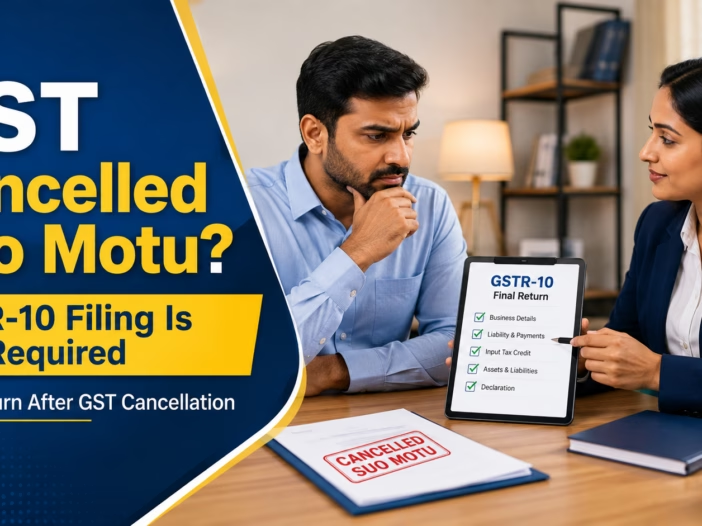
Many taxpayers believe that once the GST Department cancels their GST registration suo motu, they no longer need to complete any GST compliance. However, this assumption can create further notices, late fees and tax liabilities.
Cancellation of GST registration does not automatically remove your past GST responsibilities. If GSTR-10 applies to you, you must file the Final Return even when the GST officer has cancelled your registration on their own.
Therefore, if your GST registration has been cancelled due to non-filing of GST returns or another compliance issue, you should check whether GSTR-10 is pending and complete the required compliance.
What Is Suo Motu Cancellation of GST Registration?
Suo motu cancellation means that the GST officer cancels the registration on their own initiative instead of the taxpayer voluntarily applying for cancellation.
The GST Department may start cancellation proceedings for various reasons. One common reason is continuous non-filing of GST returns.
Before cancelling the registration, the proper officer generally issues a show cause notice and gives the taxpayer an opportunity to respond. The GST Portal also provides a facility to view the cancellation notice and submit a clarification.
However, cancellation of GST registration does not mean that liabilities relating to the period before cancellation disappear.
Section 29(3) of the CGST Act specifically provides that cancellation does not affect the taxpayer’s liability to pay tax or other dues or discharge obligations relating to the period before cancellation.
What Is GSTR-10?
GSTR-10 is known as the Final Return under GST.
A taxpayer whose GST registration has been cancelled may have to file this return to complete the GST registration closure process.
Rule 81 of the CGST Rules prescribes Form GSTR-10 for taxpayers required to furnish the Final Return under Section 45 of the CGST Act.
In simple words, GSTR-10 helps the taxpayer disclose and settle relevant liabilities at the time of closure of the GST registration.
Is GSTR-10 Required After Suo Motu GST Cancellation?
Yes, where Section 45 applies, GSTR-10 remains applicable even if the GST Department has cancelled the registration suo motu.
It does not matter whether:
- You applied for cancellation yourself; or
- The GST officer cancelled your registration.
The important point is that cancellation itself does not erase the Final Return requirement.
Section 45 requires an eligible registered person whose registration has been cancelled to furnish a Final Return.
Therefore, a taxpayer should never assume:
“My GSTIN is already cancelled, so I don’t have to file anything now.”
That approach can lead to additional compliance problems.
Due Date for Filing GSTR-10
GSTR-10 must generally be filed within three months from:
- the date of cancellation of GST registration; or
- the date of the cancellation order,
whichever is later.
This rule is particularly important in cases of retrospective cancellation.
For example, suppose the department passes a cancellation order later but makes the cancellation effective from an earlier date. The three-month period is determined by applying the “whichever is later” rule under Section 45.
Therefore, always check both the effective date of cancellation and the date of the cancellation order.
GST Cancellation Does Not Remove Earlier Pending Returns
Another common mistake is to think that cancellation automatically closes all earlier return periods.
It does not.
If GSTR-1, GSTR-3B or other applicable returns were pending before cancellation, those compliances may still need to be completed.
In fact, the GST Portal’s GSTR-10 manual states that Form GSTR-10 may not be enabled where applicable earlier returns such as GSTR-1, GSTR-3B and other specified returns remain unfiled.
Therefore, before filing GSTR-10, first check the complete return filing status of the cancelled GSTIN.
Do You Have to Pay GST on Closing Stock?
GSTR-10 is not merely a formality.
A taxpayer should carefully examine stock and Input Tax Credit at the time of cancellation.
Under Section 29(5), a registered person whose registration is cancelled may have to pay an amount in respect of:
- Inputs held in stock
- Inputs contained in semi-finished goods
- Inputs contained in finished goods
- Capital goods
- Plant and machinery
The liability broadly considers the Input Tax Credit attributable to such goods or the applicable tax amount as prescribed under GST law.
Therefore, businesses holding closing stock or capital assets on which ITC was claimed should calculate the liability carefully before filing GSTR-10.
What If There Was No Business and No Closing Stock?
A taxpayer may have had no business activity before the department cancelled the registration.
For example, a person may have:
- Made no sales
- Made no purchases
- Claimed no ITC
- Held no closing stock
- Had no capital goods involving ITC
- Had no outstanding tax liability
In such a case, there may be little or no tax payable through GSTR-10. However, where GSTR-10 is legally applicable, the absence of business activity does not by itself mean that the taxpayer should simply ignore the Final Return.
The taxpayer should verify the GST Portal, pending returns, electronic ledgers and cancellation order before completing the final compliance.
Who Is Generally Not Required to File GSTR-10?
GSTR-10 does not apply to every type of GST registration.
According to the GSTN guidance, the Final Return requirement does not generally apply to certain categories such as:
- Input Service Distributors
- Non-resident taxable persons
- Persons required to deduct TDS under Section 51
- Composition taxpayers
- Persons required to collect TCS under Section 52
Therefore, always check the taxpayer category before concluding that GSTR-10 is mandatory.
What Happens If You Do Not File GSTR-10?
Ignoring GSTR-10 after cancellation can lead to further proceedings.
Section 46 provides for a notice to a return defaulter where a required Final Return is not furnished. The taxpayer may be required to file the return within the prescribed period.
GST law also allows the proper officer to proceed with a best-judgment assessment if the taxpayer continues to default after receiving the notice.
The prescribed notice for non-filing of the Final Return is Form GSTR-3A, while an assessment under Section 62 may be issued in Form GST ASMT-13.
Therefore, ignoring a cancelled GSTIN can create unnecessary future notices.
Is Late Fee Applicable to GSTR-10?
Yes. Delay in furnishing a Final Return covered by Section 45 can attract late fee under Section 47.
Under the statutory provision, the CGST component is ₹100 per day, subject to a maximum of ₹5,000. A corresponding late fee can apply under the respective SGST law.
Accordingly, the combined late fee can ordinarily work out to ₹200 per day, subject to the applicable limits, unless a specific waiver or relief notification applies.
Since the Government may introduce specific relief or amnesty schemes from time to time, taxpayers should check the amount appearing on the GST Portal and the notifications applicable when filing.
How to File GSTR-10 Online
You can file GSTR-10 through the GST Portal.
Follow these steps:
- Log in to the GST Portal.
- Go to Services.
- Select Returns.
- Click Final Return.
- Open the GSTR-10 tile.
- Click Prepare Online.
- Enter the address for future correspondence.
- Provide applicable details of goods and closing stock.
- Check the tax liability.
- Preview the draft GSTR-10 carefully.
- Proceed to file the return.
- Pay any applicable tax or other liability.
- Select the declaration and authorised signatory.
- File GSTR-10 using DSC or EVC.
- Download the filed GSTR-10 and keep the ARN for your records.
After successful filing, the GST Portal generates an ARN and changes the status of GSTR-10 to “Filed.”
Official GST filing portal: GST Portal
Official GSTR-10 filing guide: GST Portal GSTR-10 User Manual
What If You Want Your Cancelled GST Registration Back?
Before treating the cancellation as final, consider whether you actually want to close the GSTIN.
If the department cancelled the GST registration suo motu but you still want to continue the business, you may need to examine the option of applying for revocation of cancellation instead.
Where registration was cancelled because of failure to file GST returns, the GST Portal states that an application for revocation cannot be filed unless the required returns are furnished and the tax due, along with applicable interest, penalty and late fee, is paid.
Therefore, first decide whether you want:
- Permanent closure of the GST registration; or
- Revocation and continuation of the same GST registration.
This decision should ideally be made before completing the closure process.
GSTR-10 Filing Assistance in Greater Noida
Taxpayers in Greater Noida whose GST registration has been cancelled should not ignore the cancelled GSTIN.
Before filing GSTR-10, it is advisable to check:
- Cancellation order
- Effective date of cancellation
- Pending GSTR-1 and GSTR-3B returns
- Electronic Cash Ledger
- Electronic Credit Ledger
- Outstanding GST liability
- Closing stock
- ITC claimed on stock and capital goods
- Any pending GST notices
Proper review can help avoid incorrect tax payment, unnecessary late fees and future departmental notices.
Conclusion
Suo motu cancellation of GST registration does not automatically end your GST responsibilities.
If GSTR-10 applies to you, you should file the Final Return even when the department has already cancelled the GST registration.
Moreover, cancellation does not remove earlier tax liabilities, pending returns or other obligations relating to the period before cancellation.
Therefore, instead of ignoring a cancelled GSTIN, review the cancellation order, complete pending GST returns, calculate any stock-related liability and file GSTR-10 within the applicable time limit.
Timely compliance can help you close the GST registration properly and reduce the risk of further notices, late fees and assessment proceedings.
Frequently Asked Questions
1. Is GSTR-10 compulsory after suo motu GST cancellation?
Where the taxpayer falls within Section 45, GSTR-10 is required even if the GST officer cancelled the registration suo motu. However, certain categories of taxpayers are outside the GSTR-10 requirement.
2. What is the due date for GSTR-10?
GSTR-10 is generally required within three months from the date of cancellation or the date of the cancellation order, whichever is later.
3. My GST registration was cancelled because I did not file GST returns. Do I still need to file the pending returns?
Yes. Cancellation does not automatically remove earlier GST compliance obligations. Pending applicable returns should be reviewed and completed.
4. Can I file GSTR-10 without filing pending GSTR-1 and GSTR-3B?
The GST Portal may not enable GSTR-10 where specified applicable earlier returns remain pending. Therefore, complete the required pending returns first.
5. My business had no transactions. Do I still need GSTR-10?
If GSTR-10 applies to your taxpayer category, merely having no business transactions does not automatically remove the filing requirement. However, your tax liability may be nil depending on the facts.
6. Is there any tax payable while filing GSTR-10?
There may be. Tax or ITC-related liability can arise on inputs, closing stock, semi-finished or finished goods, capital goods or plant and machinery, depending on ITC claimed and the facts of the case.
7. Is there a late fee for delayed GSTR-10?
Yes. Late fee can apply under Section 47 if GSTR-10 is filed after its due date, subject to applicable limits and any relief or waiver notified by the Government.
8. Can the GST Department issue a notice if GSTR-10 is not filed?
Yes. Non-filing can lead to a notice in Form GSTR-3A and further assessment proceedings under Section 62 if the default continues.
9. Can I restore a GST registration cancelled suo motu?
Depending on the circumstances and applicable time limits, you may apply for revocation of cancellation. If cancellation occurred due to non-filing of GST returns, pending returns and applicable dues generally need to be cleared before filing the revocation application.
10. Is GST registration cancelled for not filing Income Tax Return or ITR?
Do not confuse an Income Tax Return with a GST return. Suo motu GST cancellation for return default relates to non-compliance under GST law, such as failure to furnish applicable GST returns. ITR filing is governed separately under the Income-tax law.
11. Where can I file GSTR-10?
You can file GSTR-10 online through the official GST Portal under Services > Returns > Final Return.
12. Can a CA help with GSTR-10 filing in Greater Noida?
Yes. A Chartered Accountant can help review pending returns, cancellation orders, closing stock, Input Tax Credit, tax liability and other GST compliance before filing the Final Return.