
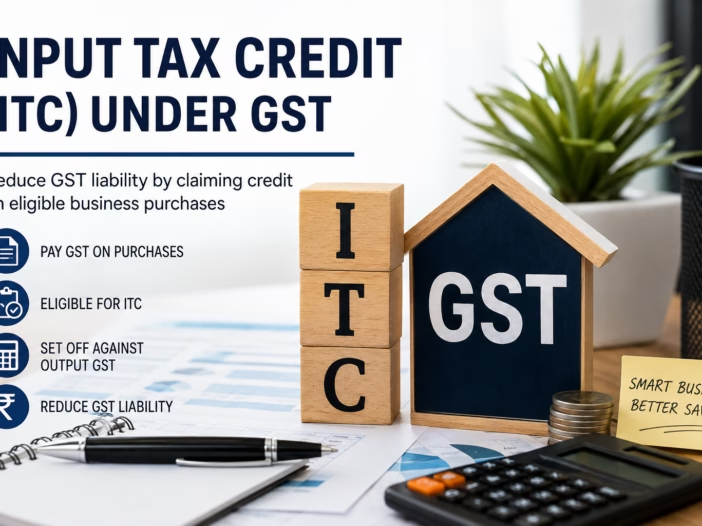
Input Tax Credit, commonly known as ITC, is one of the most important features of the Goods and Services Tax system. It helps businesses reduce their overall GST liability by allowing them to claim credit for the GST already paid on eligible purchases and expenses.
In simple words, when a business purchases goods or services and pays GST on them, it can generally use that GST amount to reduce the GST payable on its sales. Therefore, ITC prevents the cascading effect of tax and ensures that GST applies mainly to the value added at each stage of the supply chain.
Businesses in Greater Noida and across India should understand the basic ITC rules because incorrect claims may lead to interest, penalties, notices, and additional tax liability.
What Is Input Tax Credit Under GST?
Input Tax Credit means the credit of GST paid on purchases of goods or services used for business purposes.
For example, suppose a trader purchases goods worth ₹1,00,000 and pays GST of ₹18,000. Later, the trader sells those goods and collects GST of ₹27,000 from customers.
In this situation:
GST collected on sales = ₹27,000
Less: Eligible ITC = ₹18,000
Net GST payable = ₹9,000
Therefore, instead of paying the entire ₹27,000 to the government, the trader can adjust the eligible GST already paid on purchases.
Who Can Claim Input Tax Credit?
A person registered under GST can generally claim ITC if the purchases relate to business activities and all prescribed conditions are satisfied.
However, simply having a GST registration does not automatically make every purchase eligible for ITC. The taxpayer must ensure that the transaction meets the conditions specified under GST law.
Basic Conditions for Claiming ITC
To claim Input Tax Credit, a taxpayer should normally satisfy the following conditions.
1. Possession of a Valid Tax Invoice
The buyer should have a valid tax invoice, debit note, or another prescribed tax-paying document issued by the supplier.
Therefore, businesses should always verify the GSTIN, invoice number, date, taxable value, and GST amount mentioned on the invoice.
2. Receipt of Goods or Services
The taxpayer must actually receive the goods or services.
For example, if a supplier issues an invoice but the buyer has not received the goods, the buyer should not claim ITC merely on the basis of the invoice.
3. Supplier Should Report the Invoice
The supplier should correctly report the transaction in the relevant GST return or statement.
As a result, businesses should regularly reconcile their purchase records with GSTR-2B before claiming ITC.
4. Tax Should Be Paid to the Government
The tax charged on the supply should ultimately be paid to the government by the supplier, subject to the provisions of GST law.
Therefore, businesses should deal with compliant suppliers and regularly monitor their GST records.
5. GST Return Should Be Filed
The taxpayer claiming ITC should file the applicable GST return.
Proper and timely return filing helps avoid unnecessary mismatches and compliance issues.
What Is GSTR-2B?
GSTR-2B is an auto-generated statement that provides details of eligible and ineligible Input Tax Credit based on information reported by suppliers.
Businesses should compare their purchase register with GSTR-2B before filing GSTR-3B.
This reconciliation helps identify issues such as:
Missing invoices
Incorrect GSTIN
Wrong invoice value
Duplicate invoices
Supplier filing delays
Ineligible ITC
For businesses in Greater Noida, regular GSTR-2B reconciliation can significantly reduce the risk of receiving GST notices.
What Expenses Can Generally Be Eligible for ITC?
Depending on the nature of business and applicable GST provisions, ITC may be available on several business-related expenses.
Examples may include:
Raw materials
Goods purchased for resale
Office rent
Professional services
Internet expenses
Software subscriptions
Business consultancy
Advertising expenses
Freight and transportation charges
Office equipment
Business-related repairs and maintenance
However, the taxpayer must ensure that the expense is used for business purposes and is not specifically blocked under GST law.
What Is Blocked Input Tax Credit?
GST law restricts ITC on certain goods and services even if a registered person incurs the expense.
These restrictions are commonly known as blocked credits.
Some common examples may include:
Certain motor vehicles
Food and beverages in specified cases
Club and health membership expenses
Personal expenses
Goods lost, stolen, destroyed, or written off
Gifts and free samples
Certain construction-related expenses
Therefore, businesses should not assume that GST paid on every expense is automatically claimable.
Can ITC Be Claimed on Personal Expenses?
No. ITC is generally available only to the extent that goods or services are used for business purposes.
For example, if a business owner purchases an item entirely for personal use, the GST paid on that item should not normally be claimed as ITC.
Similarly, if an expense has both personal and business use, appropriate proportionate treatment may be required.
ITC on Capital Goods
Businesses may also claim ITC on eligible capital goods used for business purposes.
For example, a company may purchase computers, machinery, office equipment, or other eligible assets and pay GST on them.
Subject to GST provisions, the business may claim ITC on such purchases.
However, the accounting and income-tax treatment of depreciation should also be considered separately.
Importance of ITC Reconciliation
Regular ITC reconciliation is extremely important because differences between the purchase register and GSTR-2B may create compliance problems.
A business should ideally reconcile ITC before filing each GST return.
During reconciliation, the taxpayer should check:
Whether all purchase invoices are recorded
Whether invoices appear in GSTR-2B
Whether GST amounts match
Whether duplicate ITC has been claimed
Whether any blocked credit is included
Whether credit notes have been properly considered
This process helps businesses maintain accurate GST records.
Common ITC Mistakes Businesses Should Avoid
Many businesses make simple mistakes while claiming ITC.
One common mistake is claiming ITC without checking GSTR-2B. Another mistake is claiming GST on personal or blocked expenses.
Businesses may also forget to reverse ITC where required or may claim the same invoice twice.
In addition, incorrect GSTIN details, invoice mismatches, or supplier non-compliance may create further problems.
Therefore, businesses should review their ITC records carefully before filing GSTR-3B.
What Happens If Wrong ITC Is Claimed?
If a taxpayer claims excess or ineligible ITC, the GST department may require the taxpayer to reverse the credit.
Depending on the circumstances, interest and penalty provisions may also apply.
Therefore, taxpayers should correct mistakes as soon as they identify them instead of waiting for a GST notice.
Why ITC Management Is Important for Businesses in Greater Noida
Greater Noida has a growing number of manufacturers, traders, service providers, startups, restaurants, professionals, and other businesses registered under GST.
For these businesses, proper ITC management can directly affect cash flow.
If a business misses eligible ITC, it may pay more GST than necessary. On the other hand, if it claims incorrect ITC, it may face notices and additional liability.
Therefore, maintaining proper purchase records, checking GSTR-2B, and filing GST returns accurately is essential.
Conclusion
Input Tax Credit is a major benefit available under the GST system. It allows businesses to reduce their GST liability by claiming credit for eligible GST paid on business purchases and expenses.
However, taxpayers must satisfy the prescribed conditions before claiming ITC. They should maintain proper invoices, reconcile purchases with GSTR-2B, identify blocked credits, and file GST returns correctly.
Businesses in Greater Noida should regularly review their Input Tax Credit records to avoid unnecessary GST liabilities, interest, penalties, and notices.
Professional guidance can also help businesses claim eligible ITC correctly while staying compliant with GST requirements.
Frequently Asked Questions
1. What is Input Tax Credit under GST?
Input Tax Credit is the credit of GST paid on eligible business purchases and expenses. A registered taxpayer can use this credit to reduce the GST payable on outward supplies.
2. Can I claim ITC if the invoice is not showing in GSTR-2B?
ITC claims are subject to GST provisions and reporting requirements. Therefore, taxpayers should carefully reconcile invoices with GSTR-2B before claiming credit.
3. Can ITC be claimed on office rent?
If GST is charged on office rent and the premises are used for eligible business purposes, ITC may generally be available subject to applicable conditions.
4. Can I claim GST paid on a car?
ITC on motor vehicles is restricted in many cases. However, certain businesses and specified uses may qualify for credit.
5. Can ITC be claimed on personal expenses?
No. GST paid on expenses used for personal purposes is generally not eligible for Input Tax Credit.
6. What is blocked ITC?
Blocked ITC refers to GST credit that the law specifically does not allow on certain goods and services, even if a registered person pays GST on them.
7. Is GSTR-2B reconciliation compulsory?
Businesses should reconcile their purchase records with GSTR-2B before claiming ITC. This helps identify missing invoices, mismatches, duplicate claims, and ineligible credits.
8. What happens if I claim excess ITC?
Excess or ineligible ITC may have to be reversed. Interest and other consequences may also apply depending on the circumstances.
9. Can ITC be claimed on capital goods?
Yes, ITC may generally be available on eligible capital goods used for business purposes, subject to GST conditions.
10. Why should businesses in Greater Noida regularly review ITC?
Regular ITC review helps businesses claim eligible credit correctly, improve cash flow, reduce mismatches, and avoid GST notices.