
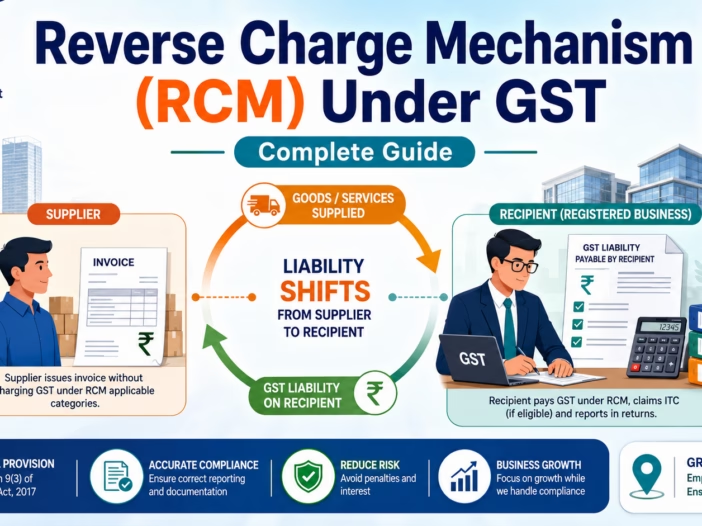
Normally, a supplier collects Goods and Services Tax (GST) from the customer and deposits it with the government. However, in certain specified transactions, GST law shifts this responsibility from the supplier to the recipient. This system is known as the Reverse Charge Mechanism or RCM.
In simple words, under RCM, the person receiving the goods or services has to calculate and pay GST directly to the government instead of paying GST to the supplier. Section 2(98) of the CGST Act defines reverse charge as the liability to pay tax by the recipient instead of the supplier under the specified provisions of the CGST Act and IGST Act.
RCM is particularly important for businesses because missing an RCM transaction can result in additional tax, interest, and penalties. Therefore, businesses in Greater Noida and across India should regularly review expenses such as legal fees, freight, director fees, security services, foreign service payments, and certain property rentals.
What Is Reverse Charge Mechanism Under GST?
Under the normal GST system, the supplier:
- Issues a GST invoice.
- Collects GST from the customer.
- Reports the sale in the GST return.
- Deposits the GST with the government.
Under RCM, this process changes. The recipient becomes responsible for paying GST directly to the government.
For example, suppose a company in Greater Noida receives taxable legal services from an advocate for ₹50,000. If the transaction falls under RCM, the advocate does not collect GST from the company. Instead, the company calculates the applicable GST and deposits it directly with the government. The company may then claim Input Tax Credit, subject to the normal ITC conditions.
Legal Provisions for RCM Under GST
The main provisions governing RCM are Section 9(3) and Section 9(4) of the CGST Act. Similar provisions exist under Sections 5(3) and 5(4) of the IGST Act.
Section 9(3) of the CGST Act
Under Section 9(3), the government notifies specific goods or services on which the recipient must pay GST. Therefore, RCM applies because of the nature of the transaction and the notification issued by the government. Common examples include legal services, certain GTA services, director services, security services, and specified goods.
Section 9(4) of the CGST Act
Section 9(4) applies to specified classes of registered persons receiving specified goods or services from unregistered suppliers. An important point is that GST does not apply under RCM merely because a registered person buys something from an unregistered supplier. Section 9(4) now applies only to specifically notified transactions or classes of recipients.Therefore, businesses should not automatically pay RCM on every purchase from an unregistered supplier.
Is GST Registration Compulsory for RCM?
Section 24(iii) of the CGST Act provides compulsory registration for persons who are required to pay GST under reverse charge, subject to specific exemptions provided under GST notifications. Therefore, in many cases, the normal turnover threshold does not protect a person who becomes liable to pay GST under RCM. However, the exact registration requirement depends on the nature of the RCM transaction and any exemption available under the GST law.
Major Goods and Services Covered Under RCM
The government has notified several goods and services under the Reverse Charge Mechanism. Some commonly encountered transactions are explained below.
| Category | When RCM May Apply | Person Paying GST |
| Legal services | Legal services supplied by an individual advocate, senior advocate or firm of advocates to a business entity in the taxable territory | Business recipient |
| GTA services | Certain GTA services where the GTA does not discharge GST under the applicable forward-charge option and the recipient falls within a notified category | Specified recipient |
| Director services | Services provided by a director to a company or body corporate outside the employer-employee relationship | Company or body corporate |
| Renting of motor vehicle | Certain passenger vehicle rental services supplied by a non-body corporate to a body corporate | Body corporate |
| Security services | Security personnel services supplied by specified non-body-corporate suppliers to registered recipients, subject to exceptions | Registered recipient |
| Import of services | Taxable services received from a supplier located outside India where the applicable conditions are satisfied | Recipient in India |
| Commercial property rent | Certain renting of immovable property other than residential dwelling by an unregistered person to a registered regular taxpayer | Registered recipient |
| Metal scrap | Specified metal scrap supplied by an unregistered person to a registered person | Registered purchaser |
Legal services supplied by advocates to business entities are specifically covered under the RCM notification.Similarly, GST applies under RCM to taxable services provided by a director to the company where those services do not form part of an employer-employee relationship. Salary paid for services performed as an employee is treated differently.
RCM on Metal Scrap
RCM rules for metal scrap are particularly important for scrap dealers, manufacturers and other registered businesses. With effect from 10 October 2024, specified metal scrap falling under Chapters 72, 73, 74, 75, 76, 77, 78, 79, 80 or 81 supplied by an unregistered person to a registered person falls under RCM.Therefore, the registered buyer must pay GST instead of the unregistered scrap seller.
For example, if a registered manufacturer purchases qualifying metal scrap worth ₹1,00,000 from an unregistered seller, the manufacturer must calculate and pay the applicable GST under RCM.
RCM on Commercial Property Rent
Another important change relates to commercial and other immovable property.Where an unregistered landlord rents an immovable property other than a residential dwelling to a registered person, the registered recipient may become liable to pay GST under RCM.
However, from 16 January 2025, a person who has opted for the GST composition levy is excluded from this particular RCM entry.Therefore, a regular GST-registered business in Greater Noida taking a commercial office, shop, warehouse or similar property on rent from an unregistered landlord should carefully check the RCM provisions.
RCM on Legal Services
Legal services are one of the most common RCM transactions.When an individual advocate, senior advocate or firm of advocates provides legal services to a business entity located in the taxable territory, the business recipient generally pays GST under RCM.
For example, if a Greater Noida private limited company pays ₹1,00,000 as professional legal fees to an advocate and the transaction falls within the notified RCM category, the company will pay GST directly to the government. The company may claim ITC if it satisfies the normal conditions for claiming credit.
RCM on Director Services
A company must carefully distinguish between salary paid to a director as an employee and payments made for services outside the employer-employee relationship.
For example, sitting fees paid to an independent director generally attract GST under RCM. Similarly, commission or other remuneration paid for services provided in the capacity of a director may attract RCM where the payment does not relate to employer-employee services. Therefore, companies should review director payments before filing GSTR-3B.
RCM on GTA Services
Goods Transport Agency services can also fall under RCM. However, RCM does not automatically apply to every transportation payment. The treatment depends on whether the transporter qualifies as a Goods Transport Agency, whether a consignment note is issued, the type of recipient, applicable exemptions, and whether the GTA has chosen the applicable forward-charge option.
Therefore, businesses should not treat every truck or freight payment as an RCM transaction. A normal road transporter who does not qualify as a GTA may have a different GST treatment.
RCM on Security Services
Certain services involving the supply of security personnel can attract RCM when a person other than a body corporate provides the service to a registered person, subject to prescribed exceptions. Importantly, businesses should not treat every manpower service as a security service.
The specific RCM entry relates to the supply of security personnel and its notified conditions. Therefore, a business should first examine the nature of the service and the status of the supplier before applying RCM.
RCM on Import of Services
RCM may also apply when an Indian business receives taxable services from a foreign supplier.
Common examples may include:
- software subscriptions;
- consultancy services;
- professional services;
- technical services;
- royalty payments; and
- certain online services.
However, the tax treatment depends on whether the transaction qualifies as an import of service, the place-of-supply rules, the nature of the recipient, and any applicable exemption. Where IGST becomes payable under RCM on import of services, the taxpayer generally reports eligible ITC in Table 4(A)(2) of GSTR-3B.
Self-Invoicing Under RCM
Self-invoicing becomes important where the supplier is unregistered and the registered recipient is liable to pay GST under Section 9(3) or Section 9(4). Under Section 31(3)(f), the registered recipient must issue an invoice for such inward supply. Rule 47A now requires the recipient to issue the self-invoice within 30 days from the date of receipt of the goods, services or both.
This 30-day requirement applies where the supplier is unregistered and the recipient has the responsibility to issue the invoice. It does not mean that a recipient must create a separate self-invoice for every RCM transaction received from a registered supplier. In addition, Section 31(3)(g) requires the recipient to issue a payment voucher at the time of making payment to the supplier where applicable.
Can RCM Liability Be Paid Through ITC?
No. A taxpayer must pay GST liability under the Reverse Charge Mechanism through the Electronic Cash Ledger. The taxpayer cannot use the balance available in the Electronic Credit Ledger to discharge RCM liability.
For example:
Taxable RCM service: ₹1,00,000
GST rate: 18%
RCM liability: ₹18,000
Even if the taxpayer already has ₹50,000 of ITC in the Electronic Credit Ledger, the taxpayer cannot use that credit to pay the ₹18,000 RCM liability. The taxpayer must pay ₹18,000 through the Electronic Cash Ledger.
Can We Claim ITC on GST Paid Under RCM?
Yes, generally the recipient can claim Input Tax Credit of GST paid under RCM if the inward supply is used in the course or furtherance of business and all normal ITC conditions are satisfied. Therefore, after paying the RCM liability, the recipient can claim eligible ITC.
However, ITC does not automatically become available in every case. Section 17(5), exempt supplies, personal use, proportionate reversals and other restrictions can limit or block the credit. CBIC also confirms that GST paid under reverse charge qualifies as input tax where the recipient otherwise satisfies the ITC conditions.
How to Report RCM in GSTR-3B
The recipient should generally report RCM liability in:
Table 3.1(d) – Inward supplies liable to reverse charge. After paying the tax, eligible ITC is generally reported as follows:
| Nature of ITC | GSTR-3B Table |
| Import of services | Table 4(A)(2) |
| Other inward supplies liable to RCM | Table 4(A)(3) |
The GST Portal also uses GSTR-2B information to auto-populate certain domestic RCM details. However, transactions such as import of services or certain supplies received from unregistered persons may require the taxpayer to add or verify the amount manually. Therefore, businesses should never rely only on auto-populated values. They should reconcile GSTR-2B with their books of account and RCM expense ledgers.
How Does the Supplier Report RCM in GSTR-1?
Where a registered supplier makes a B2B supply on which the recipient has to pay GST under reverse charge, the supplier should report the invoice as an RCM supply in GSTR-1. The GST Portal provides Table 4B for B2B supplies attracting tax on reverse charge basis. The supplier should not collect and deposit GST as normal output tax where the transaction is legally covered under RCM.
Time of Supply Under RCM
The time-of-supply rules determine when the recipient becomes liable to pay GST. Time of Supply for Goods
Under Section 12(3), the time of supply for goods under RCM is generally the earliest of:
- Date of receipt of goods;
- Date of payment recorded in the recipient’s books or date on which the bank account is debited, whichever is earlier; or
- Date immediately following 30 days from the date of the supplier’s invoice or similar document.
If the taxpayer cannot determine the time of supply using these rules, the date of entry in the recipient’s books applies.
Time of Supply for Services
Under Section 13(3), the time of supply for services under RCM is generally the earlier of:
- Date of payment recorded in the recipient’s books or the date on which the bank account is debited, whichever is earlier; or
- Date immediately following 60 days from the date of the supplier’s invoice or similar document.
If the taxpayer cannot determine the time using these rules, the date of entry in the recipient’s books generally applies.
Example of RCM Calculation
Suppose a GST-registered company in Greater Noida receives legal services worth ₹1,00,000 from an advocate. Assume GST applies at 18%.
Taxable value: ₹1,00,000
CGST under RCM: ₹9,000
SGST under RCM: ₹9,000
Total GST payable under RCM: ₹18,000
The company will:
- Record the legal expense.
- Identify the transaction as an RCM supply.
- Pay ₹18,000 through the Electronic Cash Ledger.
- Report the liability in Table 3.1(d) of GSTR-3B.
- Claim eligible ITC of ₹18,000 in Table 4(A)(3), subject to the ITC conditions.
Thus, RCM may create a temporary cash-flow impact even when the business ultimately receives full ITC.
Accounting Entry for RCM
A simple accounting treatment may look like this:
At the time of booking the expense:
Legal Expenses A/c Dr. ₹1,00,000
To Advocate A/c ₹1,00,000
For RCM liability:
Input CGST A/c Dr. ₹9,000
Input SGST A/c Dr. ₹9,000
To CGST RCM Payable A/c ₹9,000
To SGST RCM Payable A/c ₹9,000
When the company pays GST:
CGST RCM Payable A/c Dr. ₹9,000
SGST RCM Payable A/c Dr. ₹9,000
To Bank / Electronic Cash Ledger ₹18,000
The exact ledger structure may vary depending on the accounting software used by the business.
Interest on Late Payment of RCM
If a taxpayer does not pay RCM liability within the prescribed time, interest can become payable under Section 50. Generally, delayed payment of tax attracts interest at 18% per annum for the period of delay. Therefore, even where the taxpayer can later claim ITC, delaying the original RCM payment can create an interest cost.
Penalty for Non-Payment of RCM
Businesses should not ignore RCM simply because corresponding ITC may be available. For tax periods covered by Section 74A, which applies to determination proceedings relating to FY 2024-25 onwards, a non-fraud case can attract a penalty equal to 10% of the tax due or ₹10,000, whichever is higher, subject to the provisions dealing with payment and conclusion of proceedings.
Where fraud, wilful misstatement or suppression of facts to evade tax is established, the penalty can be equal to the tax due.Therefore, timely identification and payment of RCM liability remains important even where the transaction is revenue-neutral because ITC is available.
Common RCM Mistakes Businesses Should Avoid
Businesses frequently make RCM errors because they focus mainly on sales while filing GST returns.Common mistakes include:
- assuming every purchase from an unregistered supplier attracts RCM;
- failing to identify legal fees covered under RCM;
- ignoring director sitting fees;
- treating every transporter as a GTA;
- applying security-service RCM to all manpower services;
- missing RCM on taxable foreign service payments;
- ignoring RCM on qualifying commercial property rent;
- missing RCM on metal scrap purchased from an unregistered supplier;
- paying RCM liability using ITC instead of cash;
- claiming ITC without first discharging the RCM liability;
- failing to issue a self-invoice where the supplier is unregistered;
- missing the 30-day self-invoice requirement; and
- relying completely on GSTR-2B instead of reconciling the books.
Therefore, businesses should create a separate RCM checklist while reviewing monthly accounts.
Conclusion
The Reverse Charge Mechanism is an important part of GST compliance because it shifts the responsibility for paying GST from the supplier to the recipient. Businesses should identify RCM transactions before filing GSTR-3B, pay the tax through the Electronic Cash Ledger, issue self-invoices where required, and claim eligible ITC correctly.
Transactions involving advocates, directors, GTA services, security personnel, foreign service providers, metal scrap and certain property rentals require particular attention. For businesses in Greater Noida, maintaining a separate RCM expense ledger and reviewing it every month can significantly reduce the chances of missed liability, interest and penalties.
Since RCM applicability depends on the exact nature of the supply, supplier status, recipient status and relevant GST notifications, businesses should examine unusual transactions carefully before filing GST returns.
Frequently Asked Questions on RCM Under GST
1. What is RCM under GST?
RCM stands for Reverse Charge Mechanism. Under RCM, the recipient of specified goods or services pays GST directly to the government instead of the supplier.
2. Does RCM apply to every purchase from an unregistered person?
No. RCM does not apply merely because the supplier is unregistered. It applies only where the transaction falls under a notified RCM provision.
3. Can RCM liability be paid using Input Tax Credit?
No. A taxpayer must pay RCM liability through the Electronic Cash Ledger. Existing ITC cannot be used to pay the RCM tax.
4. Can we claim ITC on GST paid under RCM?
Yes. The recipient can claim ITC after paying GST under RCM if the expense relates to eligible business activity and the credit is not blocked or otherwise restricted.
5. Where is RCM reported in GSTR-3B?
The recipient generally reports the RCM liability in Table 3.1(d) of GSTR-3B.
Eligible ITC on domestic RCM supplies generally goes to Table 4(A)(3), while ITC relating to import of services generally goes to Table 4(A)(2).
6. Is self-invoicing compulsory under RCM?
Self-invoicing is required where Section 31(3)(f) applies, mainly where the recipient is liable under RCM and receives the relevant supply from an unregistered supplier.
7. What is the time limit for issuing an RCM self-invoice?
Rule 47A requires the registered recipient to issue the self-invoice within 30 days from the date of receipt of goods, services or both where the rule applies.
8. Does GST apply under RCM on advocate fees?
Yes, legal services supplied by advocates or firms of advocates to qualifying business entities generally fall under RCM. The business recipient pays GST.
9. Does RCM apply to director salary?
Salary paid to a director for services performed under an employer-employee relationship does not attract GST. However, payments such as sitting fees or remuneration for services provided in the capacity of a director outside the employment relationship may attract RCM.
10. Does RCM apply to commercial rent?
RCM can apply where an unregistered person supplies the service of renting an immovable property other than a residential dwelling to a registered regular taxpayer. Composition taxpayers are excluded from this particular RCM entry from 16 January 2025.
11. Is metal scrap covered under RCM?
Yes. Specified metal scrap falling under Chapters 72 to 81 supplied by an unregistered person to a registered person is covered under RCM from 10 October 2024.
12. Is RCM applicable on import of services?
RCM can apply to taxable import of services where the applicable conditions under the IGST law are satisfied. The Indian recipient generally pays IGST under RCM.
13. Can RCM tax and ITC be reported in the same GSTR-3B?
Where the RCM tax is properly discharged and the recipient satisfies the ITC conditions, eligible credit may be claimed in the relevant GSTR-3B. However, the taxpayer must first ensure that the RCM liability is correctly reported and paid in cash.
14. What happens if RCM is not paid on time?
Delayed RCM payment can result in interest under Section 50. Depending on the circumstances and proceedings involved, penalties may also apply.
15. What is the easiest way to manage RCM compliance?
Maintain a separate RCM ledger and review expenses such as legal fees, freight, director payments, security services, foreign payments, rent and notified goods before filing every GSTR-3B.