
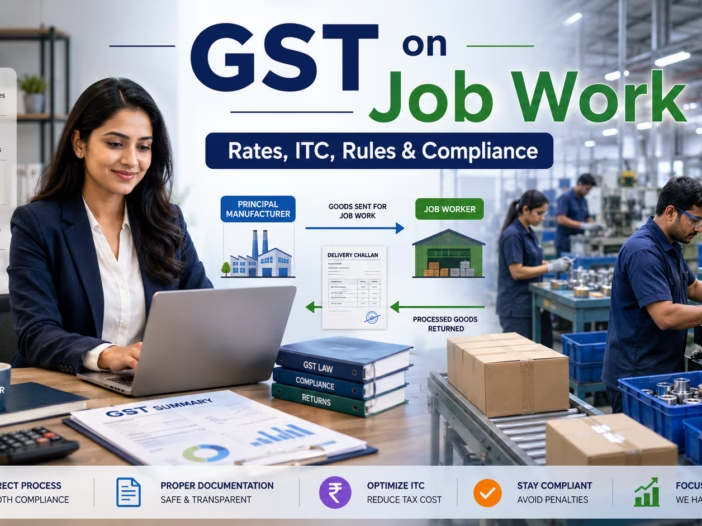
Many manufacturers do not complete every stage of production at their own premises. Instead, they send raw materials, semi-finished goods, or components to another person for activities such as cutting, polishing, printing, stitching, assembling, packing, machining, or finishing. GST law refers to this arrangement as job work.
Businesses in industrial areas such as Greater Noida, Noida, and other manufacturing hubs commonly use job workers. However, many businesses still face confusion about GST rates, input tax credit, delivery challans, e-way bills, return of goods, and GST compliance.
Fortunately, GST law provides a special procedure for job work. A registered principal can send goods to a job worker without paying GST at the time of movement, provided the principal follows the prescribed conditions. Therefore, understanding the basic GST rules for job work can help businesses avoid unnecessary tax demands and compliance issues.
What Is Job Work Under GST?
Under GST, job work means carrying out any treatment or process on goods that belong to another registered person. In simple words, one person owns the goods, while another person performs processing or manufacturing work on those goods.
For example, suppose a garment manufacturer sends fabric to another unit for stitching. The manufacturer continues to own the fabric, while the stitching unit only performs the required work. Therefore, the stitching activity may qualify as job work.
Similarly, job work can include:
- Cutting
- Polishing
- Painting
- Printing
- Packing
- Machining
- Stitching
- Welding
- Plating
- Assembly
- Processing
- Finishing
However, GST law specifically defines job work with reference to goods belonging to another registered person.
Who Is a Principal and Who Is a Job Worker?
GST law uses two important terms in job-work transactions: principal and job worker. The principal owns the goods and sends them for processing. The job worker receives those goods and carries out the required treatment or process.
For example, ABC Manufacturing sends metal sheets to XYZ Fabricators for cutting and bending. In this case:
Principal: ABC Manufacturing
Job Worker: XYZ Fabricators
ABC Manufacturing continues to own the metal sheets throughout the job-work process.
Is GST Payable When Goods Are Sent for Job Work?
Generally, no.
A registered principal can send inputs or capital goods to a job worker without paying GST at the time of dispatch, subject to the conditions prescribed under GST law. Therefore, the movement of goods from the principal to the job worker does not automatically become a sale.
However, the principal must send the goods under proper documents and ensure that the goods return within the prescribed time limit or are otherwise supplied in accordance with GST provisions. Meanwhile, if the job worker is registered and provides taxable job-work services, the job worker normally charges GST on the job-work service.
What Is the GST Rate on Job Work?
GST does not prescribe one common rate for every type of job work. Instead, the applicable GST rate depends on the nature of the goods and the processing activity. Generally, job-work services that do not fall under a specific concessional category may attract GST at 12%.
However, certain job-work activities may attract other rates. For example:
| Type of Job Work / Service | GST Rate |
|---|---|
| General job work not covered by a specific entry | 12% |
| Certain textile-related job work | 5% |
| Certain printing job work | 5% or 12%, depending on classification |
| Job work relating to diamonds | 1.5% |
| Certain handicraft-related job work | 5% |
| Job work relating to umbrella manufacturing | 12% |
| Bus body building job work | 18% |
| Certain manufacturing services | 18% |
Therefore, businesses should first identify the exact nature of the goods and processing activity before applying a GST rate. Moreover, they should verify the relevant HSN or SAC classification wherever required.
Is GST Charged on the Full Value of Goods?
Generally, the job worker charges GST on the value of the job-work service and not on the full value of the goods belonging to the principal. For example:
Value of goods sent by the principal: ₹5,00,000
Job-work charges: ₹50,000
GST rate: 12%
GST calculation:
₹50,000 × 12% = ₹6,000
Therefore, the job worker may issue an invoice as follows:
Job-work charges: ₹50,000
GST: ₹6,000
Total invoice value: ₹56,000
Thus, the value of the principal’s goods does not automatically become part of the job worker’s taxable value merely because the job worker holds or processes those goods. However, if the job worker supplies additional material or services and recovers their value from the principal, those amounts may affect the taxable value.
Can the Principal Claim Input Tax Credit?
Yes. The principal can claim eligible input tax credit on inputs and capital goods sent to a job worker, subject to the normal ITC conditions. More importantly, GST law also allows the principal to claim eligible ITC even when the supplier directly delivers the goods to the job worker. For example, suppose a manufacturer in Greater Noida buys raw material from a supplier in Delhi.
Instead of asking the supplier to first deliver the material to the manufacturer’s factory, the manufacturer instructs the supplier to send it directly to the job worker. In such a case, the principal may still claim eligible ITC, provided all applicable conditions are satisfied. Therefore, businesses can reduce unnecessary movement of goods without automatically losing their ITC benefit.
What Is the Time Limit for Bringing Goods Back?
GST law prescribes different time limits for inputs and capital goods sent for job work.
Inputs
The principal should generally receive the inputs back or supply them from the job worker’s premises within one year.
Capital Goods
The principal should generally receive the capital goods back or supply them from the job worker’s premises within three years. However, special treatment applies to moulds and dies, jigs and fixtures, and tools. Therefore, businesses should maintain proper records of the date on which they send each item to the job worker.
What Happens If Goods Do Not Return Within the Time Limit?
The principal should closely monitor the prescribed time limits. If inputs do not return or are not otherwise supplied within one year, GST law may treat the goods as if the principal supplied them to the job worker on the original date of dispatch.
Similarly, if eligible capital goods do not return or are not otherwise supplied within three years, GST law may treat them as supplied from the original date of dispatch. As a result, the principal may face GST liability along with applicable interest and other consequences. Therefore, businesses should regularly reconcile goods lying with job workers instead of waiting until the end of the year.
Why Is a Delivery Challan Important?
The principal normally sends goods to a job worker under a delivery challan instead of a tax invoice because the movement itself does not generally represent a sale. A proper delivery challan helps the business establish that it sent the goods only for processing.
The challan should contain the prescribed details, such as:
- Challan number and date
- Name and GSTIN of the principal
- Name and address of the job worker
- Description of goods
- HSN, wherever applicable
- Quantity of goods
- Value, wherever required
- Place of supply, where applicable
- Signature or authentication
Moreover, the principal should preserve the challan records until the goods return or are otherwise supplied. Proper documentation can become especially important during GST assessments or departmental verification.
Can Goods Move from One Job Worker to Another?
Yes. GST law allows goods to move from one job worker to another job worker for further processing. Therefore, the goods do not need to return to the principal after every stage. For example:
Principal → Job Worker A → Job Worker B → Principal
Suppose Job Worker A performs cutting, while Job Worker B performs polishing. The principal can arrange movement from Job Worker A directly to Job Worker B, subject to proper documentation. As a result, businesses can save transportation time and cost. However, they should maintain a clear record of each movement.
Is an E-Way Bill Required for Job Work?
An e-way bill may apply even when the movement of goods does not involve a sale. Generally, businesses must generate an e-way bill when the consignment value crosses the prescribed limit, subject to applicable exemptions and conditions. Since job work involves movement of goods for reasons other than supply, e-way bill provisions can still apply.
Furthermore, special requirements may apply to certain inter-State movements for job work. Therefore, businesses should not assume that an e-way bill is unnecessary merely because they do not issue a tax invoice.
What Is Form GST ITC-04?
Form GST ITC-04 helps the principal report prescribed details of goods sent to and received from job workers. The reporting frequency depends on the principal’s aggregate turnover. Generally:
- A principal with aggregate turnover exceeding ₹5 crore in the immediately preceding financial year files ITC-04 on a half-yearly basis.
- Other eligible principals generally file it on an annual basis.
Therefore, businesses should maintain job-work records throughout the year. If they wait until the filing date to collect the information, they may face reconciliation problems.
Does Every Job Worker Need GST Registration?
No. A person does not need GST registration merely because that person works as a job worker. Instead, GST registration depends on the applicable turnover limit, nature of supply, and compulsory registration provisions.
If a job worker becomes liable for GST registration, the job worker should obtain registration and issue tax invoices for taxable services. On the other hand, an unregistered job worker does not charge GST on the job-work service.
However, the principal must still follow the job-work provisions relating to movement, documentation, and return of goods.
Can the Principal Sell Goods Directly from the Job Worker’s Premises?
Yes, subject to prescribed conditions. The principal may supply finished or processed goods directly from the job worker’s premises without first bringing them back to the principal’s factory. This option can significantly reduce transportation costs.
For instance, suppose a manufacturer in Greater Noida sends goods to a job worker in another location. After processing, the principal finds a customer near the job worker’s premises. Instead of bringing the goods back to Greater Noida and sending them again to the customer, the principal may directly dispatch them from the job worker’s premises, subject to GST conditions.
However, where the job worker is unregistered, the principal may need to declare the job worker’s premises as an additional place of business unless an exception applies. Therefore, businesses should check the registration status of the job worker before adopting this arrangement.
How Does GST Apply to Scrap Generated During Job Work?
Job work often produces waste or scrap. GST law also provides a mechanism for handling such scrap. If the job worker holds GST registration, the job worker may sell the scrap directly from the job worker’s premises and pay the applicable GST.
However, if the job worker is unregistered, the principal generally handles the supply of the scrap. Therefore, businesses should also maintain records of scrap generated during processing. Ignoring scrap transactions may create differences between stock records and GST records.
Simple Example of Job Work Under GST
Suppose a furniture manufacturer in Greater Noida sends wooden components worth ₹4,00,000 to a registered job worker for polishing. The manufacturer sends the goods under a delivery challan.
The job worker completes the polishing and charges ₹40,000. Assume the applicable GST rate is 12%.
The invoice would be:
Job-work charges: ₹40,000
GST @ 12%: ₹4,800
Total invoice: ₹44,800
The principal may claim eligible ITC of ₹4,800, subject to normal GST conditions. After completing the work, the job worker sends the processed goods back to the principal. Therefore, the manufacturer pays GST only on the job-work service and does not treat the temporary movement of goods as a sale.
Important GST Compliance Checklist for Job Work
Businesses should follow these basic steps:
- Send goods under a proper delivery challan.
- Maintain separate records for each job worker.
- Record the date of dispatch of goods.
- Track the quantity sent and received back.
- Monitor the prescribed one-year and three-year time limits.
- Generate an e-way bill wherever required.
- File GST ITC-04 wherever applicable.
- Verify the correct GST rate on job-work charges.
- Collect proper GST invoices from registered job workers.
- Reconcile goods lying with job workers regularly.
- Maintain records of waste and scrap.
- Check whether goods move from one job worker to another.
- Keep supporting documents ready for GST verification.
By following these steps, businesses can reduce the risk of GST notices, ITC disputes, and unnecessary tax demands.
Common Mistakes Businesses Make in Job Work
Businesses often make simple mistakes that later create compliance issues. For example, they may send goods without a delivery challan or forget to track the return date.
Similarly, some businesses assume that every job-work service attracts the same GST rate. Others fail to reconcile goods that remain with job workers for long periods.
Businesses may also forget to check e-way bill requirements for inter-State movements. Therefore, proper accounting and documentation play an important role in job-work compliance. A simple job-worker-wise register can help businesses monitor all such transactions effectively.
Conclusion
GST law provides a practical mechanism for job work. A registered principal can send inputs and capital goods to job workers without paying GST merely because the goods move from one place to another.
At the same time, the principal must follow the prescribed rules relating to delivery challans, ITC, time limits, e-way bills, GST ITC-04, and record keeping. Therefore, businesses should focus on proper documentation and regular reconciliation.
They should know what goods they sent, when they sent them, where those goods are lying, and when they expect them back. For manufacturers and businesses operating in Greater Noida and other industrial areas, strong job-work compliance can protect input tax credit, improve stock control, and reduce the risk of GST disputes.
Frequently Asked Questions
1. What is job work under GST?
Job work means treatment or processing carried out on goods that belong to another registered person.
2. Is GST payable when a principal sends goods to a job worker?
Generally, no. A registered principal can send goods to a job worker without paying GST at the time of dispatch, subject to prescribed conditions.
3. What is the general GST rate on job work?
General job-work services that do not fall under a specific category may attract GST at 12%. However, some activities may attract 1.5%, 5%, 12%, or 18%, depending on their classification.
4. Does the job worker charge GST on the full value of the goods?
Generally, no. The job worker normally charges GST on the job-work service value. However, additional materials or services supplied by the job worker may affect the taxable value.
5. Can the principal claim ITC on goods sent for job work?
Yes. The principal can claim eligible ITC on inputs and capital goods sent for job work, subject to normal ITC conditions.
6. Can a supplier send goods directly to the job worker?
Yes. The supplier may directly deliver goods to the job worker, and the principal may still claim eligible ITC, subject to applicable conditions.
7. What is the time limit for inputs sent for job work?
The principal should generally receive the inputs back or supply them within one year.
8. What is the time limit for capital goods?
The principal should generally receive the capital goods back or supply them within three years, subject to specified exceptions.
9. Is a delivery challan compulsory for job work?
The principal generally sends goods for job work under a delivery challan rather than a tax invoice.
10. Can goods move from one job worker to another?
Yes. Goods can move from one job worker to another for further processing, subject to proper documentation.
11. Is an e-way bill required for job work?
An e-way bill may be required depending on the value, nature, and movement of the goods. Special requirements can also apply to certain inter-State job-work movements.
12. What is GST ITC-04?
GST ITC-04 is a statement through which the principal reports prescribed details relating to goods sent to and received from job workers.
13. Does every job worker need GST registration?
No. Registration depends on the applicable turnover threshold and other GST registration provisions.
14. Can the principal sell goods directly from the job worker’s premises?
Yes. The principal can directly supply processed goods from the job worker’s premises, subject to prescribed GST conditions.
15. Who pays GST on scrap generated during job work?
A registered job worker may directly sell the scrap and pay GST. If the job worker is unregistered, the principal generally handles the taxable supply of the scrap.