
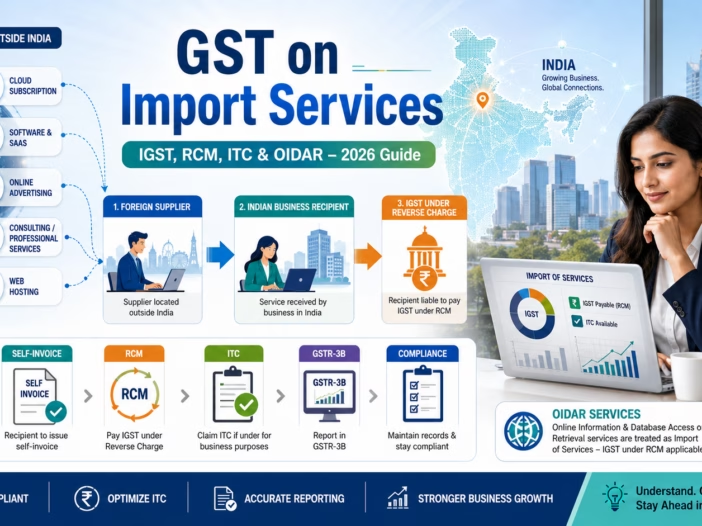
Indian businesses no longer purchase everything from Indian suppliers. Today, even a small business may pay an overseas company for software, cloud storage, website hosting, online advertising, consultancy, technical support or professional services.
For example, a company operating from Greater Noida may use cloud software supplied by a company in the United States. Similarly, a consultant may advertise through an overseas digital platform or obtain legal advice from a foreign professional. Although the foreign supplier may not mention Indian GST on the invoice, the Indian recipient may still have to pay GST in India. In most business-to-business cases, the Indian recipient pays Integrated Goods and Services Tax, or IGST, under the Reverse Charge Mechanism.
Therefore, businesses should not ignore foreign invoices while preparing their GST returns. Instead, they should identify the nature of the service, determine its place of supply, calculate the applicable tax and report it correctly in Form GSTR-3B. This article explains GST on import services in simple language. It also covers IGST, Reverse Charge Mechanism, Input Tax Credit, OIDAR services, related-party transactions, GST registration, self-invoicing and return reporting based on the provisions applicable as of July 2026.
What Qualifies as an Import of Services?
Section 2(11) of the IGST Act, 2017 defines an import of services. According to this provision, a transaction qualifies as an import of services only when it satisfies all the following conditions:
- The supplier of the service is located outside India.
- The recipient of the service is located in India.
- The place of supply of the service is in India.
Therefore, all three conditions must exist together. A payment to a foreign company does not automatically become an import of services merely because the supplier operates outside India. The business must also check whether the place of supply falls in India.
In simple words:
Foreign supplier + Indian recipient + place of supply in India = Import of services
Simple Example
Suppose a private limited company in Greater Noida purchases an annual software subscription from a company located in the United States.
In this case:
- The supplier is located outside India.
- The recipient is located in India.
- The company uses the software in India, and the place-of-supply provisions treat the recipient’s location as the place of supply.
As a result, the transaction generally qualifies as an import of services.
Why Does IGST Apply to Imported Services?
Under the GST framework, the government treats an import of services as an inter-State supply. Consequently, IGST applies instead of separate CGST and SGST. However, a foreign supplier may not have a regular GST registration in India. Therefore, in most business transactions, the law shifts the responsibility to the Indian recipient through the Reverse Charge Mechanism.
Notification No. 10/2017–Integrated Tax (Rate) covers specified services supplied by a person located in a non-taxable territory to a person located in the taxable territory and places the liability on the recipient, subject to the applicable exclusions and special provisions.
What Is the Reverse Charge Mechanism?
Under the normal GST system, the supplier charges GST on the invoice, collects it from the customer and deposits it with the government. However, under the Reverse Charge Mechanism, commonly called RCM, the recipient calculates and pays GST directly to the government.
Therefore, when an Indian business receives a taxable service from an overseas supplier, the Indian business generally has to:
- Determine whether the service qualifies as an import of services.
- Identify the correct GST rate.
- Calculate IGST on the taxable value.
- Report the RCM liability in Form GSTR-3B.
- Pay the tax through the Electronic Cash Ledger.
- Claim eligible Input Tax Credit after paying the tax.
Thus, the foreign supplier generally does not collect Indian GST in a standard business-to-business transaction covered by RCM.
Common Examples of Imported Services
Businesses in Greater Noida, Noida and other parts of India commonly receive the following services from overseas suppliers:
- Cloud storage services
- Software subscriptions
- Software-as-a-Service applications
- Website hosting services
- Online advertising services
- Foreign legal consultancy
- Management consultancy
- Technical consultancy
- Engineering and design services
- Market research services
- Recruitment services
- Foreign accounting services
- Professional advisory services
- Royalty and licence services
- Remote technical support
- Database access
- Digital marketing tools
- Online productivity software
- Foreign commission agent services
- Online training and educational services
- Cybersecurity and data-protection services
Nevertheless, the GST treatment does not depend only on the description written on the invoice. The business must also examine the agreement, actual nature of the service, place of supply, applicable exemption and status of the recipient.
What Is the GST Rate on Import Services?
GST law does not prescribe one common rate for every imported service. Instead, the applicable rate depends on the classification and nature of the service. However, many commonly imported business services generally attract IGST at 18%, including:
- Consultancy services
- Software subscriptions
- Online advertising
- Technical support
- Professional services
- Cloud-based services
- Website hosting
- Management services
At the same time, some services may attract a different rate or qualify for an exemption. Therefore, the business should first determine the correct service classification before calculating the tax.
Example of GST Calculation
Suppose a company in Greater Noida receives a consultancy invoice of ₹1,00,000 from a foreign supplier. Assuming that IGST applies at 18%, the calculation will be:
Taxable value: ₹1,00,000
IGST under RCM at 18%: ₹18,000
Total amount including RCM impact: ₹1,18,000
The Indian company must pay ₹18,000 through its Electronic Cash Ledger. However, if the company uses the consultancy service for eligible taxable business activities, it may claim the same ₹18,000 as Input Tax Credit after paying the tax.
Can a Business Use ITC to Pay the RCM Liability?
No. A registered taxpayer cannot use the balance available in the Electronic Credit Ledger to discharge GST payable under the Reverse Charge Mechanism. Instead, the taxpayer must pay the RCM liability through the Electronic Cash Ledger.
After making the cash payment, the taxpayer may claim eligible Input Tax Credit in Form GSTR-3B. Therefore, RCM can create a temporary cash-flow requirement even when the business eventually receives the full ITC benefit.
Input Tax Credit on Imported Services
A registered business can generally claim Input Tax Credit of the IGST paid under RCM. However, it must satisfy the normal ITC conditions.
Accordingly, the business should ensure that:
- It has actually received the service.
- It uses the service in the course or furtherance of business.
- It has paid the IGST under RCM.
- It maintains the prescribed invoice and supporting documents.
- The credit does not fall under Section 17(5) of the CGST Act.
- It uses the service for taxable or zero-rated supplies.
- It claims the credit within the applicable statutory time limit.
CBIC guidance also confirms that IGST paid on the import of eligible services may be available as Input Tax Credit, subject to the prescribed conditions.
When Will ITC Not Be Available?
The business may not receive full ITC in the following situations:
- It uses the imported service for personal purposes.
- It uses the service only for making exempt supplies.
- The credit falls under the blocked-credit provisions.
- It operates under the composition scheme.
- It does not possess proper supporting documents.
- It has not paid the IGST under RCM.
- It claims the credit after the statutory deadline.
- It uses the service partly for business and partly for personal purposes.
- It uses the service partly for taxable supplies and partly for exempt supplies.
Furthermore, when the business uses the service partly for taxable and partly for exempt activities, it may have to reverse the proportionate ITC according to the applicable rules.
Is GST Registration Compulsory for Importing Services?
Section 24 of the CGST Act generally requires a person who becomes liable to pay tax under the Reverse Charge Mechanism to obtain GST registration. Consequently, the normal turnover threshold may not always protect a person who becomes liable to pay GST under RCM.
Example
Suppose a consultancy firm in Greater Noida has an annual turnover of only ₹12 lakh. During the year, it purchases a taxable professional service from an overseas consultant. Even though its turnover remains below the normal threshold applicable to service providers, it must separately examine whether the RCM liability triggers compulsory GST registration.
However, the firm should first confirm whether:
- The transaction qualifies as an import of services.
- The place of supply is in India.
- Any specific exemption applies.
- The recipient is covered by the RCM notification.
- The service was received for business or personal purposes.
Therefore, a foreign payment alone does not automatically create a registration liability. The taxpayer must examine the complete nature of the transaction.
Why Is the Place of Supply Important?
The place of supply plays a crucial role because a transaction qualifies as an import of services only when the place of supply falls in India. Section 13 of the IGST Act generally applies when either the supplier or the recipient is located outside India.
Under the general rule, the place of supply is normally the location of the recipient. Therefore, when a company in Greater Noida receives consultancy, accounting, technical or software services from a foreign supplier, the place of supply will generally be the location of the company in India.
However, special place-of-supply rules apply to certain services, such as:
- Services connected with immovable property
- Event-related services
- Performance-based services
- Banking and financial services
- Passenger transportation
- Transportation of goods
- Services supplied on board a conveyance
- Intermediary services
- OIDAR services
- Certain telecommunication services
Therefore, the business should not apply the general rule blindly. Instead, it should first determine whether a special rule covers the service.
Time of Supply Under Reverse Charge
The time of supply determines the tax period in which the recipient must report and pay the RCM liability. For services covered under reverse charge, the time of supply is generally the earlier of:
- The date of payment recorded in the recipient’s books or the date on which the bank account is debited, whichever occurs earlier; or
- The date immediately following 60 days from the date of the foreign supplier’s invoice or similar document.
If the business cannot determine the time of supply through these rules, it may use the date on which it records the service in its books. Moreover, special timing rules apply to services received from an associated enterprise located outside India. In such cases, the time of supply is generally the earlier of:
- The date of entry in the recipient’s books; or
- The date of payment.
Example
A foreign consultant issues an invoice on 1 July 2026. The Indian company pays the invoice on 20 July 2026. Since the company makes the payment before 60 days expire from the invoice date, 20 July 2026 will generally become the time of supply.
Accordingly, the company should report and pay the RCM liability in the relevant return period.
How Should a Business Calculate the Taxable Value?
The business should generally calculate IGST on the transaction value of the imported service.
The taxable value may include:
- Basic service charges
- Subscription charges
- Licence fees
- Incidental expenses charged by the supplier
- Reimbursements that form part of the consideration
- Service-related costs paid by the recipient on behalf of the supplier
- Other amounts directly connected with the supply
Additionally, when the foreign supplier issues the invoice in foreign currency, the Indian recipient must convert the amount into Indian rupees according to the applicable GST valuation and exchange-rate provisions.
Therefore, the business should preserve:
- The foreign supplier’s invoice
- Exchange-rate calculations
- Bank debit advice
- Remittance documents
- Agreement or purchase order
- Accounting entries
- RCM working papers
Documentation Required for Import Services
Proper documentation plays an important role in establishing the nature of the service, taxable value, business purpose and ITC eligibility.
Accordingly, the business should maintain the following documents:
- Foreign supplier’s invoice
- Service agreement or engagement letter
- Purchase order, wherever applicable
- Proof of receipt of the service
- Email correspondence
- Work report or completion report
- Bank payment advice
- Foreign remittance documents
- Form 15CA, wherever applicable
- Form 15CB, wherever applicable
- Exchange-rate working
- Self-invoice, wherever required
- Payment voucher, wherever required
- Proof of IGST payment
- GSTR-3B working
- Input Tax Credit register
- TDS working under Section 195, wherever applicable
Moreover, the business should clearly record the commercial reason for obtaining the service from an overseas supplier.
Self-Invoice for Imported Services
A foreign supplier who does not hold an Indian GST registration may issue only a commercial invoice. Therefore, the registered Indian recipient may have to prepare a self-invoice under the applicable reverse-charge invoicing provisions.
The self-invoice should generally contain:
- Name and address of the Indian recipient
- GSTIN of the Indian recipient
- Name and address of the foreign supplier
- Description of the service
- Date of the transaction
- Taxable value
- Applicable IGST rate
- Amount of IGST
- Place of supply
- Foreign invoice number and date
- Signature or digital authentication
Furthermore, the Indian recipient may also need to prepare a payment voucher when making payment to the foreign supplier, subject to the applicable invoicing provisions. Therefore, businesses should not rely only on the invoice issued by the overseas vendor. They should also maintain the documents required under Indian GST law.
How to Report Import Services in GSTR-3B
The Indian recipient generally reports the imported service and related tax liability in Form GSTR-3B.
Reporting the RCM Liability
The business should generally disclose the taxable value and IGST liability in Table 3.1(d), which covers inward supplies liable to reverse charge.
Paying the Tax
Next, the business must pay the RCM liability through the Electronic Cash Ledger. It cannot use the available Input Tax Credit to make this payment.
Claiming Input Tax Credit
After paying the IGST, the business may claim eligible ITC under Table 4(A)(3), which covers inward supplies liable to reverse charge. CBIC’s instructions regarding Form GSTR-3B explain the reporting of output liability and Input Tax Credit through the relevant tables of the return.
Monthly Reconciliation
In addition, the business should reconcile the RCM figures with:
- Foreign vendor ledgers
- Bank remittance records
- Expense accounts
- Foreign invoices
- Form 15CA and Form 15CB
- TDS records
- Input Tax Credit register
- GSTR-3B filings
This reconciliation is especially important because foreign supplier invoices generally do not appear in GSTR-2B in the same manner as normal domestic invoices.
GST on Business and Personal Imports
The GST treatment may differ depending on whether the recipient receives the service for business or personal use.
Services Imported for Business Purposes
When an Indian business receives a taxable service from a foreign supplier and the transaction qualifies as an import of services, the Indian recipient generally pays IGST under RCM. Afterward, the recipient may claim eligible ITC if it uses the service for taxable business activities.
Services Imported for Personal Purposes
Certain services received by an individual from a supplier located outside India for purposes unrelated to business, commerce, industry or profession may qualify for an exemption. However, this exemption does not cover every situation. In particular, OIDAR services follow special rules.
Therefore, an individual should first identify the nature of the foreign service before concluding that no GST applies.
Import of Services From Related Parties
GST law gives special treatment to services received from foreign related parties. Schedule I of the CGST Act can treat an import of services from a related person or another establishment of the same legal entity as a taxable supply even when the Indian recipient does not pay any consideration.
However, the service must relate to the course or furtherance of business.
Example
Suppose a foreign parent company provides the following services to its Indian subsidiary in Greater Noida:
- Management support
- Technical assistance
- Accounting support
- Human-resource support
- Brand-related services
- Information-technology support
- Marketing assistance
Even if the foreign parent does not issue a separate invoice or immediately recover the cost, GST may still apply because the parties are related and the services support the Indian business.
Therefore, Indian companies should review:
- Free services received from foreign group entities
- Head-office expenses
- Cost allocations
- Management charges
- Shared software costs
- Group-level technical support
- Brand and licence arrangements
- Employee support provided by overseas entities
In addition, the company should maintain a proper valuation working to support the value adopted for GST purposes.
GST on Import of Services Without Consideration
A service received without payment does not always attract GST. Generally, a supply requires consideration. However, Schedule I treats certain transactions as supplies even when no consideration exists.
Accordingly, GST may apply when:
- The supplier and recipient are related persons.
- The transaction occurs between establishments of the same legal entity.
- The service supports the course or furtherance of business.
- Schedule I specifically treats the transaction as a supply.
On the other hand, a free service received from an unrelated foreign person may not qualify as a taxable supply unless another specific GST provision applies. Therefore, the business should examine both the relationship between the parties and the purpose of the service.
Special Treatment of OIDAR Services
OIDAR stands for Online Information and Database Access or Retrieval services. Broadly, OIDAR services are delivered through the internet or an electronic network and can usually be provided with minimal human involvement.
Common examples include:
- Cloud services
- Online advertising
- Downloadable software
- Digital data storage
- Streaming services
- E-books
- Online databases
- Digital subscriptions
- Online gaming services
- Automated online tools
- Downloadable digital content
- Access to online information platforms
However, not every service delivered through email or video call automatically becomes an OIDAR service. The business must examine the level of automation and human involvement.
B2B OIDAR Services
When a foreign OIDAR supplier provides services to a GST-registered business in India, the Indian business generally pays IGST under RCM.
Example
A GST-registered company in Greater Noida purchases cloud-storage services from a foreign company.
In this case, the Indian company generally:
- Records the overseas invoice.
- Calculates IGST under RCM.
- Pays the tax through the Electronic Cash Ledger.
- Reports the liability in Form GSTR-3B.
- Claims eligible ITC after making the payment.
B2C OIDAR Services
Different rules apply when a foreign OIDAR supplier provides services to a non-taxable online recipient in India.
In such cases, the foreign OIDAR supplier generally has to:
- Obtain registration under the simplified GST registration system.
- Charge IGST to the Indian consumer.
- Collect the tax from the consumer.
- Deposit the tax with the Indian government.
- File the applicable GST return.
Therefore, an individual purchasing a foreign streaming subscription, digital product or automated online service may find Indian GST directly charged on the invoice.
Import of Services by a Composition Dealer
A taxpayer registered under the composition scheme must also pay GST under RCM when it receives a taxable imported service covered by reverse charge. However, a composition taxpayer cannot claim Input Tax Credit. Consequently, the IGST paid under RCM becomes an additional business cost for the composition dealer.
Example
A composition taxpayer operating a restaurant in Greater Noida purchases an overseas software subscription for business use. If the transaction qualifies as a taxable import of services, the taxpayer may have to pay IGST under RCM. However, it cannot claim ITC of the tax paid.
Therefore, composition taxpayers should carefully consider the additional cost before purchasing major services from overseas suppliers.
TDS and GST on Foreign Service Payments
Income-tax TDS and GST work under separate laws. Therefore, a foreign service payment may attract both:
- TDS under Section 195 of the Income-tax Act; and
- IGST under Reverse Charge Mechanism under GST.
Accordingly, the business should separately examine:
- Whether the foreign income is taxable in India
- The nature of the foreign service
- The applicable Double Taxation Avoidance Agreement
- Permanent establishment provisions
- The applicable TDS rate
- Form 15CA requirements
- Form 15CB requirements
- The GST place of supply
- The RCM liability
- The applicable GST rate
- ITC eligibility
Therefore, paying TDS does not remove the GST liability. Similarly, paying GST does not remove the TDS obligation.
Practical Example for a Greater Noida Business
Suppose ABC Private Limited operates from Greater Noida and purchases the following overseas services during July 2026:
Software subscription: ₹50,000
Online advertising: ₹1,00,000
Foreign consultancy: ₹2,00,000
Total taxable value: ₹3,50,000
Assuming that all three services qualify as taxable imports and attract IGST at 18%:
IGST under RCM: ₹3,50,000 × 18%
IGST payable: ₹63,000
ABC Private Limited should then:
- Record all foreign invoices in its books.
- Verify the nature and place of supply of each service.
- Calculate the correct taxable value.
- Prepare the required self-invoices and payment vouchers.
- Report ₹3,50,000 under the RCM section of GSTR-3B.
- Pay ₹63,000 through the Electronic Cash Ledger.
- Claim ₹63,000 as ITC if the services support eligible taxable business activities.
- Maintain all remittance and tax-payment documents.
- Examine Section 195 TDS separately.
Thus, although the company initially pays ₹63,000 in cash, it may receive the ITC benefit if it fulfils all the prescribed conditions.
Common Mistakes Businesses Make
Ignoring Small Foreign Subscriptions
Businesses often ignore small payments for online tools, software, hosting or cloud services. However, GST law does not provide a general exemption merely because an individual invoice has a small value. Therefore, businesses should review even small recurring international payments.
Assuming That No GST Applies Because the Invoice Is Foreign
A foreign supplier may issue an invoice without Indian GST. Nevertheless, the Indian recipient may still have to calculate and pay IGST under RCM.
Using ITC to Pay RCM
Businesses sometimes try to use the Electronic Credit Ledger to discharge RCM liability. However, the recipient must pay RCM tax through the Electronic Cash Ledger.
Claiming ITC Without Paying RCM
A business cannot simply record the RCM liability and claim credit without paying the tax. Instead, it should first pay the IGST and then claim eligible ITC.
Ignoring Foreign Group-Company Support
Businesses may overlook free management, technical, accounting or software support received from a foreign parent or related entity. However, Schedule I may treat such services as taxable even without consideration.
Applying 18% Without Checking the Service
Although many imported business services attract 18% GST, the rate depends on the actual classification. Therefore, the business should confirm the correct rate instead of automatically applying 18% to every foreign payment.
Ignoring Place-of-Supply Rules
A payment to a foreign supplier does not automatically qualify as an import of services. The place of supply must also fall in India.
Depending Only on GSTR-2B
Foreign service invoices may not appear automatically in GSTR-2B. Therefore, the business must identify RCM liability through its vendor ledger, bank statements, foreign remittance records and expense accounts.
Ignoring TDS Under Section 195
GST compliance does not replace income-tax compliance. Therefore, the business should separately examine the requirement to deduct TDS, obtain Form 15CB or file Form 15CA.
Compliance Checklist for Indian Businesses
To ensure proper GST compliance, an Indian business should follow these steps every month:
- Review all payments made to foreign vendors.
- Identify the exact nature of every foreign service.
- Check whether the transaction qualifies as an import of services.
- Determine whether the place of supply is in India.
- Check whether any exemption applies.
- Confirm the applicable GST rate.
- Determine the time of supply.
- Convert the foreign-currency amount correctly.
- Prepare the required self-invoice.
- Prepare the payment voucher, wherever required.
- Report the RCM liability in GSTR-3B.
- Pay IGST through the Electronic Cash Ledger.
- Claim eligible Input Tax Credit.
- Reconcile the amount with the foreign vendor ledger.
- Check TDS under Section 195 separately.
- Maintain agreements, invoices and remittance records.
- Review related-party and free-of-cost services.
- Preserve the complete working for future assessment or audit.
Consequences of Not Paying GST on Imported Services
When a business fails to report or pay GST under RCM, the department may demand:
- Unpaid IGST
- Interest for delayed payment
- Penalty, depending on the facts of the case
- Reversal or denial of Input Tax Credit
- Supporting documents
- Foreign-vendor reconciliation
- Expense-ledger reconciliation
- Explanation of foreign remittances
Furthermore, the department may compare GST returns with:
- Financial statements
- Foreign-remittance records
- Bank statements
- Expense ledgers
- Form 15CA and Form 15CB
- TDS returns
- Agreements with overseas suppliers
Therefore, regular reconciliation and timely payment can protect the business from avoidable interest, penalties and disputes.
Conclusion
GST on import services affects almost every modern business that purchases software, cloud storage, online advertising, consultancy, technical support or professional services from an overseas supplier. In most business-to-business cases, the Indian recipient must pay IGST under the Reverse Charge Mechanism. The recipient must first determine whether the transaction qualifies as an import of services, verify the place of supply, calculate the applicable tax and pay the liability through the Electronic Cash Ledger.
After making the payment, the recipient may claim Input Tax Credit if it uses the imported service for eligible taxable business activities. However, the business must maintain proper documentation and comply with the normal ITC conditions. Businesses in Greater Noida should regularly review their foreign vendor ledgers, international subscriptions, overseas consultancy payments, digital advertising expenses and related-party services. This simple monthly review can prevent missed RCM liabilities, interest, penalties and ITC disputes.
Finally, every foreign payment may not receive the same treatment. Therefore, businesses should examine the nature of the service, place of supply, applicable exemption, relationship between the parties, recipient’s status and relevant documentation before taking a final GST position.
Frequently Asked Questions
1. What is GST on import services?
GST on import services refers to IGST payable when a supplier located outside India provides a service to a recipient located in India and the place of supply is also in India.
2. Who pays GST on imported services?
In most business-to-business cases, the Indian recipient pays IGST under the Reverse Charge Mechanism.
3. Does the foreign supplier have to charge Indian GST?
Generally, a foreign supplier does not charge Indian GST in a standard B2B transaction covered under RCM. Instead, the Indian recipient calculates and pays IGST directly.
However, different rules apply to foreign OIDAR suppliers providing services to Indian consumers.
4. What is the GST rate on imported services?
The rate depends on the nature and classification of the service. Many common business services attract IGST at 18%, although some services may attract another rate or qualify for an exemption.
5. Can I use ITC to pay GST under RCM?
No. You must pay the RCM liability through the Electronic Cash Ledger.
Afterward, you may claim eligible Input Tax Credit.
6. Can I claim ITC of IGST paid on imported services?
Yes. A registered taxpayer may claim ITC when it uses the service for eligible taxable business activities and fulfils all normal ITC conditions.
7. Do imported service invoices appear in GSTR-2B?
Generally, foreign supplier invoices do not appear in GSTR-2B in the same manner as domestic invoices.
Therefore, the recipient must identify and report the RCM liability through its own records.
8. Where should I report imported services in GSTR-3B?
You should generally report the taxable value and IGST liability in Table 3.1(d).
After paying the tax, you may claim eligible ITC in Table 4(A)(3).
9. Is GST registration compulsory for importing services?
A person who becomes liable to pay GST under RCM generally has to examine the compulsory-registration provisions, even if turnover remains below the normal threshold.
However, the person should first confirm whether the transaction actually attracts RCM and whether any exemption applies.
10. Is GST applicable to a foreign software subscription?
Yes, GST may apply when an Indian business purchases software or a digital subscription from an overseas supplier and the transaction qualifies as an import of services.
11. Is GST applicable to payments made to Google or Meta?
GST may apply when an Indian business directly receives online advertising services from a foreign entity.
However, the business should check the name and GST status of the invoicing entity because the treatment may differ when an Indian registered entity issues the invoice.
12. Is GST applicable to foreign cloud-storage services?
Yes. A foreign cloud-storage service may qualify as an import of services or an OIDAR service.
In a B2B case, the Indian recipient generally pays IGST under RCM.
13. Is GST applicable to free services received from a foreign parent company?
Yes, GST may apply when an Indian company receives business-related services without consideration from a related foreign entity.
Schedule I can treat such a transaction as a taxable supply.
14. Is GST applicable to personal services received from outside India?
Certain services received by an individual for purposes unrelated to business, commerce, industry or profession may qualify for exemption.
However, special rules apply to OIDAR and certain other services.
15. What are OIDAR services?
OIDAR services are digital services delivered through the internet or an electronic network with minimal human involvement.
Examples include cloud storage, streaming, downloadable software, online databases and automated digital subscriptions.
16. Who pays GST on B2C OIDAR services?
The foreign OIDAR supplier generally registers in India, charges IGST to the Indian consumer and deposits the tax with the government.
17. Does a composition dealer have to pay GST on imported services?
Yes. A composition dealer must pay GST under RCM on taxable imported services.
However, the dealer cannot claim Input Tax Credit.
18. Do I need to issue a self-invoice?
A registered recipient may have to prepare a self-invoice when it receives a taxable service from an unregistered foreign supplier and the reverse-charge invoicing provisions apply.
19. Do I also need a payment voucher?
The recipient may need to prepare a payment voucher when making payment to the foreign supplier, subject to the applicable GST invoicing provisions.
20. Does paying TDS under Section 195 remove the GST liability?
No. TDS and GST are separate obligations.
A foreign payment may attract both TDS under the Income-tax Act and IGST under RCM.
21. What happens if I pay RCM late?
The business may have to pay the unpaid IGST along with applicable interest.
Additionally, a penalty may apply depending on the facts and nature of the default.
22. Does every foreign payment attract GST?
No. The business must examine the nature of the transaction, place of supply, recipient’s status, relationship between the parties, consideration and applicable exemptions.
A payment to a foreign party does not automatically become a taxable import of services.
23. Can I claim RCM credit in the same month?
A business may generally claim eligible ITC after paying the RCM liability, subject to the normal conditions and correct reporting in GSTR-3B.
24. Is RCM an additional cost for every business?
Not always. A regular taxpayer may claim eligible ITC of the IGST paid under RCM.
However, RCM becomes a cost when ITC is unavailable, blocked, reversed or not permitted, such as in the case of a composition taxpayer.
25. Should businesses review foreign payments every month?
Yes. Businesses should review foreign vendor payments every month because overseas invoices may not automatically appear in GSTR-2B.
Regular review helps identify RCM liability on time and prevents interest and compliance disputes.