Introduction
Many business owners in Greater Noida want to expand their business beyond India. Some businesses want to export goods to foreign buyers, while others want to import raw materials, machinery, spare parts, or trading products from other countries. However, before starting import or export activities, a business usually needs an Import Export Code, commonly known as IEC.
In simple words, IEC gives your business a legal identity for international trade. Moreover, it helps you deal with customs, banks, shipping companies, and foreign buyers smoothly. Therefore, if you plan to enter the import-export business, you should understand IEC before taking the next step.
What is Import Export Code (IEC)?
Import Export Code is a unique business identification number issued by the Directorate General of Foreign Trade, also known as DGFT. Businesses use IEC for importing goods into India or exporting goods from India.
To put it simply, IEC works like a business identity number for international trade. Customs authorities, banks, and government departments use it to identify your business during import-export transactions.
For example, if a business in Greater Noida wants to export garments, handicrafts, food products, machinery parts, or electronic goods, it will generally need IEC. Similarly, if a business wants to import raw material, spare parts, machines, or trading goods, IEC becomes important.
Why is IEC Important?
IEC plays an important role in import-export business. Without IEC, a business may face problems in customs clearance, export documentation, foreign payment, and import formalities.
In addition, IEC helps your business create a professional identity in global trade. As a result, foreign buyers, suppliers, banks, and authorities can process your transactions more easily.
A business may need IEC for:
- Exporting goods from India
- Importing goods into India
- Receiving foreign payments from buyers
- Clearing goods from customs
- Applying for export-related benefits
- Expanding business in international markets
- Building trust with foreign buyers and suppliers
Therefore, IEC is not only a registration number. It gives your business a proper identity in global trade.
Who Needs IEC?
Any person or business that wants to import or export goods may need IEC. In fact, various types of applicants can apply for it, such as:
- Proprietorship firms
- Partnership firms
- LLPs
- Private limited companies
- Public limited companies
- Trusts
- Societies
- Individuals doing import-export business
For instance, a small manufacturer in Greater Noida, a trader in Noida, an e-commerce seller, or a private limited company dealing with foreign buyers can apply for IEC.
Is IEC Required for Service Export?
In many normal service export cases, IEC may not be compulsory. However, a service provider may still need IEC if they want to claim export-related benefits or complete specific foreign trade compliances.
Therefore, service exporters should check their business activity, payment structure, and benefit requirement before deciding whether IEC is required. This helps them avoid unnecessary registration as well as future compliance issues.
Example for Better Understanding
Let us understand this with a simple example. Suppose a company in Greater Noida manufactures decorative lights. The company receives an order from a buyer in Dubai. Now, to ship the goods outside India, the company will need IEC for export documents, customs clearance, and banking formalities.
Similarly, if a business imports machine parts from Germany or China for production or resale, IEC will help the business complete import formalities without unnecessary delay.
Thus, IEC supports both exporters and importers in completing international trade transactions smoothly.
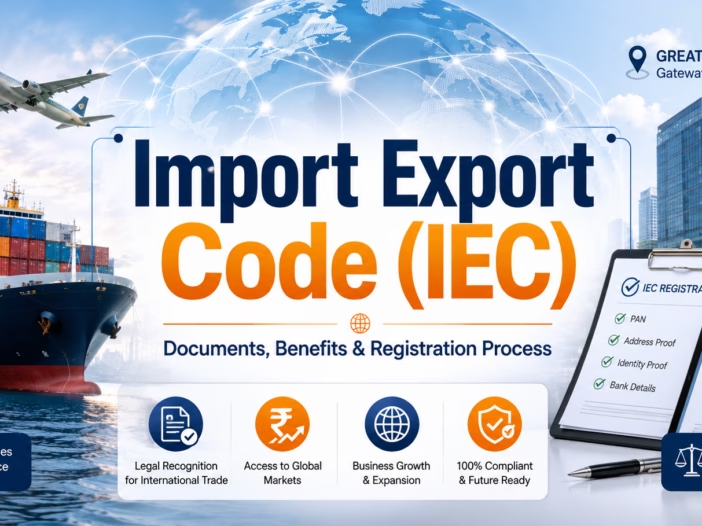
Documents Required for IEC Registration
Before applying for IEC, you should keep the required documents ready. This helps you complete the process smoothly and reduces the chances of rejection or delay.
1. PAN Card
First, you need the PAN of the individual, firm, LLP, or company.
2. Aadhaar or Identity Proof
Next, in the case of an individual or proprietor, Aadhaar or another valid identity proof may be required.
3. Business Address Proof
After that, you need business address proof. You can use an electricity bill, rent agreement, sale deed, property tax receipt, or any other valid address proof.
4. Bank Details
In addition, you may need a cancelled cheque or bank certificate to verify the business bank account.
5. Mobile Number and Email ID
Also, you should use an active mobile number and email ID because DGFT may send OTPs and important updates.
6. Digital Signature or Aadhaar Authentication
Lastly, depending on the applicant type and portal requirement, you may need a digital signature or Aadhaar-based authentication.
How to Apply for IEC Online
You can apply for IEC online through the DGFT portal. The process becomes easier when you keep all documents ready in advance.
If you need professional help, you can Apply for IEC Registration in Greater Noida through our team.
Step 1: Visit the DGFT Portal
First, visit the official DGFT portal and create your login account.
Step 2: Select IEC Application
After creating your login, choose the option to apply for IEC.
Step 3: Enter Business Details
Next, enter your business name, PAN, address, bank details, branch details, and other required information.
Step 4: Upload Documents
After entering the details, upload the required documents in the correct format.
Step 5: Verify All Details
Now, check every detail carefully. A small mistake in PAN, address, bank details, or email ID can delay the application.
Step 6: Pay the Government Fee
Then, pay the applicable government fee online.
Step 7: Submit the Application
Finally, submit the application. Once DGFT approves it, you can download your IEC online.
How Much Time Does IEC Registration Take?
IEC registration usually takes less time when the documents and details are correct. However, the process may take longer if there is any mismatch in PAN, bank details, address proof, or business information.
Therefore, you should check your documents carefully before filing the application. In addition, you should use correct contact details so that you do not miss any OTP, alert, or communication from the portal.
Is IEC Valid for Lifetime?
IEC generally remains valid for the lifetime of the business. However, IEC holders must update or confirm their IEC details on the DGFT portal as required.
Even if there is no change in business details, you should still confirm your IEC profile within the prescribed time. Otherwise, your IEC may become inactive. As a result, your business may face problems in import-export transactions.
Therefore, you should not treat IEC as a one-time registration only. Instead, you should also keep it updated from time to time.
IEC Modification or Update
You should update your IEC whenever your business details change. For example, you should modify IEC in case of changes in:
- Business address
- Bank account
- Email ID
- Mobile number
- Director or partner details
- Branch details
- Firm or company information
Moreover, regular IEC profile confirmation keeps your IEC active and helps you avoid unnecessary delays in trade transactions.
Benefits of IEC Registration
IEC gives several benefits to businesses that want to enter international markets. Most importantly, it helps your business complete import-export transactions legally and professionally.
1. Helps You Start Import-Export Business
IEC allows your business to start import or export activities legally. Therefore, it becomes the first step for many businesses entering global trade.
2. Supports Business Growth
With IEC, you can connect with foreign buyers and suppliers. As a result, you can expand your business outside India.
3. Helps in Customs Clearance
Customs authorities use IEC for import and export documentation. Hence, IEC helps you clear goods more smoothly.
4. Helps You Receive Foreign Payments
Banks may ask for IEC while processing export payments or import remittances. Therefore, IEC also supports smooth banking transactions.
5. Supports Export Benefits
In eligible cases, IEC helps businesses apply for export-related benefits and schemes. Consequently, it can support long-term export growth.
6. Improves Business Credibility
IEC gives your business a more professional image in international trade. Moreover, it helps foreign buyers and suppliers trust your business more easily.
IEC for Businesses in Greater Noida
Greater Noida has many manufacturers, traders, startups, exporters, and e-commerce sellers. Businesses here deal in electronics, machinery parts, garments, food products, handicrafts, industrial goods, and packaging materials.
If your Greater Noida business wants to import raw materials or export finished goods, IEC can become your first important step. It helps you deal with customs, banks, shipping companies, foreign buyers, and suppliers more smoothly.
Moreover, professional support can help you avoid common mistakes in documents, address proof, PAN details, bank details, and DGFT portal filing. As a result, you can save time and start your import-export activities with more confidence.
Common Mistakes While Applying for IEC
Many applicants make small mistakes while applying for IEC. Unfortunately, these mistakes can delay registration or create problems later.
Common mistakes include:
- Entering wrong PAN details
- Uploading unclear documents
- Using an inactive mobile number or email ID
- Giving mismatched bank details
- Entering an incorrect business address
- Not updating IEC after business changes
- Ignoring IEC profile confirmation
Therefore, you should review every detail before submitting the application. In addition, you should keep all business documents updated to avoid unnecessary objections.
Difference Between IEC and GST Registration
Many business owners confuse IEC with GST registration. However, both serve different purposes.
IEC helps you carry out import-export business. On the other hand, GST registration helps you comply with GST laws.
For example, if a trader in Greater Noida exports goods, IEC helps in export documentation and customs clearance. At the same time, GST registration may also be required depending on the nature of business, turnover, and GST rules.
Therefore, many businesses may need both IEC and GST registration. However, the requirement depends on the business activity and applicable laws.
Can a Proprietor Apply for IEC?
Yes, a proprietor can apply for IEC. Since a proprietorship is not a separate legal entity, DGFT generally issues IEC based on the proprietor’s PAN.
This option helps small exporters, online sellers, consultants, traders, and home-based businesses start import-export activities easily. Moreover, it allows small businesses to enter international markets without forming a company or LLP.
Can IEC Be Cancelled?
Yes, a business can surrender or cancel IEC if it no longer wants to continue import-export activities. However, before applying for cancellation, the business should check whether any export obligation, import transaction, bank matter, or customs issue is still pending.
This step helps avoid future compliance problems. Therefore, you should review all pending matters before surrendering IEC.
Practical Example for Greater Noida Business Owners
Suppose a startup in Greater Noida wants to sell organic food products to customers in the UAE. In this case, the startup may need:
- IEC registration
- GST registration, if applicable
- FSSAI registration or licence
- Proper export invoice
- Shipping bill
- Customs documentation
- Bank compliance for foreign payment
Here, IEC becomes the base registration for export activity. After getting IEC, the business can move ahead with other export-related compliances. Therefore, IEC helps the business take its first step toward international trade.
Conclusion
Import Export Code is one of the most important registrations for businesses that want to import or export goods. It gives your business a legal identity for international trade and helps you complete customs, banking, and export documentation smoothly.
For businesses in Greater Noida, IEC can open the door to international markets. However, you should apply with correct documents, update your IEC profile on time, and follow DGFT requirements properly.
If you want to start import-export activities without confusion, you can Apply for IEC Registration in Greater Noida and get professional assistance for the complete process.
FAQs on Import Export Code (IEC)
1. What is the full form of IEC?
IEC stands for Import Export Code.
2. Who issues IEC?
DGFT issues IEC in India.
3. Is IEC mandatory for import and export?
Yes, IEC is generally mandatory for importing or exporting goods unless a specific exemption applies.
4. Can a small business apply for IEC?
Yes, a small business, proprietor, startup, trader, or e-commerce seller can apply for IEC.
5. Is GST registration compulsory for IEC?
GST registration is not always compulsory only for taking IEC. However, GST may be required depending on your business activity, turnover, and GST rules.
6. Does IEC expire?
IEC generally remains valid for the lifetime of the business. However, you must update or confirm the IEC profile as required on the DGFT portal.
7. What happens if IEC is not updated?
If you do not update or confirm IEC details, your IEC may become inactive. Consequently, you may face problems in import-export transactions.
8. Can IEC details be changed later?
Yes, you can modify IEC details online through the DGFT portal.
9. Can an individual apply for IEC?
Yes, an individual can apply for IEC if they want to do import-export business.
10. Is professional help useful for IEC registration?
Yes, professional help can save time and reduce mistakes, especially when documents, GST, customs, bank details, or export compliance are involved.