
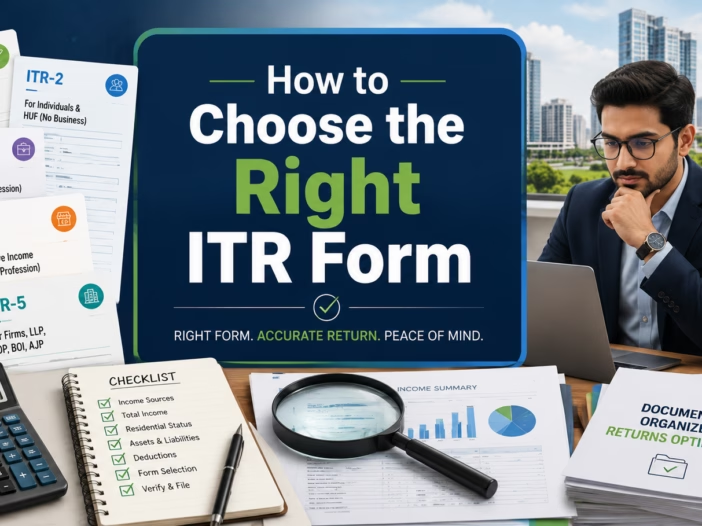
Introduction
Filing an Income Tax Return starts with one important decision: choosing the right ITR form. Many taxpayers focus only on income, deductions, and refund amounts. However, they often ignore the form selection part. This mistake can create problems later.
If you choose the wrong ITR form, the Income Tax Department may mark your return as defective. As a result, your refund may get delayed, and you may need to revise your return or respond to a notice.
Today, the tax filing system matches your return with AIS, TIS, Form 26AS, TDS details, bank interest, capital gains, and other reported transactions. Therefore, you should select the correct ITR form according to your income profile.
For taxpayers in Greater Noida, Noida, Delhi NCR, and other parts of India, the right form depends on your legal status, source of income, residential status, capital gains, business income, foreign assets, and tax regime choice.
Let us understand this in simple language.
What Is an ITR Form?
ITR stands for Income Tax Return. It is a form through which a taxpayer reports income, deductions, exemptions, taxes paid, refund claim, and other financial details to the Income Tax Department.
In simple words, your ITR shows:
- How much income you earned
- From where you earned that income
- How much tax was deducted or paid
- Whether you need to pay more tax
- Whether you are eligible for a refund
Since every taxpayer does not earn income in the same way, the department provides different ITR forms for different taxpayers.
Why Choosing the Right ITR Form Is Important
Choosing the correct ITR form helps you file your return smoothly. It also reduces the chances of defective return notices, refund delays, and mismatch issues.
For example, a salaried person with simple income may file ITR-1. However, if the same person sells shares, mutual funds, or property, ITR-2 may apply. Similarly, a freelancer, consultant, trader, or business owner may need ITR-3 or ITR-4.
Therefore, you should not choose a form only because it looks simple. Instead, you should match your income details with the correct ITR form.
Quick Guide to ITR Forms
The Income Tax Department classifies ITR forms according to the taxpayer’s legal status, income source, and reporting requirements. Here is a simple guide.
ITR-1: For Simple Salaried Individuals
ITR-1 is also known as Sahaj. It is a simple form for resident individuals with a straightforward income profile.
You may use ITR-1 if your income mainly comes from:
- Salary or pension
- House property, subject to conditions
- Bank interest
- Family pension
- Dividend income
- Agricultural income up to the allowed limit
- Other simple sources
Example
Suppose you work in a company in Greater Noida. You earn salary, bank interest, and dividend income. You do not have business income, professional income, foreign assets, unlisted shares, or complicated capital gains. In this case, ITR-1 may apply to you, subject to eligibility conditions.
When You Should Not Use ITR-1
You should not use ITR-1 if:
- You are a non-resident
- You have business or professional income
- You have capital gains that are not allowed in ITR-1
- You are a director in a company
- You hold unlisted equity shares
- You have foreign assets or foreign income
- You want to carry forward losses
- Your income exceeds the prescribed limit
If any of these conditions apply, you should check ITR-2, ITR-3, or another applicable form.
ITR-2: For Capital Gains and Complex Individual Income
ITR-2 applies to individuals and HUFs who do not have business or professional income but cannot file ITR-1.
You may need ITR-2 if you have:
- Capital gains from shares
- Capital gains from mutual funds
- Capital gains from sale of property
- Income above the ITR-1 eligibility limit
- Foreign income
- Foreign assets
- Income as a non-resident
- Directorship in a company
- Investment in unlisted equity shares
Example
Suppose you are a salaried person in Greater Noida and you sold mutual fund units during the year. Even if the capital gain is small, you should check whether ITR-2 applies. In many cases, capital gains require detailed reporting, so ITR-1 may not be suitable.
Important Point
ITR-2 does not apply to business or professional income. Therefore, if you run a business, work as a consultant, earn freelancing income, or trade actively as a business, you should check ITR-3 or ITR-4.
ITR-3: For Business Owners and Professionals
ITR-3 applies to individuals and HUFs who have income from business or profession and cannot use ITR-1, ITR-2, or ITR-4.
You may need ITR-3 if you have:
- Business income
- Professional income
- Freelancing income
- Consultancy income
- Trading income treated as business income
- Intraday equity trading income
- Futures and Options income
- Remuneration or interest from a partnership firm
- Capital gains along with business income
Example
Suppose you provide consultancy services from Greater Noida and receive professional fees from clients. You also invest in shares and earn capital gains. In this case, you may need ITR-3 because you have professional income along with other income.
Partner in a Firm: Which ITR Form Applies?
If you are a partner in a partnership firm or LLP and receive salary, bonus, commission, remuneration, or interest from the firm, the law generally treats this income as business income in your hands.
Therefore, you should not file ITR-1 or ITR-2 in such a case. You should usually check ITR-3.
ITR-4: For Presumptive Taxation
ITR-4 is also known as Sugam. It applies to eligible resident individuals, HUFs, and firms, other than LLPs, who choose the presumptive taxation scheme.
You may use ITR-4 if you declare income under:
- Section 44AD for eligible business
- Section 44ADA for eligible profession
- Section 44AE for goods carriage business
Presumptive taxation makes return filing easier for small taxpayers. Under this scheme, eligible taxpayers can declare income at a prescribed rate instead of maintaining detailed books of accounts in the normal manner.
Example
Suppose you run a small retail shop in Greater Noida and declare income under section 44AD. If you satisfy all conditions of presumptive taxation, ITR-4 may apply.
Similarly, if you are an eligible professional and declare income under section 44ADA, you may use ITR-4, subject to conditions.
When You Should Not Use ITR-4
You should not use ITR-4 if:
- You are an LLP
- You are a company director
- You hold unlisted equity shares
- You have foreign assets or foreign income
- You have capital gains that are not allowed in ITR-4
- You want to carry forward losses
- You are not eligible for presumptive taxation
- Your income exceeds the prescribed limit
In these situations, you should check ITR-3 or another suitable form.
ITR-5: For Firms, LLPs and Other Entities
ITR-5 applies to partnership firms, LLPs, AOPs, BOIs, and certain other non-company taxpayers.
For example, if an LLP in Greater Noida needs to file its income tax return, it will generally use ITR-5.
However, individuals and HUFs do not use ITR-5.
ITR-6: For Companies
ITR-6 applies to companies other than companies claiming exemption under section 11.
For example, a private limited company registered in Greater Noida will generally file ITR-6. The company should also review audit requirements, depreciation, MAT provisions, loans, related-party transactions, share capital, and other company-specific disclosures before filing the return.
ITR-7: For Trusts and Specified Taxpayers
ITR-7 applies to persons, trusts, institutions, political parties, universities, and other taxpayers who need to file returns under specific provisions such as sections 139(4A), 139(4B), 139(4C), or 139(4D).
A normal salaried person, business owner, partnership firm, or private limited company does not usually file ITR-7 unless specific provisions apply.
Step-by-Step Method to Choose the Right ITR Form
You can follow this simple process before filing your return.
Step 1: Check Your Legal Status
First, identify your legal status.
If you are an individual or HUF, you should check ITR-1, ITR-2, ITR-3, or ITR-4.
and If you are a partnership firm or LLP, you should generally check ITR-5.
If you are a company, you should generally check ITR-6.
If you are a trust, political party, university, or specified institution, you should check ITR-7.
Step 2: Check Whether You Have Business or Professional Income
Next, check whether you have business or professional income.
If you have business or professional income, check whether you are eligible for presumptive taxation. If you choose presumptive taxation and satisfy all conditions, ITR-4 may apply.
However, if you maintain full books of accounts, have complex business income, have capital gains along with business income, or are not eligible for ITR-4, you may need ITR-3.
If you do not have business or professional income, move to the next step.
Step 3: Check Capital Gains, Foreign Assets and Corporate Links
Then, check whether you have capital gains, foreign assets, foreign income, directorship in a company, or unlisted equity shares.
You should review your AIS, broker capital gain statement, mutual fund statement, Form 26AS, and bank records.
If you sold shares, mutual funds, property, gold, or any other capital asset, ITR-2 may apply if you do not have business income.
Similarly, if you hold foreign shares, foreign bank accounts, or foreign assets, you should choose the correct form and disclose the details properly.
Step 4: Check Whether You Pass the ITR-1 Test
Finally, if you have no business income, no professional income, no complex capital gains, no foreign assets, and no corporate restrictions, check whether your income falls within the ITR-1 eligibility conditions.
If your income mainly comes from salary, pension, house property, bank interest, dividend, and other simple sources, ITR-1 may apply.
However, if you fail any condition, you should move to ITR-2 or another suitable form.
Quick Table to Choose the Right ITR Form
| Situation | Suitable ITR Form |
|---|---|
| Salary income with simple interest income | ITR-1 |
| Salary income with capital gains | ITR-2 |
| Sale of shares or mutual funds | ITR-2 |
| Sale of property by individual | ITR-2 |
| Non-resident individual with Indian income | ITR-2 |
| Freelancer or consultant | ITR-3 or ITR-4 |
| Small business under presumptive taxation | ITR-4 |
| Business owner maintaining regular books | ITR-3 |
| Intraday or F&O trading as business income | ITR-3 |
| Partner receiving remuneration or interest from firm | ITR-3 |
| Partnership firm or LLP | ITR-5 |
| Private limited company | ITR-6 |
| Trust or charitable institution | ITR-7 |
Common Mistakes While Choosing ITR Form
Many taxpayers select the wrong ITR form because they do not check all income sources. Therefore, you should avoid the following mistakes.
Filing ITR-1 Despite Capital Gains
Many salaried people invest in shares and mutual funds. However, when they sell these investments, capital gains may arise. In many cases, even a small capital gain transaction requires a form other than ITR-1.
Therefore, you should check your capital gain statement before filing your return.
Ignoring AIS and Form 26AS
AIS and Form 26AS show important financial details such as TDS, interest income, dividend income, securities transactions, and other reported transactions.
So, you should always check AIS, TIS, and Form 26AS before selecting and filing your ITR.
Reporting Freelancing Income Incorrectly
Many taxpayers report freelancing income as “income from other sources.” However, freelancing income usually falls under business or professional income.
Therefore, freelancers should carefully check whether ITR-3 or ITR-4 applies.
Choosing ITR-4 Without Checking Eligibility
ITR-4 is simple, but it does not apply to everyone. If you have foreign assets, unlisted shares, certain capital gains, losses to carry forward, or other restricted items, you may not be able to use ITR-4.
So, always check eligibility before choosing ITR-4.
Ignoring Income from Partnership Firm
If you receive remuneration or interest from a partnership firm, you should not treat it like normal salary income. The Income Tax Act generally treats it as business income in the hands of the partner.
Therefore, you may need ITR-3.
Not Selecting the Correct Tax Regime
The new tax regime works as the default tax regime. Therefore, if you want to use the old tax regime and claim deductions such as section 80C, 80D, HRA, LTA, or home loan interest benefits, you must select the old regime properly in the return.
This step is important because a wrong tax regime selection may increase your tax liability or reduce your eligible benefits.
Documents Required Before Selecting ITR Form
Before choosing your ITR form, keep these documents ready:
- PAN and Aadhaar
- Form 16
- Form 16A, if applicable
- Form 26AS
- AIS and TIS
- Bank statements
- Interest certificates
- Capital gain statement from broker
- Mutual fund capital gain statement
- Property sale and purchase documents
- Rent details
- Home loan interest certificate
- Business income details
- Professional receipt details
- GST turnover details, if applicable
- TDS challans
- Advance tax challans
- Foreign asset details, if applicable
- Deduction proofs
Once you collect these documents, you can match your income profile with the correct ITR form.
Practical Examples for Taxpayers
Example 1: Salaried Employee
Rahul works in a private company in Greater Noida. Rahul earns salary, bank interest, and dividend income. He has no capital gains, business income, or foreign assets.
He may file ITR-1 if he satisfies all eligibility conditions.
Example 2: Salaried Employee with Mutual Fund Sale
Neha works in Noida and sold mutual fund units during the year. She earned capital gains from the redemption.
She should check ITR-2 because capital gains usually require detailed reporting.
Example 3: Freelancer
Amit provides digital marketing services from Greater Noida. He receives professional fees from different clients.
He may need ITR-3. However, if he is eligible for presumptive taxation under section 44ADA and satisfies all conditions, ITR-4 may apply.
Example 4: Small Business Owner
Pooja runs a small retail shop in Greater Noida and declares income under section 44AD.
She may file ITR-4 if she satisfies the presumptive taxation conditions.
Example 5: Partner in Firm
Rohit is a partner in a partnership firm and receives remuneration and interest from the firm.
He should check ITR-3 because partner remuneration and interest generally fall under business income.
Example 6: Private Limited Company
A private limited company registered in Greater Noida must generally file ITR-6.
It should also review audit details, financial statements, tax audit applicability, and company-specific disclosures before filing.
Final Checklist Before Filing ITR
Before uploading your return on the e-filing portal, check the following points:
- Have you selected the correct assessment year?
- Have you matched income with AIS and Form 26AS?
- Have you included all bank interest?
- Have you reported dividend income?
- Have you checked capital gains from shares, mutual funds, and property?
- Have you selected the correct tax regime?
- Have you included all deductions and exemptions correctly?
- Have you verified TDS and advance tax details?
- Have you selected the correct ITR form?
- Have you validated and e-verified the return?
This checklist can help you avoid common filing mistakes.
Conclusion
Choosing the right ITR form is the first and most important step in income tax return filing. If you choose the wrong form, you may face defective return issues, refund delays, or unnecessary compliance work.
Therefore, you should first identify your legal status, income sources, capital gains, business income, foreign assets, and tax regime choice. After that, you should match your profile with the correct ITR form.
A salaried person with simple income may use ITR-1. A salaried person with capital gains may need ITR-2. A freelancer, consultant, business owner, partner in a firm, or trader may need ITR-3 or ITR-4. Similarly, firms, LLPs, companies, and trusts have separate ITR forms.
In short, the correct ITR form depends on your actual income profile. So, review your documents carefully, select the right form, and file your return correctly.
FAQs on Choosing the Right ITR Form
1. Which ITR form should a salaried person file?
A salaried person may file ITR-1 if the income is simple and all eligibility conditions are satisfied. However, if the person has capital gains, foreign assets, business income, or other complex income, ITR-2 or another applicable form may be required.
2. Can I file ITR-1 if I sold shares?
In many cases, no. If you sold shares and earned capital gains, you may need ITR-2. Therefore, you should check your broker statement and AIS before filing.
3. Which ITR form applies to freelancers?
Freelancers usually earn professional or business income. Therefore, they may need ITR-3. However, if they choose presumptive taxation and satisfy all conditions, ITR-4 may apply.
4. Which ITR form applies to small business owners?
Small business owners may use ITR-4 if they choose presumptive taxation and satisfy the conditions. Otherwise, they may need ITR-3.
5. Can an LLP file ITR-4?
No. An LLP cannot file ITR-4. An LLP generally files ITR-5.
6. Which ITR form applies to a private limited company?
A private limited company generally files ITR-6, unless a specific exemption-related situation applies.
7. Which ITR form applies to a partner in a firm?
A partner who receives remuneration or interest from a firm generally needs ITR-3 because such income is treated as business income.
8. Can I change the ITR form after filing?
Yes, you may file a revised return within the permitted time if you selected the wrong form. However, you should choose the correct form from the beginning to avoid defective return issues.
9. Is Form 16 enough for filing ITR?
No. Form 16 is important for salary income, but it is not enough in every case. You should also check AIS, TIS, Form 26AS, bank interest, dividend income, capital gains statements, and other financial records.
10. Which ITR form applies to a non-resident individual?
A non-resident individual generally cannot use ITR-1. Depending on income sources, ITR-2 or another applicable form may apply.
11. What happens if I choose the wrong ITR form?
The Income Tax Department may treat your return as defective. You may need to correct it or file a revised return. Therefore, correct form selection is very important.
12. Should I check AIS before choosing the ITR form?
Yes. AIS may show interest, dividend, securities transactions, mutual fund redemptions, property transactions, and other details. Therefore, you should check AIS before choosing and filing your ITR.